The Earth is smaller than assumed: German researchers
Jul 05, 2007
Earth
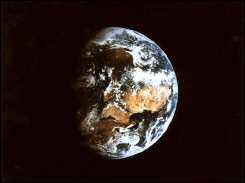
German researchers at the University of Bonn said that the world is smaller than first thought.

Although the discrepancy is not large, it is significant: Geodesists from the University of Bonn have remeasured the size of the Earth in a long lasting international cooperation project. The blue planet is accordingly some millimeters smaller than previously assumed.

The results are important, for example, to be able to demonstrate a climate contingent rise in sea level. The results have now appeared in the renowned Journal of Geodesy.

The system of measurement used by the Bonn Geodesists is invisible. It consists of radiowaves that are transmitted into space from punctiform sources, the so-called Quasars. A network of more than 70 radio telescopes worldwide receives these waves. Because the gaging stations are so far apart from each other, the radio signals are received with a slight time-lag.

"From this difference we can measure the distance betwen the radio telescopes—and to the preciseness of two millimeters per 1,000 kilometers ", explained Dr. Axel Nothnagel, reasearch group leader for the Geodesy Institute of the University of Bonn.

The procedure is called VLBI, which stands for "Very Long Baseline Interferometry". The technique can be used, for example, to demonstrate that Europe and North America are distancing from each other at a rate of about 18 millimeters annually. The distance of the gaging stations from each other allows the the size of the Earth or the exact location of the center of the Earth to be determined.

"We have analyzed the measurements and calculations from 34 partners in 17 countries",explained Nothnagel. "A combination of GPS and satellite laser measurements will enable the availability of the coordinates from almost 400 points on the surface of the Earth with unparalleled exactness."

The results are the basis for a new coordinate system for the planet. With this system it would be possible, for example, to determine the track of so-called Altimeter-Satellites within a few millimeters precision. Altimeter-Satellites measure their altitude over the Earth’s surface and can, for example, register a rise in sea level. Deviations from the flight path, however, falsify the result. If the satellite flies higher than expected, the distance to the surface of the Earth differentiates from what is recorded—the sea level appears lower than it really is.

Source: University of Bonn

Explore further: NASA sees Cyclone Mahasen hit Bangladesh

add to favorites email to friend print save as pdf

Related Stories

Eastern US to be overrun by billions of cicadas (Update)

May 06, 2013

Any day now, billions of cicadas with bulging red eyes will crawl out of the earth after 17 years underground and overrun the East Coast. The insects will arrive in such numbers that people in the southern ...

'Tapping into the vast potential of satellites'

Apr 12, 2013

Satellites can be used in many applications, such as identifying micromovements in a dam, managing a fleet of vehicles, and monitoring logging operations in a protected forest or a coffee plantation. Helping ...

Curiosity maneuver prepares for drilling

Jan 29, 2013

(Phys.org)—NASA's Mars rover Curiosity has placed its drill onto a series of four locations on a Martian rock and pressed down on it with the rover's arm, in preparation for using the drill in coming days.

Recommended for you

Alaska volcano shoots ash 15,000 feet into the air

9 hours ago

(AP)—One of Alaska's most restless volcanoes has shot an ash cloud 15,000 feet into the air in an ongoing eruption that has drawn attention from a nearby community but isn't expected to threaten air traffic.

NASA sees Cyclone Mahasen hit Bangladesh

21 hours ago

NASA's Tropical Rainfall Measuring Mission satellite known as TRMM measured Cyclone Mahasen's rainfall rates from space as it made landfall on May 16. Mahasen has since dissipated over eastern India.

Rapid climate change ruled out ice age trees

May 17, 2013

Short, sharp fluctuations in the Earth's climate throughout the last ice age may have stopped trees from getting a foothold in Europe and northern Asia, scientists say.

Earth's iron core is surprisingly weak, researchers say

May 17, 2013

The massive ball of iron sitting at the center of Earth is not quite as "rock-solid" as has been thought, say two Stanford mineral physicists. By conducting experiments that simulate the immense pressures deep in the planet's ...

User comments : 0

More news stories

Alaska volcano shoots ash 15,000 feet into the air

(AP)—One of Alaska's most restless volcanoes has shot an ash cloud 15,000 feet into the air in an ongoing eruption that has drawn attention from a nearby community but isn't expected to threaten air traffic.

Chinese, Indian airlines face EU pollution fines

Eight Chinese and two Indian airlines face fines of up to several million euros for not paying for their greenhouse gas emissions during flights within the bloc, the European Commission said on Friday.

NASA's STEREO detects a CME from the sun

On 5:24 a.m. EDT on May 17, 2013, the sun erupted with an Earth-directed coronal mass ejection or CME, a solar phenomenon that can send billions of tons of solar particles into space that can reach Earth ...

New colonoscope provides ground-breaking view of colon

A ground-breaking advance in colonoscopy technology signals the future of colorectal care, according to research presented today at Digestive Disease Week(DDW). Additional research focuses on optimizing the minimal withdrawal ...

Yahoo Japan suspects 22 million IDs stolen

Yahoo Japan Corp. has said it suspects up to 22 million user IDs may have been stolen during an unauthorised attempt to access the administrative system of its Yahoo! Japan portal.

US seizes Bitcoin operator accounts

US authorities seized the accounts of a Bitcoin digital currency exchange operator, claiming it was functioning as an "unlicensed money service business," court documents showed Friday.