Kamchatka volcano blows its top
Jul 05, 2007
Klyuchevskoy Volcano
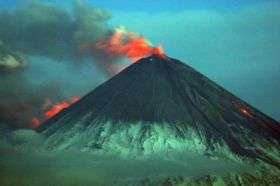
This photo captures strombolian activity and lava flows of Klyuchevskoy volcano on May 31, 2007. Credit: Photo by Yu Demyanchuk

Klyuchevskoy (pronounced Kloo-shef-skoy), a stratovolcano located in the north central region of the Kamchatka Peninsula, is blasting ash up to 32,000 feet in the air, and has diverted air traffic headed toward the Far East. This is the largest eruption to occur in the North Pacific in a decade, and is providing students at the University of Alaska Fairbanks a unique opportunity to collaborate with scientists, as well as state and federal agencies.

Tracking the Klyuchevskoy eruption locally are a handful students and faculty from the Geophysical Institute and the Alaska Volcano Observatory (GI/AVO) who process data used to reroute air traffic around dangerous volcanic ash clouds. Information is collected by satellite, Web cam, and Puff, a three-dimensional volcanic ash computer model. Once these data are synthesized, they are then shared at large to ensure the safety of thousands of people living in, or flying through the North Pacific.

Klyuchevskoy’s been erupting since January, but the largest explosions in the eruption began June 28, 2007. These explosions created a 1,360-mile-long band of ash, stretching from the Sea of Okhotsk to the Aleutian Islands, clogging well-used air routes with volcanic ash that prove deadly for aircraft.

“It’s best for us to keep an eye on Klyuchevskoy,” said Ken Dean, a professor of geology specializing in remote sensing with the Geophysical Institute and the Alaska Volcano Observatory. “Any ash that travels to Alaska is drifting right through the superhighway of air travel to the Far East. It’s critical for us to understand how distal plumes are moving.”

The eruption of one volcano will have far-reaching affects. Although Klyuchevskoy is located in Kamchatka, its ash crossed the Bering Sea and reached Unimak Island in the Aleutians within one day. Volcanic ash moves quickly through the atmosphere, so it’s important for scientists to have up-to-date information at their fingertips to generate a response plan.

Twice a day, the GI/AVO team goes through a rigorous process to examine the current condition of the more than 150 active volcanoes in the North Pacific. In addition, faculty is on call 24-hours a day to respond to large events like the recent explosions from Klyuchevskoy to guarantee information is shared and public safety is addressed.

Source: University of Alaska Fairbanks

Explore further: Origins of human culture linked to rapid climate change

add to favorites email to friend print save as pdf

Related Stories

Alaska volcano shoots ash 15,000 feet into the air

May 18, 2013

(AP)—One of Alaska's most restless volcanoes has shot an ash cloud 15,000 feet into the air in an ongoing eruption that has drawn attention from a nearby community but isn't expected to threaten air traffic.

US budget cuts pare real-time volcano monitoring (Update)

May 14, 2013

Scientists monitoring Alaska's volcanoes have shut down stations that track eruptions in real time and put off repairing seismic equipment due to U.S. budget cuts—moves that could delay getting vital information ...

Probing a link from Sahara dust to climate change

Feb 10, 2012

Qilong Min, Ph.D., Senior Research Associate and Professor with the Atmospheric Sciences Research Center (ASRC) at the University at Albany is developing innovative ways to measure how dust in the Sahara Desert ...

Russia's Kamchatka volcanoes spew giant ash clouds

Oct 28, 2010

(AP) -- Two volcanoes erupted Thursday on Russia's far-eastern Kamchatka Peninsula, tossing massive ash clouds miles (kilometers) into the air, forcing flights to divert and blanketing one town with thick, ...

Indonesia's last glacier will melt within years

Jul 01, 2010

(AP) -- Lonnie Thompson spent years preparing for his expedition to the remote, mist-shrouded mountains of eastern Indonesia, hoping to chronicle the affect of global warming on the last remaining glacier ...

Recommended for you

Origins of human culture linked to rapid climate change

3 hours ago

Rapid climate change during the Middle Stone Age, between 80,000 and 40,000 years ago, during the Middle Stone Age, sparked surges in cultural innovation in early modern human populations, according to new research.

Bangladeshi, South Korean climbers die on Everest

10 hours ago

A climber from Bangladesh and another from South Korea have died on Mount Everest as hundreds flock to the world's highest peak during good weather, Nepalese tourism officials said Tuesday.

User comments : 0

More news stories

Building a better team—on Mars

Sometime in the next quarter-century, NASA plans to send the first humans to Mars, a mission that will push the boundaries of teamwork for a handful of astronauts who will spend as long as three years together ...

Internet cable from Cuba to Jamaica comes online

A new branch of the Venezuela-to-Cuba undersea fiber-optic cable has reportedly come online, linking the island to nearby Jamaica, increasing Cuba's potential international communications bandwidth and providing a backup ...