Edmonton city site was dinosaur dining room
Jun 29, 2007
Edmonton city site was dinosaur dining room
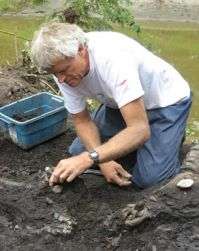
Dr. Phil Currie works in a dinosaur bone bed, located near Edmonton.

A dinosaur bone bed in southwest Edmonton that served as a feeding area for the direct ancestor of Tyrannosaurus rex has revealed that two dinosaurs, thought to have lived in different eras, actually lived at the same time.

Scientists digging for bones at the site this year discovered fossils of Edmontosaurus and Saurolophus this year.

"We weren't expecting it," said Dr Phil Currie, a world-renowned paleontologist with the University of Alberta Faculty of Science. Until this find in Edmonton, the Saurolophus and Edmontosaurus had only been found at different levels in the rocks near Drumheller.

In Drumheller, Saurolophus fossils are never found in the same localities as Edmontosaurus. According to Currie, finding fossils of both plant-eating species together "means they were here at the same time. It's a new discovery."

Currie and his team of students and volunteers from BP Canada Energy Company also found a lot of teeth from Daspletosaurus, a meat-eating dinosaur from the tyrannosaurus family and a direct ancestor of Tyrannosaurus rex. The finding means Daspletosaurus used the spot as a feeding area.

Like most other meat-eating dinosaurs, Daspletosaurus replaced their teeth every year and a half to two years. The cycle would begin as their teeth loosened. Just like humans, a new tooth would grow and their body would dissolve away the root of the old tooth leaving them with a loose crown.

"Daspletosaurus couldn't really take their little hands and wiggle their teeth," explained Currie. "When they were feeding on big dinosaurs, the loose teeth would fall out and get mixed in with the bones of the animals they were eating."

Currie and his team also found tooth marks on some of the bones. "All Tyrannosaurus had really powerful jaws. They could bite through bone," said Currie, who also expects to eventually find Albertosaurus fossils in the bone bed. Albertosaurus is another meat-eating dinosaur that lived in the same area and time - the late Cretaceous period between 80 and 73 million years ago - as the others.

Currie calls the bone bed site one of the best sites in the world. "This is the kind of thing you see in some of the best dinosaur sites in the world. There are a few sites in China where we have thick bone beds like this."

Research on the site will continue for many years. While there are many Edmontosaurus bone beds from Alaska to South Dakota, Currie says the animal really hasn't been studied much. "We don't even know how many species we're dealing with. We're not sure how long it lived, we're not sure what kind of environments it lived in. There's a whole bunch of questions relating to the Edmontosaurus that we can solve if we put the time into it," he said.

He added that Phil Bell, an MSc student who is doing his thesis on this material, will study the bone bed to see what else it reveals.

Source: University of Alberta

Explore further: UNESCO warns Syrian heritage sites endangered

add to favorites email to friend print save as pdf

Related Stories

Scientists name two new species of horned dinosaur

Mar 12, 2012

Two new horned dinosaurs have been named based on fossils collected from Alberta, Canada. The new species, Unescopceratops koppelhusae and Gryphoceratops morrisoni, are from the Leptoceratopsidae family of hor ...

Tyrannosaur Survivorship -- Tough Times For Teens

Aug 01, 2006

A massive dinosaur death bed in Alberta has helped map out the animal's life span and thrown doubt on long-held theories about how one species lived, says new research conducted in part at the University of Alberta.

Recommended for you

UNESCO warns Syrian heritage sites endangered

1 hour ago

UNESCO on Thursday added six ancient sites in Syria including a fortress of Saladin and a Crusader castle to the endangered World Heritage list, warning that more than two years of civil war had inflicted ...

Wooden beam could be detached part of shipwreck

11 hours ago

A wooden beam that has long been the focus of the search for a 17th century shipwreck in northern Lake Michigan was not attached to a buried vessel as searchers had suspected, but still may have come from the elusive Griffin ...

Prehistoric rock art maps cosmological belief

18 hours ago

It is likely some of the most widespread and oldest art in the United States. Pieces of rock art dot the Appalachian Mountains, and research by University of Tennessee, Knoxville, anthropology professor Jan ...

User comments : 0

More news stories

UNESCO warns Syrian heritage sites endangered

UNESCO on Thursday added six ancient sites in Syria including a fortress of Saladin and a Crusader castle to the endangered World Heritage list, warning that more than two years of civil war had inflicted ...

Prehistoric rock art maps cosmological belief

It is likely some of the most widespread and oldest art in the United States. Pieces of rock art dot the Appalachian Mountains, and research by University of Tennessee, Knoxville, anthropology professor Jan ...

Gay marriage ruling unlikely to cause anti-gay backlash

Concerns that a U.S. Supreme Court ruling favorable to gay marriage might produce a backlash that would impede efforts to achieve equality are unfounded, according to a study by researchers at University of California campuses ...

Dusty surprise around giant black hole

(Phys.org) —ESO's Very Large Telescope Interferometer has gathered the most detailed observations ever of the dust around the huge black hole at the centre of an active galaxy. Rather than finding all of ...

How do bees make honey? It's not just bee barf

(Phys.org) —Last weekend, my daughter asked me how bees made honey, and I realized that I didn't know the answer. How do bees make honey? I did some homework, and can now explain it to her – and to you.