NASA Prepares for Performing New Science on the Moon
June 21, 2007

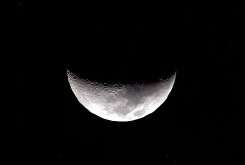
Moon from the International Space Station

This image released by NASA in 2003 shows a partial moon that was photographed by an Expedition 7 crewmember from the International Space Station.

NASA has selected proposals for future lunar science activities and established two new programs that will enhance research made possible by the Vision for Space Exploration.

The proposals and programs are part of an effort by NASA to develop new opportunities to conduct important science investigations during the planned renewal of human exploration of the moon.

In a highly competitive selection, NASA chose seven proposals from more than 70 submissions under the Lunar Sortie Science Opportunities (LSSO) Program. These newly funded efforts in the space science community will complement two new programs established in the Science Mission Directorate's Planetary Sciences Division at NASA Headquarters in Washington: the Lunar Advanced Science and Exploration Research (LASER) Program and the Lunar Reconnaissance Orbiter (LRO) Participating Scientist Program.

The seven selected proposals will result in advanced development for simple, autonomous instrument packages deployed on the lunar surface by astronauts. Such "suitcase science" packages could open up a wide variety of research applications regarding the moon and the lunar environment.

Some of the funded efforts will help scientists understand the lunar dust that creates problems for astronauts on the moon. Other studies will provide a better understanding of the moon's interior, look for natural resources on the lunar surface and use lasers to provide precise information about the position of the moon and its features.

"The proposals we received show that the scientific community is excited about the opportunity to capitalize on the nation's planned lunar outpost. The moon has much to teach us about itself, the history of our solar system, and even the history of the sun. In the future, more and more scientists will be able to participate in lunar research as we focus attention on Earth's fascinating satellite," said Alan Stern, associate administrator for NASA's Science Mission Directorate.

Selected proposals are:

-- Jet Propulsion Laboratory, Pasadena, Calif., William Banerdt, Principal Investigator (PI) "Autonomous Lunar Geophysical Experiment Package"

-- Jet Propulsion Laboratory, Pasadena, Calif., Slava Turyshev (PI) "Lunar Laser Transponder and Retroreflector Science"

-- Goddard Space Flight Center, Greenbelt, Md., Daniel Glavin (PI) "Volatile Analysis by Pyrolysis of Regolith on the Moon using Mass Spectrometry"

-- Goddard Space Flight Center, Patrick Taylor (PI) "Seismology and Heat flow instrument package for Lunar Science and Hazards"

-- Southwest Research Institute, Boulder, Colo., Donald Hassler (PI) "Lunar Radiation Environment and Regolith Shielding Experiment"

-- U.S. Army Engineer Research and Development Center, Fort Wainwright, Ark., Jerome Johnson (PI) "Lunar Suitcase Science: A Lunar Regolith Characterization Kit"

-- Ball Aerospace and Technologies Corp., Boulder, Colo., Christian Grund (PI) "Autonomous Lunar Dust Observer"

Under the planned LASER program, proposals will be solicited for investigations to increase knowledge of the moon while also providing necessary information for humans to live and work there. Studies may include simulations and laboratory work to better understand the lunar environment and its hazards, such as dust and radiation. The program also will support analysis of existing lunar data, including the Apollo and robotic mission data archives, and work to understand the origin and evolution of the moon.

In the upcoming LRO Participating Scientist Program, NASA will select researchers to perform detailed investigations using instruments aboard the LRO spacecraft during its first years in lunar orbit. Proposals for both programs are due Sept. 7, 2007.

LRO is NASA's next orbital mission to the moon. Launch is planned in late 2008. It will orbit the moon for at least one year, providing data to accelerate opportunities for future science missions and human exploration.

Source: NASA

3.3 /5 (3 votes)  

Rank 3.3 /5 (3 votes)
Tags

Relevant PhysicsForums posts
  • Distance of planets from stars and revolution
    created13 hours ago
  • revamping general concept and cosmological principle
    createdMay 25, 2012
  • Transiting Exoplanet Light Curve
    createdMay 25, 2012
  • Math behind Theoretical Physics
    createdMay 24, 2012
  • Do we know whats at the center of galaxies yet?
    createdMay 23, 2012
  • Structure of the Milky Way?
    createdMay 20, 2012
  • More from Physics Forums - General Astronomy

More news stories

Yale study concludes public apathy over climate change unrelated to science literacy

Are members of the public divided about climate change because they don't understand the science behind it? If Americans knew more basic science and were more proficient in technical reasoning, would public consensus match ...

Space & Earth / Environment

created 13 hours ago | popularity 4.8 / 5 (6) | comments 30 | with audio podcast

Land and sea species differ in climate change response: study

(Phys.org) -- Marine and terrestrial species will likely differ in their responses to climate warming, new research by Simon Fraser University and Australia’s University of Tasmania has found.

Space & Earth / Environment

created 11 hours ago | popularity 4 / 5 (5) | comments 9 | with audio podcast

10 million years needed to recover from mass extinction

It took some 10 million years for Earth to recover from the greatest mass extinction of all time, latest research has revealed.

Space & Earth / Earth Sciences

created 13 hours ago | popularity 4.2 / 5 (5) | comments 5 | with audio podcast

Sophisticated simulations predict future warming

The chances of our planet being hit by a global warming of 3 degrees Celsius by 2050 is as likely as it being hit by an increase of 1.4 degrees, new research shows. Presented in the journal Nature Geoscience, the British study ...

Space & Earth / Earth Sciences

created May 22, 2012 | popularity 3.8 / 5 (11) | comments 51

Kyoto Protocol architect 'frustrated' by climate dialogue

UN climate talks are going nowhere, as politicians dither or bicker while the pace of warming dangerously speeds up, one of the architects of the Kyoto Protocol told AFP.

Space & Earth / Environment

created May 23, 2012 | popularity 3.4 / 5 (8) | comments 44


Stunning image of smallest possible five-ringed structure

Scientists have created and imaged the smallest possible five-ringed structure – about 100,000 times thinner than a human hair – and you'll probably recognise its shape.

'Unzipped' carbon nanotubes could help energize fuel cells, batteries

Multi-walled carbon nanotubes riddled with defects and impurities on the outside could replace some of the expensive platinum catalysts used in fuel cells and metal-air batteries, according to scientists at ...

Change in developmental timing was crucial in the evolutionary shift from dinosaurs to birds: study

At first glance, it's hard to see how a common house sparrow and a Tyrannosaurus Rex might have anything in common. After all, one is a bird that weighs less than an ounce, and the other is a dinosaur that ...

Computer model used to pinpoint prime materials for efficient carbon capture

When power plants begin capturing their carbon emissions to reduce greenhouse gases – and to most in the electric power industry, it's a question of when, not if – it will be an expensive undertaking.

T cells 'hunt' parasites like animal predators seek prey, study shows

By pairing an intimate knowledge of immune-system function with a deep understanding of statistical physics, a cross-disciplinary team at the University of Pennsylvania has arrived at a surprising finding: T cells use a movement ...

Browser wars flare in mobile space

The browser wars are heating up again, but this time the fight is for dominance of the mobile Internet.