Guinness World Records Recognizes NASA Speed Record
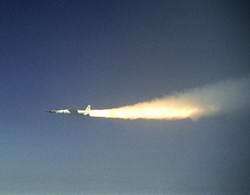
Guinness World Records has recognized the world speed record set by NASA's hypersonic X-43A aircraft earlier this year in an experimental flight over the Pacific Ocean. Using a scramjet engine, the unpiloted, 12 foot-long aircraft achieved Mach 6.83 -- almost seven times the speed of sound -- or nearly 5,000 mph, in a March 27 flight.
The accomplishment will be included in the 2006 Guinness World Records book, set for release this time next year, as follows:
"On 27 March 2004, NASA's unmanned Hyper-X (X-43A) airplane reached Mach 6.83, almost seven times the speed of sound. The X-43A was boosted to an altitude of 29,000 m (95,000 ft) by a Pegasus rocket launched from beneath a B52-B aircraft. The revolutionary 'scramjet' aircraft then burned its engine for around 11 seconds during flight over the Pacific Ocean."
If NASA researchers have their way, the record won't stand long. The final flight in the Hyper-X program is scheduled to take place in October, when another X-43A aircraft will attempt to fly at Mach 10 -- ten times the speed of sound -- or 7,200 mph.
The March 27 flight was part of NASA's Hyper-X program, designed to demonstrate advanced high-speed propulsion system concepts to overcome one of the greatest aeronautical research challenges -- air-breathing hypersonic flight. The advantage of air-breathing flight is that the vehicle, whether it is aircraft or spacecraft, scoops the air its engines need from the atmosphere rather than carrying heavy, bulky tanks, as rockets do.
The challenge is to introduce fuel, ignite it and produce positive thrust while highly compressed air rushes through the engine in mere milliseconds -- roughly analogous to lighting a match and keeping it burning in a hurricane-force wind.
Compared to rocket-powered vehicles like the Space Shuttle, scramjets promise more airplane-like operations for increased affordability, flexibility and safety in ultra high-speed flights within the atmosphere and into Earth orbit.
The X-43A flight easily set a world speed record for an air-breathing engine aircraft. The previous known record was held by a ramjet-powered missile, which achieved slightly more than Mach 5. A ramjet operates by subsonic combustion of fuel in a stream of air compressed by the forward speed of the aircraft itself, as opposed to a normal jet engine, in which the compressor section (the fan blades) compresses the air. A scramjet (supersonic-combustion ramjet) is a ramjet engine in which the airflow through the whole engine remains supersonic.
The highest speed attained by a rocket-powered airplane, NASA's X-15 aircraft, was Mach 6.7. The fastest air-breathing, manned vehicle, the SR-71, achieved slightly more than Mach 3. The X-43A more than doubled the top speed of the jet-powered SR-71.
Guinness World Records' science editor David Hawksett has already expressed an interest in attending the fall flight.
"Operating an atmospheric vehicle at almost Mach 7 is impressive enough, but to be able to use oxygen from the air, instead of a fuel tank, as it screams into the engine intakes at 5,000 mph is a mind-boggling technical achievement. It's wonderful to see scramjet technology finally begin to take off," said Hawksett.
The Hyper-X program is conducted by NASA's Aeronautics Research Mission Directorate with the NASA Langley Research Center, Hampton, Va., as lead center with responsibility for hypersonic technology development and the NASA Dryden Flight Research Center, Edwards, Calif., responsible for flight research and testing.
Source: NASA


