Tether Origami
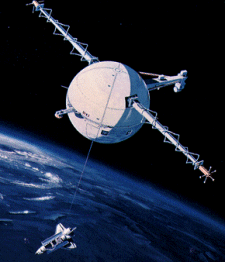
NASA is joining a Japanese team in a space experiment that uses reverse origami to show the way to help keep satellites in their proper orbits, or to return spent rocket stages quickly to Earth.
Les Johnson of NASA's Marshall Space Flight Center is working with Prof. Hironori A. Fujii of the Tokyo Metropolitan University on the Foldaway Flat Tether Deployment System--or Fortissimo, as it is sometimes called. "It's a new method for rolling out tethers in space," says Johnson. The mission is sponsored by the Japanese Aerospace Exploration Agency (ISAS/JAXA).
Fortissimo -- ff in music -- means strong in Italian. This tether will have to be strong considering its gossamer construction. While the tether is 1 km (3280 feet) long, it's only 0.05 mm thick and 50 mm (almost 2 inches) wide. "It looks like a strip of aluminum foil, almost like a tape measure," says Johnson. This is a departure from most previous tethers, "which have been braided wires of some sort."
Johnson says that many details have to be worked out before the planned 2009 launch atop an S-520 sounding rocket.
"The Japanese team has designed a deployer that looks like the way firemen store their hoses. It's very different from anything we've used before," Johnson continues. This is the reverse origami part: The product starts folded, and is then pulled up from the top to produce a nearly straight line. In this fashion, researchers believe, the tether can be deployed 1 km in only a few minutes.
The first space tethers were webbed lines that connected the Gemini 11 and 12 spacecraft to their Agena docking targets on separate missions in 1966. These demonstrated that tethers could be used to connect spacecraft for artificial gravity or to stabilize a spacecraft.
The next major effort was the 20km NASA-Italy Tethered Satellite System flown in 1992 and again in 1996. This used a complex reel system that resembled a deck winch. (TSS-1 experienced a mechanical jam early in its deployment. TSS-1R collected a large volume of data before a different mishap cut the tether.)
NASA moved on to ProSEDS, the Propulsive Small Expendable Deployer System, which built on the simpler and highly successful SEDS-1 and -2 tests. ProSEDS involved a 20 km (12 mi) tether deployed on a bobbin from a Delta II second stage. It was to fly in 2003, but after the Columbia tragedy NASA re-evaluated several missions and decided that ProSEDS posed too great a risk to the International Space Station.
Still, as Robert Goddard wrote when his space travel concepts were ridiculed, "The dream would not [go] down." Other nations have experimented with tethers in more than 20 missions overall, including Japanese participation in the Charge 1 and 2 rocket experiments in 1983 and 1984.
Recently, Fujii asked Johnson and fellow NASA researcher George Khazanov to join the project as co-investigators. They will help the Japanese team figure out how to use the tether as a means of propulsion and, in particular, assist in the modeling of the tether's reaction to Earth's magnetic field.
The principle is similar to what happens in an electrical dynamo on Earth: A wire moving through a magnetic field will produce an electrical current in the wire. In low Earth orbit, the Fortissimo tether will move through Earth's magnetic field as well as Earth's ionosphere, a conducting layer of ionized gas in the upper atmosphere. The resulting current will decelerate the spacecraft. (Deceleration by tethers is a trick that would come in handy for de-orbiting space junk. Acceleration is also possible by pumping current in the opposite direction through the tether, but testing tether acceleration is not a goal of this particular mission, notes Johnson.)
"We expect a low average current--about 1 to 3 amps," he continues. That will vary, depending on the time of day the mission launches. The ionosphere contracts at night and the tether would pass through 10 times more electrons during the day than it would in a night launch.
There also is uncertainty about friction, electrostatic charging, and other forces involved in deploying the tether. A model has been tested on the ground, but an experiment in the vacuum and free-fall of space is needed to verify predictions before possible orbital experiments.
Also different from past tethers will be the manner of the experiment: It will last just five minutes, from about 100 km (62 mi) altitude, just above most of Earth's atmosphere, to an apex of 300 km (186 mi), and until it is destroyed during re-entry.
Once in space, the probe will deploy a satellite that rises then falls at the same velocity as the probe, but moves outward, gently pulling the aluminum tape with it, and hopefully unfolding new opportunities in space.
Source: by Dave Dooling, Science@NASA


