What lies beneath: new research looks deep into the centre of the Earth
Jan 20, 2006
What lies beneath: new research looks deep into the centre of the Earth

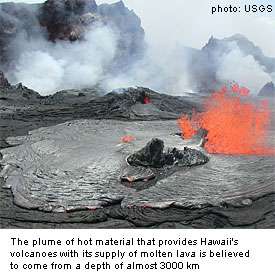
New research published this week on the evolution of volcanoes sheds light on what lies deep beneath the Earth's surface. The research, published in Nature, suggests that the plume of hot material that provides Hawaii's volcanoes with its continuous supply of molten lava originates from a depth of almost 3000 km, at the border between the Earth's core and its rocky mantle. This is far deeper than had been thought possible by many scientists.

Plumes are hot, narrow currents that well up in the mantle and which are responsible for the formation of long chains of volcanoes such as those of the Hawaiian Islands. The question of whether plumes rise from the boundary between the core of the Earth and the mantle that surrounds it, or from a much shallower boundary layer within the mantle, has been hotly debated for more than a quarter of a century.

The new research proved the presence of material from the Earth's core by using a new type of mass spectrometer to analyse the isotope signature of the element thallium in Hawaiian volcanic rocks. Isotope analysis can reveal the physical, chemical and biological processes to which a single element has been subjected.

Dr Mark Rehkamper, from Imperial College London's Department of Earth Sciences and Engineering and the senior author of the research, said: "It is only recently that scientists have developed the ability to analyse these volcanic rocks in enough detail to reveal exactly where in the Earth's interior they came from. The previous evidence has unfortunately been quite ambiguous but our new thallium isotope results are now able to conclusively rule out some of the alternative models. What remains is clear evidence of interaction between the Earth's core and mantle."

The evidence that plumes originate at the core-mantle boundary suggests that the mantle constitutes one big convective system, like a soup being continuously stirred, rather than being made up of several layers. It also reveals that sedimentary material from the Earth's surface is subducted into the mantle to make its way back to the surface in the plumes, over time periods of one or two billion years.

Previous analysis of volcanic rocks from Hawaii looked at the isotope signature of the element osmium in them and appeared to show that material from the earth's core was present. However, some scientists argued that the presence of core material was due to contamination of the mantle plume with sediments from the Earth's surface. The new research demonstrates that the quantities of sedimentary material were much too low for this to be the case.

The research was carried out by scientists at Imperial College London, ETH Zurich, Macquarie University, the Australian National University and the University of Oxford. It was funded by ETH Zurich, Schweizerische Nationalfonds and the Danish Research Agency.

Source: Imperial College, University of London

Explore further: Collisions of coronal mass ejections can be super-elastic

add to favorites email to friend print save as pdf

Related Stories

Study sheds light on Earth's early mantle

May 06, 2013

(Phys.org) —An international team of researchers, led by scientists at Boston University's Department of Earth and Environment, has found evidence that material contained in young oceanic lava flows originated ...

Ancient Earth crust stored in deep mantle

Apr 24, 2013

Scientists have long believed that lava erupted from certain oceanic volcanoes contains materials from the early Earth's crust. But decisive evidence for this phenomenon has proven elusive. New research from ...

Did diamonds begin on the ancient ocean floor?

Apr 18, 2013

(Phys.org) —Geology professor Dan Schulze calls this singular gem from the remote Guaniamo region of Venezuela the "Picasso" diamond. The blue luminescent, high-resolution image of a diamond formed over ...

Carbon's role in planetary atmosphere formation

Apr 08, 2013

(Phys.org) —A new study of how carbon is trapped and released by iron-rich volcanic magma offers clues about the early atmospheric evolution on Mars and other terrestrial bodies.

Recommended for you

Be prepared for weather extremes

54 minutes ago

Unsettled weather is an Iowa mainstay, and so is Inside's annual reminder of the university's severe weather safety and preparedness guidelines—for storms, extreme heat, flooding and more.

US House sends message on Keystone pipeline

1 hour ago

US lawmakers agreed to a bill that would speed construction of a Canada-US oil pipeline and circumvent the need for President Barack Obama's approval for the $5 billion project.

Very Large Telescope celebrates 15 years of success

1 hour ago

(Phys.org) —With this new view of a spectacular stellar nursery ESO is celebrating 15 years of the Very Large Telescope—the world's most advanced optical instrument. This picture reveals thick clumps ...

New EU climate policy unlikely before 2015: Poland

1 hour ago

The European Union is unlikely to hammer out its new policy on global warming ahead of a global climate deal that could be clinched in 2015, Poland's environment minister said Wednesday.

Forecast for Titan: Wild weather could be ahead

14 hours ago

(Phys.org) —Saturn's moon Titan might be in for some wild weather as it heads into its spring and summer, if two new models are correct. Scientists think that as the seasons change in Titan's northern hemisphere, ...

User comments : 0

More news stories

Be prepared for weather extremes

Unsettled weather is an Iowa mainstay, and so is Inside's annual reminder of the university's severe weather safety and preparedness guidelines—for storms, extreme heat, flooding and more.

Very Large Telescope celebrates 15 years of success

(Phys.org) —With this new view of a spectacular stellar nursery ESO is celebrating 15 years of the Very Large Telescope—the world's most advanced optical instrument. This picture reveals thick clumps ...

US House sends message on Keystone pipeline

US lawmakers agreed to a bill that would speed construction of a Canada-US oil pipeline and circumvent the need for President Barack Obama's approval for the $5 billion project.

Unlocking secrets of cell reproduction

Research published in Open Biology today identifies, for the first time, nearly all the genes required for reproduction of a cell in a living organism.

Fast-acting mothers' milk for healthier babies

Human breastmilk responds quickly to protect the child when there is an infection in mothers or babies, according to new international research led by The University of Western Australia.