Dusty Planetary Disks Around Two Nearby Stars Resemble Our Kuiper Belt
January 19, 2006

Dusty Planetary Disks Around Two Nearby Stars Resemble Our Kuiper Belt

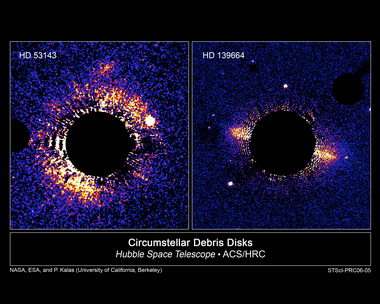
These two bright debris disks of ice and dust appear to be the equivalent of our own solar system´s Kuiper Belt, a ring of icy rocks outside the orbit of Neptune and the source of short-period comets. The disks encircle the types of stars around which there could be habitable zones and planets for life to develop. The disks seem to have a central area cleared of debris, perhaps by planets. The new disks, each about 60 light-years from Earth, bring to nine the number of dusty debris disks observable at visible wavelengths. The new ones are different, however, in that they are old enough -- more than 300 million years -- to have settled into stable configurations akin to those in our own solar system, which is 4.6 billion years old. Credit: NASA, ESA, and P. Kalas (University of California, Berkeley)

These two bright debris disks of ice and dust appear to be the equivalent of our own solar system's Kuiper Belt, a ring of icy rocks outside the orbit of Neptune and the source of short-period comets. The disks encircle the types of stars around which there could be habitable zones and planets for life to develop. The disks seem to have a central area cleared of debris, perhaps by planets.

The new disks, each about 60 light-years from Earth, bring to nine the number of dusty debris disks observable at visible wavelengths. The new ones are different, however, in that they are old enough -- more than 300 million years -- to have settled into stable configurations akin to those in our own solar system, which is 4.6 billion years old.

The wide disk on the left, which is inclined obliquely to the line-of-sight, surrounds HD 53143, a K star slightly smaller than the Sun but about 1 billion years old. The narrow disk on the right, which is tipped nearly edge-on encircles the star HD 139664, an F star slightly larger than the Sun but only 300 million years old. The sharp outer edges of the narrow belt may be telltale evidence for the existence of an unseen companion object that keeps debris gravitationally corralled, in the same way that shepherding moons trim the edges of debris rings around Saturn and Uranus.

A survey by NASA's Hubble Space Telescope shows that such disks fall into two categories: those with a broad belt, wider than about 50 astronomical units; and narrow ones with a width of between 20 and 30 AU and a sharp outer boundary, seemingly like our own Kuiper Belt. An astronomical unit, or AU, is the average distance between the Earth and Sun, about 93 million miles. Our Kuiper Belt, for example, is thought to be narrow, extending from the orbit of Neptune at 30 AU to about 50 AU.

The false-color images were taken with Hubble's Advanced Camera for Surveys in September 2004. The black central circle is an image artifact produced by the camera's coronagraph which blocks the glare from the central star to allow the much fainter disks to be seen. A smaller black circle at the edge of each photo is a "coronagraphic finger" also used to block light from a bright object in the field.

Source: Space Telescope Science Institute


Rank 5 /5 (1 vote)
Tags

Relevant PhysicsForums posts

More news stories

Yale study concludes public apathy over climate change unrelated to science literacy

Are members of the public divided about climate change because they don't understand the science behind it? If Americans knew more basic science and were more proficient in technical reasoning, would public consensus match ...

Space & Earth / Environment

created 13 hours ago | popularity 4.8 / 5 (6) | comments 30 | with audio podcast

Land and sea species differ in climate change response: study

(Phys.org) -- Marine and terrestrial species will likely differ in their responses to climate warming, new research by Simon Fraser University and Australia’s University of Tasmania has found.

Space & Earth / Environment

created 11 hours ago | popularity 4 / 5 (5) | comments 9 | with audio podcast

10 million years needed to recover from mass extinction

It took some 10 million years for Earth to recover from the greatest mass extinction of all time, latest research has revealed.

Space & Earth / Earth Sciences

created 13 hours ago | popularity 4.2 / 5 (5) | comments 5 | with audio podcast

Sophisticated simulations predict future warming

The chances of our planet being hit by a global warming of 3 degrees Celsius by 2050 is as likely as it being hit by an increase of 1.4 degrees, new research shows. Presented in the journal Nature Geoscience, the British study ...

Space & Earth / Earth Sciences

created May 22, 2012 | popularity 3.8 / 5 (11) | comments 51

Kyoto Protocol architect 'frustrated' by climate dialogue

UN climate talks are going nowhere, as politicians dither or bicker while the pace of warming dangerously speeds up, one of the architects of the Kyoto Protocol told AFP.

Space & Earth / Environment

created May 23, 2012 | popularity 3.4 / 5 (8) | comments 44


Stunning image of smallest possible five-ringed structure

Scientists have created and imaged the smallest possible five-ringed structure – about 100,000 times thinner than a human hair – and you'll probably recognise its shape.

'Unzipped' carbon nanotubes could help energize fuel cells, batteries

Multi-walled carbon nanotubes riddled with defects and impurities on the outside could replace some of the expensive platinum catalysts used in fuel cells and metal-air batteries, according to scientists at ...

Change in developmental timing was crucial in the evolutionary shift from dinosaurs to birds: study

At first glance, it's hard to see how a common house sparrow and a Tyrannosaurus Rex might have anything in common. After all, one is a bird that weighs less than an ounce, and the other is a dinosaur that ...

Computer model used to pinpoint prime materials for efficient carbon capture

When power plants begin capturing their carbon emissions to reduce greenhouse gases – and to most in the electric power industry, it's a question of when, not if – it will be an expensive undertaking.

T cells 'hunt' parasites like animal predators seek prey, study shows

By pairing an intimate knowledge of immune-system function with a deep understanding of statistical physics, a cross-disciplinary team at the University of Pennsylvania has arrived at a surprising finding: T cells use a movement ...

Browser wars flare in mobile space

The browser wars are heating up again, but this time the fight is for dominance of the mobile Internet.