Hundreds of Antarctic Peninsula glaciers accelerating as climate warms
Jun 05, 2007
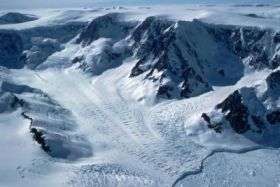
Antarctic glacier
Antarctic glacier. Credit: British Antarctic Survey

Hundreds of glaciers on the Antarctic Peninsula are flowing faster, further adding to sea level rise according to new research published this week in the Journal of Geophysical Research. Climate warming, that is already causing Antarctic Peninsula increased summer snow melt and ice shelf retreat, is the most likely cause.

Using radar images acquired by European ERS-1 and -2 satellites, scientists from British Antarctic Survey (BAS) tracked the flow rate of over 300 previously unstudied glaciers. They found a 12% increase in glacier speed from 1993 to 2003. These observations - that echo recent findings from coastal Greenland - indicate that the cause is melting of the lower glaciers, which flow directly into the sea. As they thin, the buoyancy of the ice can lift the glaciers off their rock beds, allowing them to slide faster.

In February this year, the United Nations Intergovernmental Panel on Climate Change (IPCC) reported that they could not provide an upper limit on the rate of sea-level rise from Antarctica in coming centuries because of a lack of understanding of the behaviour of the large ice sheets.

These new results give scientists a clearer picture about the way that climate warming can affect glaciers both in the Arctic and Antarctic. Furthermore, they pave the way for more reliable projections of future sea level rise, and provide a better basis for policy decisions.

Lead author Dr Hamish Pritchard says, “The Antarctic Peninsula has experienced some of the fastest warming on Earth, nearly 3 C over the last half-century. Eighty-seven percent of its glaciers have been retreating during this period and now we see these glaciers are also speeding up. It’s important that we use tools such as satellite technology that allow us to monitor changes in remote and inaccessible glaciers on a regional scale. Understanding what’s happening now gives us our best chance of predicting what’s likely to happen in the future.”

Source: British Antarctic Survey

Explore further: Professor argues Earth's mantle affects long-term sea-level rise estimates

add to favorites email to friend print save as pdf

Related Stories

China to build two more Antarctic bases

Mar 29, 2013

China is to build two extra research stations in Antarctica, where it currently has three facilities, the State Oceanic Administration confirmed on Friday.

Recommended for you

Strong earthquake at exceptional depth

11 hours ago

This morning at 05:45 CEST, the earth trembled beneath the Okhotsk Sea in the Pacific Northwest. The quake, with a magnitude of 8.2, took place at an exceptional depth of 605 kilometers. Because of the great ...

Marine forecasting on the horizon for Indian Ocean Rim

11 hours ago

Nearly all of the member countries of the Indian Ocean Rim Association for Regional Cooperation (IOR-ARC) will attend the week-long workshop to further cooperation and understanding on international ocean ...

Russia evacuates drifting Arctic research station

May 23, 2013

Russia has ordered the urgent evacuation of the 16-strong crew of a drifting Arctic research station after ice floe that hosts the floating laboratory began to disintegrate, officials said Thursday.

User comments : 0

More news stories

Galaxies fed by funnels of fuel

(Phys.org) —Computer simulations of galaxies growing over billions of years have revealed a likely scenario for how they feed: a cosmic version of swirly straws.

Dark, massive asteroid to fly by Earth on May 31

It's 1.7 miles long. Its surface is covered in a sticky black substance similar to the gunk at the bottom of a barbecue. If it impacted Earth it would probably result in global extinction. Good thing it is ...

Source of life running out: water scientists

The majority of people on Earth people will face severe water shortages within a generation or two if pollution and waste continues unabated, scientists warned at a conference in Bonn Friday.

Google eyes emerging markets networks

Google has become deeply involved in a series of projects to build and operate wireless networks in emerging markets including sub-Saharan Africa and Southeast Asia, a report said Friday.