World's third largest asteroid impact zone found in South Australia
Feb 15, 2013 by Sunanda Creagh
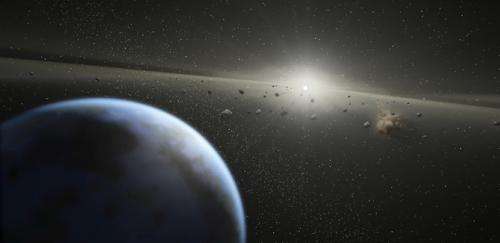
The asteroid hit Earth up to 360m years ago, the study found. Credit: NASA

An asteroid measuring up to 20km across hit South Australia up to 360 million years ago and left behind the one of the largest asteroid impact zones on Earth, according to new research published today.

The impact zone in the East Warburton Basin was buried under nearly four kilometres of earth, said Dr Andrew Glikson, a visiting fellow to the Australian National University's Planetary Science Institute and a co-author of the paper.

"It's significant because it's so large. It's the third largest impact terrain anywhere on Earth found to date," Dr Glikson said.

"It's likely to be part of a particular cluster that was linked with a mass extinction event at that time."

Dr Glikson published his findings in a paper in the journal Tectonophysics, co-authored by ANU colleagues Dr John Fitzgerald and Dr Erdinc Saygin and by the University of Queensland's Dr Tonguc Uysal.

The team analysed quartz grains drawn from over 200 samples taken from far below the Earth's surface and studied underground seismic anomalies.

Dr Glikson said there was a chance that the that caused the impact zone actually split in two before it hit.

"We are studying another anomaly in West Warburton that could well be its twin but we don't know yet."

Dr Simon O'Toole, Research Astronomer at the Australian , said the finding was very interesting.

"It strengthens the case for the idea that the Chicxulub crater is connected to the mass extinction of the dinosaurs. We are starting to see more evidence that impact events caused mass extinction events," said Dr O'Toole, who was not involved in the research.

"Australia is a fantastic place for impact crater hunters because we have huge open space with nothing in it," said Dr O'Toole, adding that the size of the new impact zone was very significant.

"It's huge. Most asteroid events are about 100m in diameter."

Another asteroid, dubbed 2012 DA14, will pass within 27,700 kilometres from Earth on Saturday, potentially passing communication satellites, but is unlikely to hit the planet.

Explore further: Research group suggests Chicxulub crater may have been caused by binary asteroids

More information: www.sciencedirect.com/science/article/pii/S0040195113000188

Related Stories

Australian researcher discovers giant asteroid impact

Oct 24, 2010

(PhysOrg.com) -- A geothermal energy researcher from the University of Queensland (UQ) has found evidence of a major asteroid impact that occurred more than 300 million years ago in the South Australian outback.

Recommended for you

China astronauts float water blob in kids' lecture

1 hour ago

Astronauts struck floating martial arts poses, twirled gyroscopes and manipulated wobbling globes of water during a lecture Thursday from China's orbiting space station that's part of efforts to popularize ...

Metamorphosis of moon's water ice explained

15 hours ago

Using data gathered by NASA's Lunar Reconnaissance Orbiter (LRO) mission, scientists believe they have solved a mystery from one of the solar system's coldest regions—a permanently shadowed crater on the ...

User comments : 1

Adjust slider to filter visible comments by rank

Display comments: newest first

Torbjorn_Larsson_OM
5 / 5 (1) Feb 16, 2013
360 Ma bp, that would be the Hangenberg event in the Late Devonian extinction series of events. [ http://en.wikiped...tinction ]

Like the K-Pg impactor event, and "Unlike the [initiating] Kellwasser event, the Hangenberg event affected marine and terrestrial habitats."

More news stories

Philippines financial capital bans plastic bags

The Philippines financial capital banned disposable plastic shopping bags and styrofoam food containers on Thursday, as part of escalating efforts across the nation's capital to curb rubbish that exacerbates ...

Singapore haze at worst yet, Malaysia schools shut

Singapore urged people to remain indoors amid unprecedented levels of air pollution Thursday as a smoky haze wrought by forest fires in neighboring Indonesia worsened dramatically. Nearby Malaysia closed ...

China astronauts float water blob in kids' lecture

Astronauts struck floating martial arts poses, twirled gyroscopes and manipulated wobbling globes of water during a lecture Thursday from China's orbiting space station that's part of efforts to popularize ...

Panic over MERS virus fades in Saudi

People in Saudi Arabia's Eastern Province have again started greeting friends with the traditional kiss on the cheek, and face masks in public are becoming rarer, as panic subsides over the outbreak of a deadly respiratory ...

S.Korean airlines ban shark fin as cargo

South Korea's two largest airlines, Korean Air and Asiana, said Thursday they had both decided to ban shark fin from their cargo flights as part of a growing global campaign against the Asian delicacy.

AP buys stake in live video service Bambuser

The Associated Press said Thursday that it has bought a minority stake in the live video service Bambuser, boosting its ability to acquire and distribute video collected by people who have witnessed news events.

UNESCO warns Syrian heritage sites endangered

UNESCO on Thursday added six ancient sites in Syria including a fortress of Saladin and a Crusader castle to the endangered World Heritage list, warning that more than two years of civil war had inflicted ...