Sea animal has grow-again penis
Feb 13, 2013
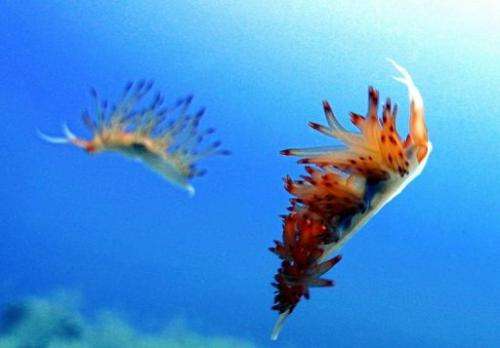
Two sea-slugs (Godiva banyulensis) from the Glaucidae familia swim in the Mediterranean sea, 29 July 2004, off the town of Kas, Turkey. Scientists reported Wednesday on the bizarre sex life of a sea slug that discards its penis after copulation. Then grows a new one.

Scientists reported Wednesday on the bizarre sex life of a sea slug that discards its penis after copulation. Then grows a new one.

"No other animal is known to repeatedly copulate using such 'disposable penes'," Japanese biologists wrote in the Royal Society journal Biology Letters, describing the behaviour as "extremely peculiar".

Dubbed Chromodoris reticulata in Latin, the red-and-white slug—technically a shell-less mollusc—inhabits warms waters in .

The critter needs 24 hours between couplings to unroll an internally coiled and compressed juvenile penis to replace the used, external bit, the scientists found.

It can repeat this feat at least three times.

The human thumb-sized slug is an hermaphrodite, meaning it has both male and female sexual organs.

The animals perform dual sexual roles during copulation. They give sperm to a mating partner while simultaneously receiving sperm, which they store for later .

The team observed copulation between sea slugs that they had captured during scuba dives and held in a tank.

After each coupling, which lasted between dozens of seconds and a few minutes, every slug discarded its penis—a thread-like organ that it projects from its side into a partner's vagina.

The team also examined the and function of the male organs—observing an internal spiral structure they believe grows into a replacement penis.

"We propose that the tissue at the spiral part of the penis is compressed and undifferentiated, gradually differentiating into the 'next penis'," the team wrote.

"It may need approximately a day for the to be ready for copulation."

In another revelation about the 's , the scientists found its penis was covered with spines—and suggested these may be used to remove the sperm of previous partners being held in store by their mate.

The are backward-pointing, making it difficult to withdraw the penis after copulation. This may explain the organ's disposable nature.

"Chromodoris reticulata may compensate for the short-term cost of decreased reproductive opportunities caused by the loss of a penis with the reproductive advantage gained by sperm displacement," wrote the study authors.

Various animals are known to discard parts of their body, such as the gecko which sheds its tail.

Few, though, are willing to part with their penis, the team noted with clinical understatement.

Explore further: 'Penis-head' fish discovered in Vietnam

add to favorites email to friend print save as pdf

Related Stories

Barnacles go to great lengths to mate

Feb 06, 2008

Compelled to mate, yet firmly attached to the rock, barnacles have evolved the longest penis of any animal for their size - up to 8 times their body length - so they can find and fertilize distant neighbours.

Penis size does matter if you are a bank vole

Oct 05, 2011

(PhysOrg.com) -- While size may not matter when it comes to humans, a new study published in Behavioural Ecology and Sociobiology found that the width of the male bank vole’s penis plays a role in soc ...

Recommended for you

Bittersweet: Bait-averse cockroaches shudder at sugar

15 hours ago

Sugar isn't always sweet to German cockroaches, especially to the ones that avoid roach baits. In a study published May 24 in the journal Science, North Carolina State University entomologists show the ne ...

White tiger mystery solved

17 hours ago

White tigers today are only seen in zoos, but they belong in nature, say researchers reporting new evidence about what makes those tigers white. Their spectacular white coats are produced by a single change ...

Scientists announce Top 10 New Species from 2012

May 23, 2013

An amazing glow-in-the-dark cockroach, a harp-shaped carnivorous sponge and the smallest vertebrate on Earth are just three of the newly discovered top 10 species selected by the International Institute for ...

User comments : 2

Adjust slider to filter visible comments by rank

Display comments: newest first

VendicarE
3.7 / 5 (3) Feb 14, 2013
So there is hope for UbVonTard after all.
Sinister1811
1 / 5 (1) Feb 14, 2013
So there is hope for UbVonTard after all.


Not much hope. There's still the problem of the missing chromosome.

More news stories

White tiger mystery solved

White tigers today are only seen in zoos, but they belong in nature, say researchers reporting new evidence about what makes those tigers white. Their spectacular white coats are produced by a single change ...

Hormone replacement therapy—clarity at last

The British Menopause Society and Women's Health Concern have today released updated guidelines on Hormone Replacement Therapy (HRT) to provide clarity around the role of HRT, the benefits and the risks. The new guidelines ...

Controlling mood through the motions of mitochondria

(Medical Xpress)—Regulating the distribution of power in neurons is done by a system that makes the national electric grid look simple by comparison. Each neuron has several thousand mitochondria confined ...

A hidden population of exotic neutron stars

(Phys.org) —Magnetars – the dense remains of dead stars that erupt sporadically with bursts of high-energy radiation - are some of the most extreme objects known in the Universe. A major campaign using ...