Malaysian customs seize record 24 tonnes of ivory
Dec 11, 2012
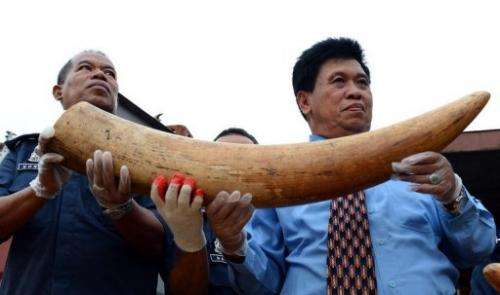
Malaysia's customs director Azis Bin Yacub (right) displays an elephant tusk to media at the customs house in Malaysia's port town of Klang outside Kuala Lumpur on December 11. Malaysian customs have seized 24 tonnes of unprocessed elephant tusks worth almost $20 million, the largest haul in the country to date, officials said Tuesday.

Malaysian customs have seized 24 tonnes of unprocessed elephant tusks worth almost $20 million, the largest haul in the country to date, officials said Tuesday.

Some 1,500 tusks hidden in two containers were discovered by customs officials at the country's main port of Klang, in the western state of Selangor.

The tusks had been hidden within pieces of timber inside the containers, which had originated from the west African nation of Togo.

State customs director Azis Yaacub said in a statement that the cargo had been transferred from one ship to another in Spain and was believed to be headed to China.
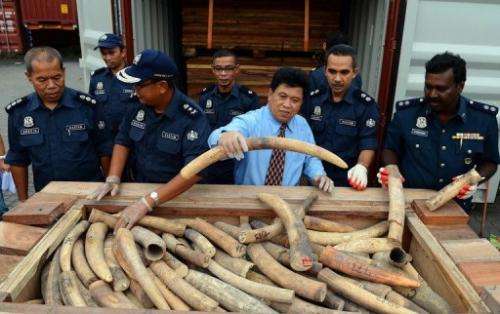
Malaysia's customs officers take out elephant tusks hidden among wooden floor tiles from two containers at the customs house in Malaysia's port town of Klang on December 11. The tusks had been hidden within pieces of timber inside the containers, which had originated from the west African nation of Togo.

"The two containers were found to be filled with sawn timber. Inside the wood there were secret compartments that were filled with elephant tusks," he said.

The haul is worth 60 million ringgit, which amounts to $19.6 million. Officials said that the seizure on December 7 was the fourth in the past year and was larger than the other three combined.

-monitoring network TRAFFIC has described Malaysia as a major hub for illicit wildlife products.

International trade in was banned in 1990 with rare exceptions, such as auctions of tusks from elephants that have died naturally, or that have been seized from poachers in Namibia, Botswana and South Africa.

However, the has grown globally since 2004, largely due to demand in China, where it is used in traditional medicine.

According to the , populations may have been as high as five million in the first part of the 20th century, but their numbers could now be as low as 470,000.

Explore further: Hong Kong customs seize over a tonne of smuggled ivory

add to favorites email to friend print save as pdf

Related Stories

Malaysia seizes million-dollar ivory shipment

Dec 13, 2011

Malaysia has seized elephant tusks and ivory handicrafts worth an estimated four million ringgit ($1.3 million) en route from Kenya to Cambodia, a customs official said Tuesday.

Malaysia seizes nearly 700 elephant tusks

Sep 06, 2011

Malaysian authorities have seized nearly 700 elephant tusks bound for China, an official said, the latest in a series of hauls indicating Malaysia had become a key ivory transit hub.

Hong Kong seizes nearly 800 smuggled elephant tusks

Aug 31, 2011

Hong Kong has seized nearly two tonnes of elephant ivory worth about $1.7 million hidden in a shipment from Malaysia and detained a local man over the haul, customs authorities said Wednesday.

Recommended for you

Climate change may have little impact on tropical lizards

May 17, 2013

A new Dartmouth College study finds human-caused climate change may have little impact on many species of tropical lizards, contradicting a host of recent studies that predict their widespread extinction in a rapidly warming ...

Wetlands: value to locals matters most

May 17, 2013

A new way of valuing ecosystem services, incorporating the local perspective, is the driving force behind a project assessing aquatic ecosystems in highland areas of Asia

Symbolic saviour of an endangered species

May 16, 2013

In 2006 Berlin Zoo saw the birth of their first polar bear cub in 33 years. A retired circus polar bear gave birth to two cubs at the zoo. One of them died soon after, but Knut survived. At only a month old he became the ...

User comments : 0

More news stories

Tiger, tiger, not burning so bright

(Phys.org) —India's tigers are facing extinction owing to a collapse in the variety of their mating partners, according to new research carried out by scientists at Cardiff University.