One of the largest astronomical images ever made
Dec 19, 2012 by Jason Major, Universe Today
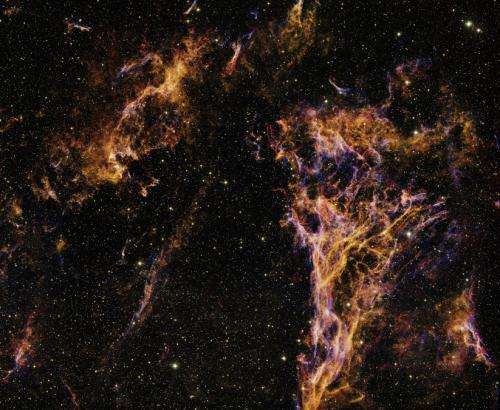
The northern portion of the Cygnus Loop, as seen in an enormous new panorama from the National Optical Astronomy Observatory (NOAO) and WIYN partners. Credit: T.A. Rector (University of Alaska Anchorage), Richard Cool (University of Arizona) and WIYN/NOAO/AURA/NSF

Looking for a stunning new desktop image to wrap up the year? Try this: it's an amazing panorama of the Cygnus Loop, a supernova remnant located 1,500 light-years away in the constellation (you guessed it) Cygnus. The full-size image, acquired with the wide-field Mosaic camera on the WIYN 0.9-meter telescope at Kitt Peak, Arizona, is a staggering 600 millionpixels in size—over 1.68 gigabytes—making it one of the largest astronomical images ever made!

See the full image (and links to download larger versions) below:
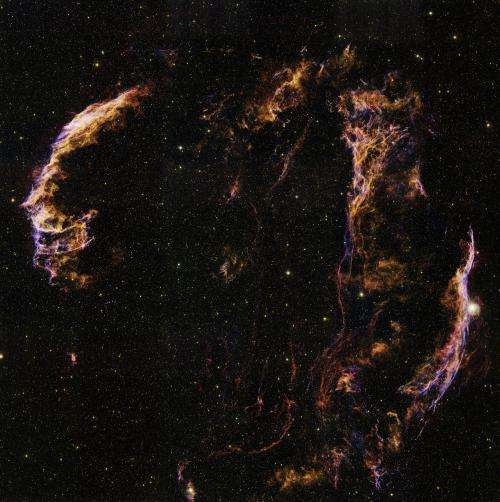
2000-pixel-wide version of the full Cygnus Loop panorama. Credit: T.A. Rector (University of Alaska Anchorage), Richard Cool (University of Arizona) and WIYN/NOAO/AURA/NSF

The entire structure of the Cygnus Loop, the gaseous remains of a supernova that occurred 5,000 – 10,000 years ago, covers an area nearly 45 times the size of the full Moon in the sky.

In the image, hydrogen alpha, sulphur, and correspond to the red, green, and blue color values, respectively.

From the NOAO press release:

Astronomers estimate the that produced the nebula occurred between 5,000 to 10,000 years ago. First noted in 1784 by , it is so large that its many parts have been catalogued as separate objects, including NGC 6992, NGC 6995 and IC 1340 along the eastern (left) side of the image, NGC 6974 and NGC 6979 near the top-center, and the Veil Nebula (NGC 6960) and Pickering's Triangle along the western (right) edge. The bright star near the western edge of the image, known as 52 Cygnus, is not associated with the supernova.

"Often, reduces images to dry tables of numerical information that we analyze in order to more deeply understand our universe," said Dr. Richard Cool, astronomer at the MMT Observatory in Arizona, who originally obtained the images in 2003 while still a graduate student. "Images like this are amazing because they can remind you of the big picture and beauty that surrounds us."

This incredible image demonstrates that even relatively small telescopes are capable of producing cutting-edge research, when equipped with modern cameras.
One of the largest astronomical images ever made
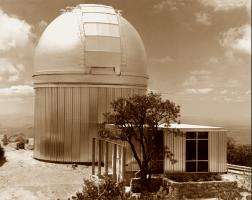
Original dome of the Kitt Peak 0.9-meter telescope. Credit: NOAO/AURA/NSF

Got bandwidth to spare? Download the full-size 1686.5 MB TIFF image here, or find other versions on the NOAO page here.

Explore further: The Bubble Nebula, observed with the new One Degree Imager Camera

add to favorites email to friend print save as pdf

Related Stories

Space Image: Cygnus Loop Nebula

Mar 27, 2012

(PhysOrg.com) -- Wispy tendrils of hot dust and gas glow brightly in this ultraviolet image of the Cygnus Loop Nebula, taken by NASA’s Galaxy Evolution Explorer.

Hubble observes a dwarf galaxy with a bright nebula

May 10, 2012

(Phys.org) -- The NASA/ESA Hubble Space Telescope has made detailed observations of the dwarf galaxy NGC 2366. While it lacks the elegant spiral arms of many larger galaxies, NGC 2366 is home to a bright, ...

New bright and blue supernova in NGC 1365

Nov 14, 2012

A very bright supernova has shown up NGC 1365, the galaxy also known as the Great Barred Spiral Galaxy, visible now for southern hemisphere observers. This already elegant galaxy lies about 56 million light-years ...

A galaxy blooming with new stars

Dec 15, 2011

(PhysOrg.com) -- The VLT Survey Telescope (VST) has captured the beauty of the nearby spiral galaxy NGC 253. The new portrait is probably the most detailed wide-field view of this object and its surroundings ...

Recommended for you

Galaxies fed by funnels of fuel

3 hours ago

(Phys.org) —Computer simulations of galaxies growing over billions of years have revealed a likely scenario for how they feed: a cosmic version of swirly straws.

Hubble reveals the ring nebula's true shape

May 23, 2013

(Phys.org) —The Ring Nebula's distinctive shape makes it a popular illustration for astronomy books. But new observations by NASA's Hubble Space Telescope of the glowing gas shroud around an old, dying, ...

User comments : 3

Adjust slider to filter visible comments by rank

Display comments: newest first

cantdrive85
1 / 5 (3) Dec 20, 2012
The filamentary nature of the plasma is unmistakable.
TimESimmons
1 / 5 (4) Dec 20, 2012
filaments may be apparent here in the plasma but they are also elsewhere in molecular matter. Here's why:-
http://www.presto...ndex.htm
Widdekind
1 / 5 (1) Dec 26, 2012
According to Wikipedia, the CL is ~3 degrees wide, as seen on the sky. At 1500lyr. distance, that makes the CL ~75lyr. across. If the object is ~7500yr. old, then the shell has been expanding at an average rate of ~0.01c.

More news stories

Galaxies fed by funnels of fuel

(Phys.org) —Computer simulations of galaxies growing over billions of years have revealed a likely scenario for how they feed: a cosmic version of swirly straws.

Dark, massive asteroid to fly by Earth on May 31

It's 1.7 miles long. Its surface is covered in a sticky black substance similar to the gunk at the bottom of a barbecue. If it impacted Earth it would probably result in global extinction. Good thing it is ...

Source of life running out: water scientists

The majority of people on Earth people will face severe water shortages within a generation or two if pollution and waste continues unabated, scientists warned at a conference in Bonn Friday.

Google eyes emerging markets networks

Google has become deeply involved in a series of projects to build and operate wireless networks in emerging markets including sub-Saharan Africa and Southeast Asia, a report said Friday.