Galaxy-wide echoes from the past
Dec 05, 2012
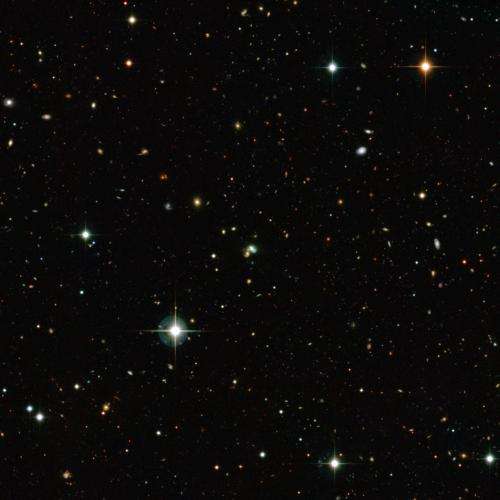
This view from the Canada-France-Hawaii Telescope shows thousands of galaxies in the distant Universe. But the one close to the centre looks very odd -- it is bright green. This very unusual object is known as J224024.1−092748 or J2240 and it is a bright example of a new class of objects that have been nicknamed green bean galaxies. Green beans are entire galaxies that are glowing under the intense radiation from the region around a central black hole. J2240 lies in the constellation of Aquarius (The Water Bearer) and its light has taken about 3.7 billion years to reach Earth. Credit: M. Schirmerm, CFHT/ESO

(Phys.org)—A new galaxy class has been identified using observations from ESO's Very Large Telescope, the Gemini South telescope, and the Canada-France-Hawaii Telescope. Nicknamed 'green bean galaxies' because of their unusual appearance, these galaxies glow in the intense light emitted from the surroundings of monster black holes and are amongst the rarest objects in the Universe.

Many have a giant black hole at their centre that causes the gas around it to glow. However, in the case of green bean galaxies, the entire galaxy is glowing, not just the centre. These new observations reveal the largest and brightest glowing regions ever found, thought to be powered by central that were formerly very active but are now switching off.

Mischa Schirmer of the had looked at many images of the , searching for clusters of galaxies, but when he came across one object in an image from the Canada-France- he was stunned—it looked like a galaxy, but it was bright green. It was unlike any galaxy he had ever seen before, something totally unexpected. He quickly applied to use ESO's Very Large Telescope to find out what was creating the unusual .

"ESO granted me special observing time at very short notice and just a few days after I submitted my proposal, this bizarre object was observed using the ," says Schirmer. "Ten minutes after the data were taken in Chile, I had them on my computer in Germany. I soon refocused my research activities entirely as it became apparent that I had come across something really new."

The new object has been labelled J224024.1−092748 or J2240. It liesin the constellation of Aquarius (The Water Bearer) and its light has taken about 3.7 billion years to reach Earth.

After the discovery, Schirmer's team searched through a list of nearly a billion other galaxies and found 16 more with similar properties, which were confirmed by observations made at the Gemini South telescope. These galaxies are so rare that there is on average only one in a cube about 1.3 billion light-years across. This new class of galaxies has been nicknamed green bean galaxies because of their colour and because they are superficially similar to, but larger than, green pea galaxies.

In many galaxies the material around the supermassive black hole at the centre gives off intense radiation and ionises the surrounding gas so that it glows strongly. These glowing regions in typical active galaxies are usually small, up to 10% of the diameter of the galaxy. However, the team's observations showed that in the case of J2240, and other green beans spotted since, it is truly huge, spanning the entire object. J2240 displays one of the biggest and brightest such regions ever found. Ionised oxygen glows bright green, which explains the strange colour that originally caught Schirmer's attention.

"These glowing regions are fantastic probes to try to understand the physics of galaxies—it's like sticking a medical thermometer into a galaxy far, far away," says Schirmer. "Usually, these regions are neither very large nor very bright, and can only be seen well in nearby galaxies. However, in these newly discovered galaxies they are so huge and bright that they can be observed in great detail, despite their large distances."

The team's further analysis of the data soon revealed another puzzle. J2240 appeared to have a much less active black hole at its centre than expected from the size and brightness of the glowing region. The team thinks that the glowing regions must be an echo from when the central black hole was much more active in the past, and that they will gradually dim as the remnants of radiation pass through them and out into space.

These galaxies signal the presence of a fading galactic centre, marking a very fleeting phase in a galaxy's life. In the early Universe galaxies were much more active, growing massive black holes at their centres that swallowed up surrounding stars and gas and shining brilliantly, easily producing up to 100 times more light than all the stars in the galaxy together. Light echoes like that seen in J2240 allow astronomers to study the shutdown processes of these active objects to understand more about how, when, and why they halt—and why we now see so few of them in younger galaxies. This is what the team aims to do next, by following up on this research with further X-ray and spectroscopic observations.

"Discovering something genuinely new is an astronomer's dream come true, a once-in-a-lifetime event," concludes Schirmer. "It's very inspiring!"

Explore further: Glitter galaxy through Hubble's eye

More information: This research was presented in a paper, "A sample of Seyfert-2 galaxies with ultra-luminous galaxy-wide NLRs - Quasar light echos?", to appear in The Astrophysical Journal.

Related Stories

What activates a supermassive black hole?

Jul 13, 2011

A new study combining data from ESO's Very Large Telescope and ESA's XMM-Newton X-ray space observatory has turned up a surprise. Most of the huge black holes in the centres of galaxies in the past 11 billion ...

Baby booms and birth control in space

Sep 25, 2007

Stars in galaxies are a bit similar to people: during the first phase of their existence they grow rapidly, after which a stellar birth control occurs in most galaxies. Thanks to new observations from Dutch ...

Small distant galaxies host supermassive black holes

Sep 15, 2011

(PhysOrg.com) -- Using the Hubble Space Telescope to probe the distant universe, astronomers have found supermassive black holes growing in surprisingly small galaxies. The findings suggest that central black ...

Glitter galaxy through Hubble's eye

Dec 03, 2012

(Phys.org)—The brilliant cascade of stars through the middle of this image is the galaxy ESO 318-13 as seen by the NASA/ESA Hubble Space Telescope.

Transforming galaxies

Feb 13, 2012

(PhysOrg.com) -- Many of the Universe's galaxies are like our own, displaying beautiful spiral arms wrapping around a bright nucleus. Examples in this stunning image, taken with the Wide Field Camera 3 on ...

The wild early lives of today's most massive galaxies

Jan 25, 2012

(PhysOrg.com) -- Using the APEX telescope, a team of astronomers has found the strongest link so far between the most powerful bursts of star formation in the early Universe, and the most massive galaxies ...

Recommended for you

Hubble reveals the ring nebula's true shape

13 hours ago

(Phys.org) —The Ring Nebula's distinctive shape makes it a popular illustration for astronomy books. But new observations by NASA's Hubble Space Telescope of the glowing gas shroud around an old, dying, ...

A hidden population of exotic neutron stars

18 hours ago

(Phys.org) —Magnetars – the dense remains of dead stars that erupt sporadically with bursts of high-energy radiation - are some of the most extreme objects known in the Universe. A major campaign using ...

Very Large Telescope celebrates 15 years of success

23 hours ago

(Phys.org) —With this new view of a spectacular stellar nursery ESO is celebrating 15 years of the Very Large Telescope—the world's most advanced optical instrument. This picture reveals thick clumps ...

Fragile mega-galaxy is missing link in history of cosmos

May 22, 2013

Two hungry young galaxies that collided 11 billion years ago are rapidly forming a massive galaxy about 10 times the size of the Milky Way, according to UC Irvine-led research published Wednesday in the journal ...

User comments : 4

Adjust slider to filter visible comments by rank

Display comments: newest first

Eoprime
1 / 5 (1) Dec 05, 2012
"Discovering something genuinely new is an astronomer's dream come true, a once-in-a-lifetime event,"

I may miss something but ... hm .. see for yourself:
http://en.wikiped...a_galaxy

yyz
5 / 5 (5) Dec 05, 2012
Eoprime, while the colors of these newly discovered galaxies are similar to Green Peas, there are several physical differences between the two.

Green Peas(GP) are compact, starburst-powered galaxies that exhibit little internal absorption (ie relatively dust free). 'Green Beans'(GB) OTOH are large dusty galaxies with extended emission line regions powered by a heavily obscured or recently shut-down AGN. The extended emission line region in J2240 has a diameter of over 70 kpc.

GBs differ from GPs in size, dust content and power source but both exhibit strong oxygen emission lines.

The paper on the discovery of the Green Bean galaxies mentioned in the article is available here: http://arxiv.org/abs/1211.7098
frajo
not rated yet Dec 05, 2012
Obviously you missed out this little sentence:
This new class of galaxies has been nicknamed green bean galaxies because of their colour and because they are superficially similar to, but larger than, green pea galaxies.
Eoprime
not rated yet Dec 06, 2012
thx yyz for the info, will read more carefully next time.

More news stories

A hidden population of exotic neutron stars

(Phys.org) —Magnetars – the dense remains of dead stars that erupt sporadically with bursts of high-energy radiation - are some of the most extreme objects known in the Universe. A major campaign using ...

Century-old science helps confirm global warming

(Phys.org) —Ocean measurements taken more than 135 years ago during the scientific expedition of HMS Challenger have provided further confirmation of human-produced global warming over the past century.

Hubble reveals the ring nebula's true shape

(Phys.org) —The Ring Nebula's distinctive shape makes it a popular illustration for astronomy books. But new observations by NASA's Hubble Space Telescope of the glowing gas shroud around an old, dying, ...

Controlling mood through the motions of mitochondria

(Medical Xpress)—Regulating the distribution of power in neurons is done by a system that makes the national electric grid look simple by comparison. Each neuron has several thousand mitochondria confined ...

Hormone replacement therapy—clarity at last

The British Menopause Society and Women's Health Concern have today released updated guidelines on Hormone Replacement Therapy (HRT) to provide clarity around the role of HRT, the benefits and the risks. The new guidelines ...