Missing data on Earth's magnetic field is in the oven
Dec 09, 2012 by Nancy Owano weblog
Missing data on Earth’s magnetic field is in the oven
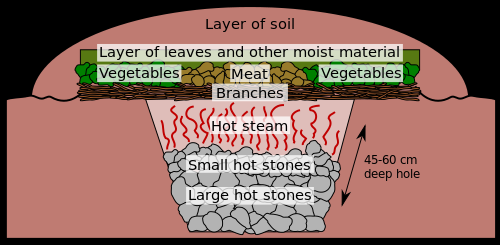
A hand-drawn picture of an earth oven, used too by the Maori. Credit: Wikipedia

(Phys.org)—A New Zealand research team hopes to retrieve missing parts of a puzzle about the Earth's magnetic field and changes to it over time. Grabbing their attention are the stones that line Maori steam ovens. They want to learn more about how those ovens may give them missing data about the magnetic field. The idea is that the cooking process generates so much heat that the magnetic minerals in these stones will realign themselves with the current field direction. Examining the stones may explain more about the Earth's magnetic behavior. The archaeological search in New Zealand is out to find sites containing the old "hangi" ovens.

Radiocarbon analysis of the charcoal left from the firewood used to light the oven may provide the date recovered with the . Dr. Gillian Turner of Victoria University, Wellington, New Zealand, recently discussed her project at the (AGU) Fall meeting. She told BBC News, "We have very good palaeomagnetic data from across the world recording field strength and direction - especially in the ." Nonetheless, the southwest Pacific is a gap that makes the global models incomplete. That is why she and her team are out looking for "good, high-resolved data from our part of the world."

To define changing directions and intensities, mathematical models require data from many points of the Earth's surface. Scientists focusing on the do so for fundamental reasons. "We use the magnetic field to navigate and it protects us from the solar wind. We still don't understand the origin of the field, but the geological record tells us that it changes its intensity on relatively short timescales and sometimes dramatically reverses its direction," she has written.

The first settlers on New Zealand were the Maori. They used steam ovens for cooking, in the form of placing hot stones, food and layers of fern fronds soaked in water into pits in the ground, then covered with soil, for several hours of cooking. They chose the stones carefully, including andesite boulders, considered ideal because fire could not crack or shatter them. Dr. Turner said they were also ideal for research purposes because they behave better magnetically.

She said by putting thermocouples in the stones the team found that the temperature got as high as 1,100C. "At that temperature, rock-forming minerals start to become plastic if not melt." A compass on top of the cooled hangi stones established that a re-magnetization had taken place.

Her team is also looking at other potential sources of information including volcanic rocks and lake sediments. Once the project is complete, Dr Turner hopes the research will help scientists to understand how the earth's magnetic field might change in the future.

Explore further: Voyager observes magnetic field fluctuations in heliosheath

More information: www.royalsociety.org.nz/2011/10/06/turner/

Related Stories

Geomagnetic storm subsiding

Apr 14, 2011

A geomagnetic storm that sparked auroras around the Arctic Circle and sent Northern Lights spilling over the Canadian border into the United States on April 12, 2011 is subsiding. NOAA forecasters estimate ...

More light shed on how pigeons navigate

Apr 27, 2012

(Phys.org) -- Pigeons are renowned for their ability to find their way home from a release point hundreds of miles away, but scientists have never fully understood how they are able to achieve the feat. Now ...

Lava flows reveal clues to magnetic field reversals

Sep 25, 2008

(PhysOrg.com) -- Ancient lava flows are guiding a better understanding of what generates and controls the Earth's magnetic field — and what may drive it to occasionally reverse direction.

Voyager observes magnetic field fluctuations in heliosheath

Oct 29, 2012

As they near the outer reaches of the solar system, for the past several years the two Voyager spacecraft have been sending back observations that challenge scientists' views of the physics at the edge of the heliosphere, ...

Recommended for you

Alaska volcano shoots ash 15,000 feet into the air

May 18, 2013

(AP)—One of Alaska's most restless volcanoes has shot an ash cloud 15,000 feet into the air in an ongoing eruption that has drawn attention from a nearby community but isn't expected to threaten air traffic.

NASA sees Cyclone Mahasen hit Bangladesh

May 17, 2013

NASA's Tropical Rainfall Measuring Mission satellite known as TRMM measured Cyclone Mahasen's rainfall rates from space as it made landfall on May 16. Mahasen has since dissipated over eastern India.

Rapid climate change ruled out ice age trees

May 17, 2013

Short, sharp fluctuations in the Earth's climate throughout the last ice age may have stopped trees from getting a foothold in Europe and northern Asia, scientists say.

User comments : 5

Adjust slider to filter visible comments by rank

Display comments: newest first

WirelessPhil
1 / 5 (4) Dec 09, 2012
I doubt this will work. When magnets or magnetic rocks are heated, like in this fire, they lose their magnetization.
Torbjorn_Larsson_OM
1 / 5 (2) Dec 09, 2012
Turner is overreaching. The magnetic field is what protects ISS LEO astronauts from the solar wind, in our case the atmosphere seems to be the sufficient protection (compare almost field less Venus).

@ WP: They did find a resulting re-magnetization. I suspect not all grains will demagnetize, too uneven temp.
Doug_Huffman
5 / 5 (4) Dec 09, 2012
I doubt this will work. When magnets or magnetic rocks are heated, like in this fire, they lose their magnetization.
That may be true, Phil. While they are hot the magnetic domains realign with what ever field is present, losing their previous alignment. In this case it is the Earth's field that is frozen into the rocks when they cool. Precisely the data sought.
Torbjorn_Larsson_OM
5 / 5 (2) Dec 09, 2012
Ah yes, thanks Doug!
Caliban
1 / 5 (2) Dec 09, 2012
Still, useless for assessing paleomagnetism further back than one to two thousand years, if that much. Probably no further back than the last time the firepit was used --say, Superbowl XLVI?

Probably have better luck using the sedimentary record.

More news stories

Mice, gerbils perish in Russia space flight

A number of mice and eight gerbils sent into space in a Russian capsule destined to find out how well organisms can withstand extended flights perished during their journey, scientists said Sunday as the ...

Bold action, big money needed to curb Asia floods

Asia's flood-prone megacities should fund major drainage, water recycling and waste reduction projects to stem deluges and secure clean supply for their booming populations, experts said Sunday.

Honeybees trained in Croatia to find land mines

(AP)—Mirjana Filipovic is still haunted by the land mine blast that killed her boyfriend and blew off her left leg while on a fishing trip nearly a decade ago. It happened in a field that was supposedly ...

Heat-related deaths in Manhattan projected to rise

Residents of Manhattan will not just sweat harder from rising temperatures in the future, says a new study; many may die. Researchers say deaths linked to warming climate may rise some 20 percent by the 2020s, ...