E-waste recycling—at whose expense?
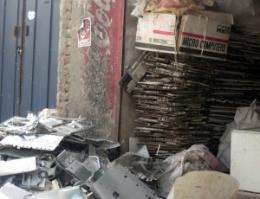
Dec 20, 2012
Globally, electronic waste is the fastest growing waste stream. 20-50 million computers become waste each year. According to recent estimations only 20 % of all e-waste is formally recycled. 80 % is shipped to developing countries where informal recycling processes are common.

Computers, tablets and mobile phones are all popular consumer products. The lifespan of these devices is usually short, between two to four years. Shakila Umair, researcher at KTH, travelled to Pakistan to see how these common electronic devices are dismantled and recycled. She investigated the harsh living conditions of people working with e-waste.

Shakila Umair, researcher at KTH Centre for Sustainable Communications, made two field trips to Pakistan to study how e-waste is actually taken care of. She conducted a "social " (s-LCA) on the social impacts of informal e-waste recycling in Pakistan.

"There are massive health and social problems connected to e- in Pakistan. At the same time it is the only source of livelihood for thousands of people", says Shakila Umair.

The assessment showed that the informal processes have a number of negative social and environmental impacts. Workers manually dismantle old equipment, burn wires to get copper and dip old circuit boards in acid to extract such as gold and silver. They inhale every day and lack awareness of the health risks.
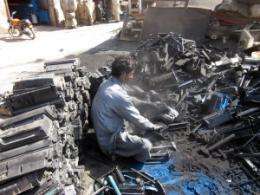
A man manually dismantling printers after which carcinogenic printer ink is left on the ground.

"Relatively small protective measures such as gloves and masks would easily make a big difference on the workers' health. But they cannot afford it themselves", says Shakila Umair.

Men, women and even children are working with e-waste up to twelve hours per day, six days a week, without social security or benefits. Their income is low, approximately 2.7 dollars per day (or less than 1.4 SEK per hour).
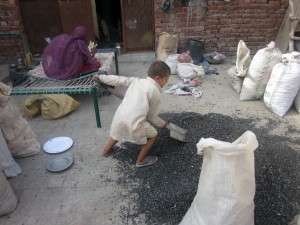
E-waste recycling--at whose expense?
Even children are working with e-waste recycling. Here a boy is shovelling capacitors removed from motherboards. The capacitors are processed for gold.

There are international regulations preventing the transfer of hazardous waste, such as e-waste from developed to less developed countries. But there are which result in a growing in e-waste. About 80% of all e-waste is shipped to developing countries where poor people recycle it manually at much lower cost than if it were recycled in more developed countries.

Recently, the regulations around e-waste have become stricter in both India and China. This means that more e-waste will end up in countries like Pakistan, Sri Lanka and Bangladesh with weaker legislation and authority control.

A boy burning wires for copper extraction.

Shakila Umair does not want to see a stop of e-waste treatment in Pakistan, since it is the livelihood for thousands of poor people. But e-waste treatment needs to be formalised, at least partially. What she asks for is that both local authorities and global ICT manufacturers take responsibility for the health and social situation of the workers in the informal e-waste economy.

"Why not include the conditions of these 'distant workers' in the Corporate Social Responsibility policies of global ICT suppliers?" concludes Shakila Umair.

Explore further: Pinpointing how nature's benefits link to human well-being

More information: Umair, S., Björklund, A., Ekener Petersen, E. (2013) Social Life Cycle Inventory and Impact Assessment of Informal recycling of Electronic ICT Waste in Pakistan. Conference paper to be presented at the First International ICT for Sustainability Conference (ICT4S), Zurich, 14-16 February 2013.
cesc.kth.se/wp-content/uploads/2013-Conference-paper-Social-LCA-Pakistan.pdf

Provided by KTH Centre of Excellence for Sustainable Communications

not rated yet
add to favorites email to friend print save as pdf

Related Stories

Africa to generate more e-waste than Europe by 2017

Mar 15, 2012

Better known as a dumping ground for used electronic goods from developed countries, Africa is set to outstrip Europe in the volumes of e-waste it generates within five years, experts said Thursday.

E-waste trade ban won't end environmental threat

Mar 22, 2010

A proposal under debate in the U.S. Congress to ban the export of electronics waste would likely make a growing global environmental problem even worse, say authors of an article from the journal Environmental Science an ...

Recommended for you

Century-old science helps confirm global warming

13 hours ago

(Phys.org) —Ocean measurements taken more than 135 years ago during the scientific expedition of HMS Challenger have provided further confirmation of human-produced global warming over the past century.

Be prepared for weather extremes

15 hours ago

Unsettled weather is an Iowa mainstay, and so is Inside's annual reminder of the university's severe weather safety and preparedness guidelines—for storms, extreme heat, flooding and more.

User comments : 1

Adjust slider to filter visible comments by rank

Display comments: newest first

WR3A
not rated yet Dec 28, 2012
There is a significant factual error in the article. "About 80% of all e-waste is shipped to developing countries where poor people recycle it manually at much lower cost than if it were recycled in more developed countries." There is no source given, the organization which has distributed it in the past has disowned it. Three peer reviewed studies found 85%, 87%, and 90% of imports were working or repairable (especially display devices, which do not follow Moore's law but are "upgraded" in wealthy nations). The article is strongest when it advocates for better workplace safety standards (already a known issue in textile manufacturing, etc. and certainly a concern in "e-waste"). But the UNEP and others have clearly shown that most of the obsolete equipment in emerging markets is generated by their own consumers, and the 80% junk exports is a myth. A scientific journal like this should elevate the discussion. visit the Fair Trade Recycling group on Facebook for other ideas.

More news stories

A hidden population of exotic neutron stars

(Phys.org) —Magnetars – the dense remains of dead stars that erupt sporadically with bursts of high-energy radiation - are some of the most extreme objects known in the Universe. A major campaign using ...

Hubble reveals the ring nebula's true shape

(Phys.org) —The Ring Nebula's distinctive shape makes it a popular illustration for astronomy books. But new observations by NASA's Hubble Space Telescope of the glowing gas shroud around an old, dying, ...

NASA head views progress on asteroid lasso mission

Surrounded by engineers, NASA chief Charles Bolden inspected a prototype spacecraft engine that could power an audacious mission to lasso an asteroid and tow it closer to Earth for astronauts to explore.

Controlling mood through the motions of mitochondria

(Medical Xpress)—Regulating the distribution of power in neurons is done by a system that makes the national electric grid look simple by comparison. Each neuron has several thousand mitochondria confined ...

A quantum simulator for magnetic materials

Physicists understand perfectly well why a fridge magnet sticks to certain metallic surfaces. But there are more exotic forms of magnetism whose properties remain unclear, despite decades of intense research. ...