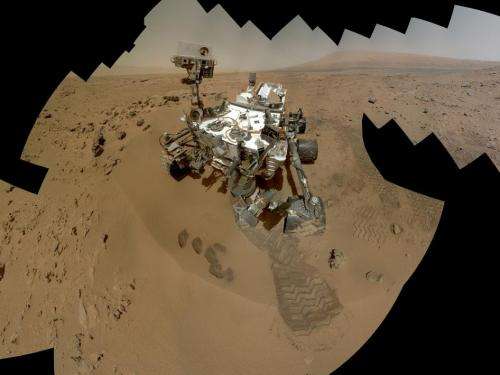
Curiosity self-portrait, wide view
Dec 27, 2012
Credit: NASA/JPL-Caltech/MSSS

(Phys.org)—On the 84th and 85th Martian days of the NASA Mars rover Curiosity's mission on Mars (Oct. 31 and Nov. 1, 2012), NASA's Curiosity rover used the Mars Hand Lens Imager (MAHLI) to capture dozens of high-resolution images to be combined into self-portrait images of the rover.

The mosaic shows the rover at "Rocknest," the spot in Gale Crater where the mission's first scoop sampling took place. Four scoop scars can be seen in the in front of the rover. A fifth scoop was collected later.

Self-portraits like this one document the state of the rover and allow mission engineers to track changes over time, such as dust accumulation and wheel wear. Due to its location on the end of the , only MAHLI (among the rover's 17 cameras) is able to image some parts of the craft, including the port-side wheels.

Explore further: The Curiosity rover's ultimate self-portrait

add to favorites email to friend print save as pdf

Related Stories

The Curiosity rover's ultimate self-portrait

Nov 02, 2012

OK, we thought the low-resolution self-portrait from yesterday was great… but here's the real goods: a monster, high-resolution awesome mosaic of 55 images taken by the Mars Hand Lens Imager (MAHLI), sh ...

First color image of Mars returned from Curiosity

Aug 07, 2012

(Phys.org) -- This view of the landscape to the north of NASA's Mars rover Curiosity was acquired by the Mars Hand Lens Imager (MAHLI) on the afternoon of the first day after landing. (The team calls this ...

Mars rover self-portrait shoot uses arm choreography

Dec 12, 2012

(Phys.org)—The robotic arm on NASA's Mars rover Curiosity held the rover's Mars Hand Lens Imager (MAHLI) camera in more than 50 positions in one day to generate a single scene combining all the images, ...

Curiosity preparing for second scoop

Oct 15, 2012

On Sol 65 (Oct. 11, 2012) of the Mars Science Laboratory mission, NASA's Mars rover Curiosity completed several activities in preparation for collecting its second scoop of soil. Like the first scoop, the ne ...

Recommended for you

Research team explains 'Lazarus' comets

2 hours ago

Astronomers from the University of Antioquia have discovered a graveyard of comets. These once-dormant comets, dubbed by astronomers as "The Lazarus comets," are now rejuvenated.

NASA ships sensors for seafaring satellite to France

3 hours ago

(Phys.org) —Three NASA-built instruments that are integral components of the next in a series of U.S./European ocean altimetry satellites have arrived in France for integration with their spacecraft in ...

Trip into space with DiCaprio costs $1.55m

3 hours ago

Leonardo DiCaprio is going to get closer to stars of a different kind as he heads into space aboard the Virgin Galactic, and a well-heeled bidder at the Cannes Film Festival has paid 1.2 million euros (1.5 million) to be ...

User comments : 2

Adjust slider to filter visible comments by rank

Display comments: newest first

scidog
5 / 5 (1) Dec 28, 2012
is there enough detail to see where the bits of plastic came off that were on the surface in some photos?
ValeriaT
3 / 5 (2) Dec 28, 2012
The terrestrial photos don't work. We apparently need ten billion dollars for another rover on Mars for achieving of higher quality portraits with Mars background.

More news stories

Source of life running out: water scientists

The majority of people on Earth people will face severe water shortages within a generation or two if pollution and waste continues unabated, scientists warned at a conference in Bonn Friday.

A hidden population of exotic neutron stars

(Phys.org) —Magnetars – the dense remains of dead stars that erupt sporadically with bursts of high-energy radiation - are some of the most extreme objects known in the Universe. A major campaign using ...