Storms, ozone, vegetation and more: NASA-NOAA Suomi NPP satellite returns first year of data
Nov 08, 2012 by Laura Betz
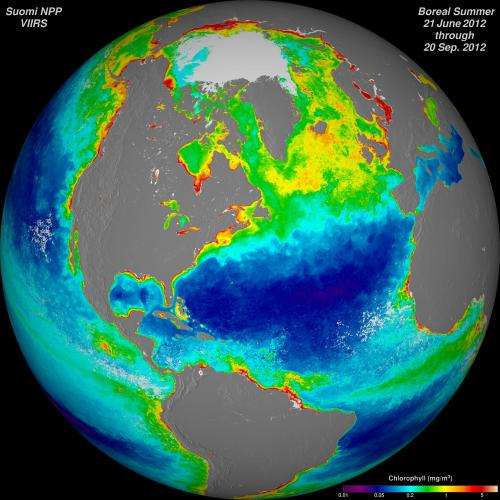
Northern hemisphere: Image of season-long composites of ocean chlorophyll concentrations derived from visible radiometric measurements made by the VIIRS instrument on Suomi NPP. The date ranges of the two composites are included in the individual images. These false-colored images make the data stand out. The purple and blue colors represent lower chlorophyll concentrations. The oranges and reds represent higher chlorophyll concentrations. These differences in color indicate areas with lesser or greater phytoplankton biomass. Credit: NASA/Suomi NPP/Norman Kuring

On Oct. 28, 2011, the Suomi National Polar-orbiting Partnership (NPP) satellite successfully blasted into orbit in a spectacular night launch from Vandenberg Air Force Base, Calif. Now, Suomi NPP has orbited the Earth more than 5,000 times and begun returning images and data that provide critical weather and climate measurements of the complex Earth system.

"The Suomi NPP flight and ground teams have spent the first year making sure the spacecraft, instruments and data products are working well. As the instruments and data products have successfully checked out, the data go out to users," says James Gleason, Suomi NPP project scientist at NASA's Goddard Space Flight Center in Greenbelt, Md.

"These data help us improve our computer models that predict future environmental conditions," Gleason adds. "Better predictions let us make better decisions, whether it is as simple as taking an umbrella to work today or as complex as responding to a changing climate."

Suomi NPP observes Earth's surface twice every day, once in daylight and once at night. The spacecraft flies 512 miles (824 kilometers) above the surface in a , circling the planet about 14 times a day. Suomi NPP sends its data once an orbit to the ground station in Svalbard, Norway, and continuously to local direct broadcast users.

Named for satellite meteorology pioneer Verner Suomi, the Suomi NPP mission is managed by NASA with the (NOAA) providing operational support and NOAA's Joint System (JPSS) managing the satellite's ground system.
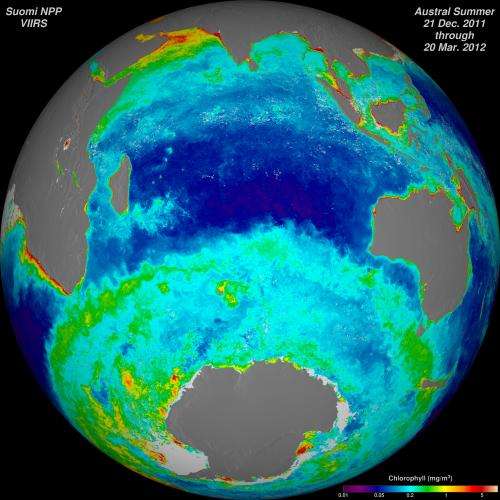
Southern hemisphere: Image of season-long composites of ocean chlorophyll concentrations derived from visible radiometric measurements made by the VIIRS instrument on Suomi NPP. The date ranges of the two composites are included in the individual images. These false-colored images make the data stand out. The purple and blue colors represent lower chlorophyll concentrations. The oranges and reds represent higher chlorophyll concentrations. These differences in color indicate areas with lesser or greater phytoplankton biomass. Credit: NASA/Suomi NPP/Norman Kuring

"Suomi NPP provides NOAA with the highest quality satellite data for critical operational products and services, such as weather forecasts, climate and ecosystem assessments," says Mitch Goldberg, NOAA's JPSS program scientist. NPP is the precursor satellite for the upcoming series of JPSS Earth-observing satellites.

What makes Suomi NPP such a powerful tool is the wide range of important observations it makes with its five instruments. These instruments send back data that allow scientists to see the entire globe from space and further understand oceans, clouds, ozone, snow, ice, vegetation and atmosphere.

Suomi NPP's five instruments include:

This year VIIRS left the world in awe with a spectacular composite image of our planet that became known as the 'blue marble,' OMPS took its first measurements of the annual ozone hole, ATMS data are now being used to make weather forecasts, and CrIS data are just about ready to be used in weather forecasts. The CERES data are being matched to that of its sibling instruments on NASA's Earth Observing System satellites Terra and Aqua with the goal of understanding clouds and the Earth's energy balance.

"Suomi NPP is a foundational satellite that offers an abundance of observations, plus it's sustaining a program of advanced observations," says Goldberg. "This is critical for long-term data continuity."

This fully functional bridges more than a decade of observations by NASA satellites—NASA's Earth Observing System—to the next generation of U.S. Earth-observing satellites—JPSS.

JPSS, currently under development, is building on the success of Suomi NPP and will provide critical observations for accurate weather forecasting, reliable severe storm outlooks, and climate science, including global measurements of atmospheric, oceanic, and terrestrial conditions such as sea surface temperatures, ozone, vegetation, and more.

Explore further: Satellite captures Hurricane Sandy's Mid-Atlantic blackout

More information: More images: www.flickr.com/photos/gsfc/sets/72157627439487497/
www.nasa.gov/npp

add to favorites email to friend print save as pdf

Related Stories

Infrared sounder on NASA's suomi NPP starts its mission

Feb 09, 2012

(PhysOrg.com) -- A powerful new infrared instrument, flying on NASA's newest polar-orbiting satellite, designed to give scientists more refined information about Earth's atmosphere and improve weather forecasts ...

NPP satellite successfully completes thermal vac testing

May 25, 2011

The NASA National Polar-orbiting Operational Environmental Satellite System (NPOESS) Preparatory Project (NPP) climate and weather satellite has successfully passed all environmental testing with the recent completion of ...

NASA's NPP satellite acquires first VIIRS image

Nov 22, 2011

The Visible Infrared Imager Radiometer Suite (VIIRS) onboard NASA's newest Earth-observing satellite, NPP, acquired its first measurements on Nov. 21, 2011. This high-resolution image is of a broad swath of ...

Recommended for you

Mars rover Opportunity examines clay clues in rock

17 hours ago

(Phys.org) —NASA's senior Mars rover, Opportunity, is driving to a new study area after a dramatic finish to 20 months on "Cape York" with examination of a rock intensely altered by water.

NASA's STEREO detects a CME from the sun

May 17, 2013

On 5:24 a.m. EDT on May 17, 2013, the sun erupted with an Earth-directed coronal mass ejection or CME, a solar phenomenon that can send billions of tons of solar particles into space that can reach Earth ...

Nine-year-old Mars rover passes 40-year-old record

May 17, 2013

While Apollo 17 astronauts Eugene Cernan and Harrison Schmitt visited Earth's moon for three days in December 1972, they drove their mission's Lunar Roving Vehicle 19.3 nautical miles (22.210 statute miles ...

Bright explosion on the Moon

May 17, 2013

For the past 8 years, NASA astronomers have been monitoring the Moon for signs of explosions caused by meteoroids hitting the lunar surface. "Lunar meteor showers" have turned out to be more common than anyone ...

User comments : 0

More news stories

Galaxy's Ring of Fire

Johnny Cash may have preferred this galaxy's burning ring of fire to the one he sang about falling into in his popular song. The "starburst ring" seen at center in red and yellow hues is not the product of ...

Alaska volcano shoots ash 15,000 feet into the air

(AP)—One of Alaska's most restless volcanoes has shot an ash cloud 15,000 feet into the air in an ongoing eruption that has drawn attention from a nearby community but isn't expected to threaten air traffic.

Chinese, Indian airlines face EU pollution fines

Eight Chinese and two Indian airlines face fines of up to several million euros for not paying for their greenhouse gas emissions during flights within the bloc, the European Commission said on Friday.

Morocco to harness the wind in energy hunt

Morocco is ploughing ahead with a programme to boost wind energy production, particularly in the southern Tarfaya region, where Africa's largest wind farm is set to open in 2014.

US seizes Bitcoin operator accounts

US authorities seized the accounts of a Bitcoin digital currency exchange operator, claiming it was functioning as an "unlicensed money service business," court documents showed Friday.