The Curiosity rover's ultimate self-portrait

Nov 02, 2012 by Nancy Atkinson, Universe Today
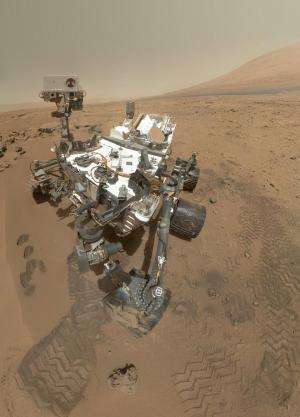
The Curiosity rover self portrait. Credit: NASA/JPL-Caltech/Malin Space Science Systems

OK, we thought the low-resolution self-portrait from yesterday was great… but here's the real goods: a monster, high-resolution awesome mosaic of 55 images taken by the Mars Hand Lens Imager (MAHLI), showing the rover at its spot in Gale Crater—called Rocknest—with the base of Gale Crater's 5-kilometer- (3-mile-) high mountain, Aeolis Mons or Mount Sharp, rising in the background. The images were taken on Sol 84 (Oct. 31, 2012), and sent to Earth today. In the foreground, four scoop scars can be seen in the regolith in front of the rover.

You can get access to the full resolution version at this link. It's amazing.

But that's not all…

says that self-portraits like this one document the state of the and allow mission engineers to track changes over time, such as dust accumulation and wheel wear. Due to its location on the end of the , only MAHLI (among the rover's 17 cameras) is able to image some parts of the craft, including the port-side wheels.

Emily Lakdawalla at the Planetary Blog talks about the projection issue, where the wheel closest to the front looks big and distorted. That's a factor of the camera angle and Emily mentions a discussion of this is taking place by the image wizards over at Unmanned Spaceflight, if you want to see the various ways to deal with this issue.

Emily also points out how the rover photographed itself photographing itself—due to the reflective surfaces on the turret, so check out her analysis.

You can always see the raw images coming in from Curiosity at this NASA website.

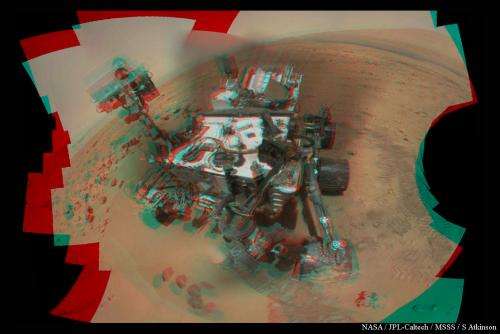
But the other cool thing is that another whole set of images was taken from a slightly different angle, which means only one thing: 3-D! Here's Stu Atkinson's first quick attempt:

Credit: NASA/JPL-Caltech

There will surely be some refinements of the 3-D version, but enjoy this one for now!
Explore further: First color image of Mars returned from Curiosity

add to favorites email to friend print save as pdf

Related Stories

First color image of Mars returned from Curiosity

Aug 07, 2012

(Phys.org) -- This view of the landscape to the north of NASA's Mars rover Curiosity was acquired by the Mars Hand Lens Imager (MAHLI) on the afternoon of the first day after landing. (The team calls this ...

Curiosity snaps evocative self portrait

Sep 10, 2012

Curiosity has snapped an evocative new color self-portrait – and it's totally unique, being the 1st head shot pose, showing the top of the Remote Sensing Mast (RSM).

Curiosity preparing for second scoop

Oct 15, 2012

On Sol 65 (Oct. 11, 2012) of the Mars Science Laboratory mission, NASA's Mars rover Curiosity completed several activities in preparation for collecting its second scoop of soil. Like the first scoop, the ne ...

New Mars rover sends higher-resolution image

Aug 06, 2012

(Phys.org) -- About two hours after landing on Mars and beaming back its first image, NASA's Curiosity rover transmitted a higher-resolution image of its new Martian home, Gale Crater. Mission Control at ...

Mars rover Curiosity's arm wields camera well

Sep 11, 2012

(Phys.org)—NASA's Mars rover Curiosity stepped through activities on Sept. 7, 8 and 9 designed to check and characterize precision movements by the rover's robotic arm and use of tools on the arm.

Mars rover Curiosity beams back images showing its descent

Aug 07, 2012

(Phys.org) -- Earlier today, just hours after NASA's Curiosity rover landed on Mars, a select group of images taken by the onboard Mars Descent Imager, or MARDI, were beamed back to Earth. The 297 color, low-resolution ...

Recommended for you

NASA's IRIS mission readies for a new challenge

1 hour ago

(Phys.org) —The time draws near. NASA is getting ready to launch a new mission, a mission to observe a largely unexplored region of the solar atmosphere that powers its dynamic million-degree outer atmosphere and drives ...

Building a better team—on Mars

21 hours ago

Sometime in the next quarter-century, NASA plans to send the first humans to Mars, a mission that will push the boundaries of teamwork for a handful of astronauts who will spend as long as three years together ...

User comments : 1

Adjust slider to filter visible comments by rank

Display comments: newest first

ScottyB
not rated yet Nov 02, 2012
That is cool as!

More news stories

NASA's IRIS mission readies for a new challenge

(Phys.org) —The time draws near. NASA is getting ready to launch a new mission, a mission to observe a largely unexplored region of the solar atmosphere that powers its dynamic million-degree outer atmosphere and drives ...

Explainer: Why are tornadoes so destructive?

Tornadoes are a part of life for people living in the Great Plains of the United States. In Oklahoma, a state that averages 62 tornadoes a year, people are prepared as best as they can be and are well warned.

Could pond waste be the 'new' fertiliser?

The University of Stirling is to lead a new project to develop a strategy for using nutrient-rich aquatic biomass waste – from ponds, wetlands and other water-bodies – in farming, as an environmentally ...

Theorists weigh in on where to hunt dark matter

(Phys.org) —Now that it looks like the hunt for the Higgs boson is over, particles of dark matter are at the top of the physics "Most Wanted" list. Dozens of experiments have been searching for them, but ...

Coral reefs 'ruled by earthquakes and volcanoes'

(Phys.org) —Titanic forces in the Earth's crust explain why the abundance and richness of corals varies dramatically across the vast expanse of the Indian and Pacific Oceans, a world-first study from the ...