Astronauts touch down in chilly Kazakhstan steppe
Nov 19, 2012 by Peter Leonard
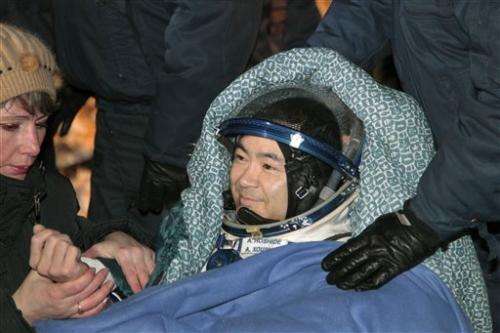
Japanese astronaut Aki Hoshide smiles after landing in a Soyuz capsule outside the town of Arkalyk, Kazakhstan, on Monday, Nov. 19, 2012. Hoshide along with NASA's Sunita Williams, and Russian astronaut Yury Malenchenko touched down in the dark, chilly expanses of central Kazakhstan onboard a Soyuz capsule Monday after a 125-day stay at the International Space Station. (AP Photo/Maxim Shipenkov)

Three astronauts touched down in the dark, chilly expanses of central Kazakhstan onboard a Soyuz capsule Monday after a 125-day stay at the International Space Station.

NASA's Sunita Williams, Russian astronaut Yury Malenchenko and Aki Hoshide of Japan's JAXA space agency landed at 07:56 a.m. local time (0156 GMT) northeast of the town of Arkalyk.

Eight helicopters rushed search-and-recovery crew to assist the crew, whose capsule did not parachute onto the exact planned touchdown site due to a minimal delay in procedures.

With the departure of the outgoing crew, NASA astronaut Kevin Ford has taken command of the space station, where he remains with Russian colleagues Oleg Novitsky and Yevgeny Tarelkin. They will be joined next month by NASA's Tom Marshburn, Chris Hadfield of the , and Russia's Roman Romanenko.

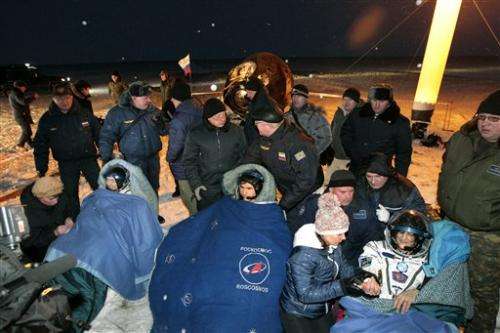
International Space Station crew members Russian astronaut Yury Malenchenko, center, U.S. astronaut Sunita Williams, right, and Japanese astronaut Aki Hoshide, left, rest shortly after landing in a Soyuz capsule outside the town of Arkalyk, Kazakhstan, on Monday, Nov. 19, 2012. The three astronauts touched down in the dark, chilly expanses of central Kazakhstan onboard a Soyuz capsule Monday after a 125-day stay at the International Space Station. (AP Photo/Maxim Shipenkov)

The Soyuz is the only means for international astronauts to reach the orbiting laboratory since the decommissioning of the U.S. shuttle fleet in 2011.

Williams, Malenchenko and Hoshide undocked from the space station Sunday at 1023 GMT to begin their return to earth.

Around 28 minutes before touchdown, the three modules of the Soyuz craft separated, leaving the 2.1-meter tall capsule to begin its entry into orbit.

A series of parachutes deployed to bring the capsule to gentle floating speed.
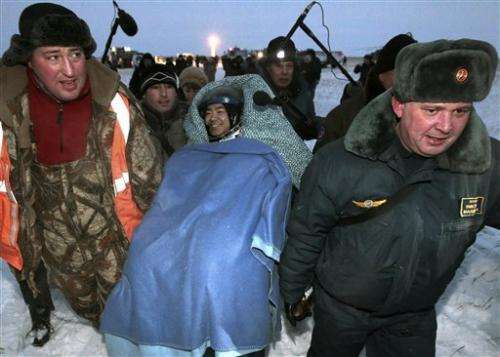
Members of the ground rescue team carry International Space Station crew member Aki Hoshide, of Japan, center, shortly after landing near the town of Arkalyk, Kazakhstan, on Monday, Nov. 19, 2012. Hoshide, NASA's Sunita Williams, and Russian astronaut Yury Malenchenko touched down in the dark, chilly expanses of central Kazakhstan onboard a Soyuz capsule Monday after a 125-day stay at the International Space Station. (AP Photo/Maxim Shipenkov)

Winds pulled the descent module on its side in the snowy terrain, which is a common occurrence, but the crew was nonetheless swiftly hoisted out by the recovery crew and lifted onto reclining chairs and swaddled in blankets to shield them from the 12 Fahrenheit degree (-11 Celsius degree) temperature.

The chairs are designed to afford the astronauts comfortable acclimatization after months of living in gravity-free conditions.

"For me, everything was very good," a smiling Williams told recovery staff, speaking in Russian.

Malenchenko has now spent 642 days in space, making him the sixth most experienced space traveler in history.

Williams has a spent a total of 322 days in space over two missions. She and Hoshide conducted a crucial spacewalk earlier this month to work on a leaky radiator system outside the space station.

That took Williams' total cumulative spacewalk time to 50 hours and 40 minutes—a record for a female astronaut.
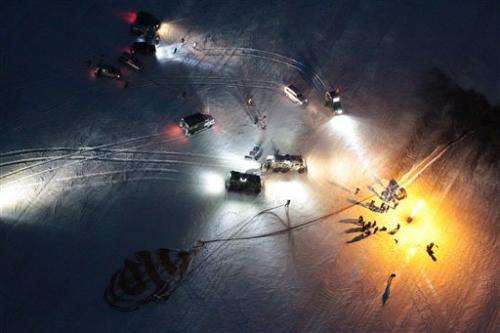
A Russian Soyuz TMA-05M spacecraft, right, lays on the ground as members of a rescue team stand nearby after it landed in a remote area near the town of Arkalyk, Kazakhstan, on Monday, Nov. 19, 2012. Three astronauts touched down in the dark, chilly expanses of central Kazakhstan onboard the Soyuz capsule Monday after a 125-day stay at the International Space Station. (AP Photo/Maxim Shipenkov)

NASA says the returning expedition conducted a range of scientific experiments while at the , included testing radiation levels on the orbiting outpost, assessing the effects of microgravity on the spinal cord, and investigating melting glaciers, seasonal changes and human impacts on the ecosystem.

The was to be taken to the town of Kostanai, from where Williams and Hoshide would board a Gulfstream jet for a trip to Houston, Texas, while Malenchenko was to return to a Russian space facility outside Moscow.

NASA footage showed celebrating recovery workers at the landing site erecting a sign marking the successful touchdown.

Explore further: Soyuz crew ready for heavy space station workload

4.8 /5 (4 votes)
add to favorites email to friend print save as pdf

Related Stories

US, Russian space trio lands in Kazakhstan

Sep 17, 2012

An international three-man crew onboard a Russian-made Soyuz capsule touched down successfully on the cloudless central Kazakhstan steppe Monday morning after 123 days at the International Space Station.

Soyuz spacecraft lands safely in Kazakhstan

Jul 01, 2012

A Soyuz space capsule carrying a three-man multinational crew touched down safely Sunday on the southern steppes of Kazakhstan, bringing an end to their 193-day mission to the International Space Station.

Soyuz with astronauts docks with space station

Oct 25, 2012

(AP)—A Russian Soyuz spacecraft carrying three astronauts and a consignment of fish successfully docked Thursday with the International Space Station after a two-day voyage.

Soyuz rocket launches on mission to space station

Jul 15, 2012

A Russian Soyuz craft launched into the morning skies over Kazakhstan on Sunday, carrying three astronauts on their way to the International Space Station, where they will quickly start preparing for a frenzy ...

Recommended for you

Forecast for Titan: Wild weather could be ahead

1 hour ago

(Phys.org) —Saturn's moon Titan might be in for some wild weather as it heads into its spring and summer, if two new models are correct. Scientists think that as the seasons change in Titan's northern hemisphere, ...

SDO observes mid-level solar flare

2 hours ago

UPDATE 16:30 p.m. EDT: The M7-class flare was also associated with a coronal mass ejection or CME, another solar phenomenon that can send billions of tons of particles into space. While this CME was not Ea ...

NASA's IRIS mission readies for a new challenge

11 hours ago

(Phys.org) —The time draws near. NASA is getting ready to launch a new mission, a mission to observe a largely unexplored region of the solar atmosphere that powers its dynamic million-degree outer atmosphere and drives ...

User comments : 1

Adjust slider to filter visible comments by rank

Display comments: newest first

theskepticalpsychic
not rated yet Nov 20, 2012
Um, picture blurb writer person: "The Russian Soyuz TMA-05M spacecraft, right, lays on the ground"? Really? It "lays" on the ground? You mean it deposits eggs in the cold soil? Has sex? What? Oh. Oh, you mean it LIES on the ground. Whew. Nothing like scientific rigor!

More news stories

Forecast for Titan: Wild weather could be ahead

(Phys.org) —Saturn's moon Titan might be in for some wild weather as it heads into its spring and summer, if two new models are correct. Scientists think that as the seasons change in Titan's northern hemisphere, ...

NASA's Landsat satellite looks for a cloud-free view

For decades, Landsat satellites have documented the desiccation of the Aral Sea in Central Asia. Once one of the largest seas in the world, it shrunk to a tenth of its original volume after Russia diverted ...

SDO observes mid-level solar flare

UPDATE 16:30 p.m. EDT: The M7-class flare was also associated with a coronal mass ejection or CME, another solar phenomenon that can send billions of tons of particles into space. While this CME was not Ea ...

FDA panel backs experimental Merck insomnia drug

(AP)—A federal panel of medical experts says that an experimental insomnia drug from Merck & Co Inc. appears safe and effective, despite evidence from company trials that the pill can cause daytime sleepiness and difficulty ...