The Orionid meteor shower
Oct 15, 2012 by Dr. Tony Phillips
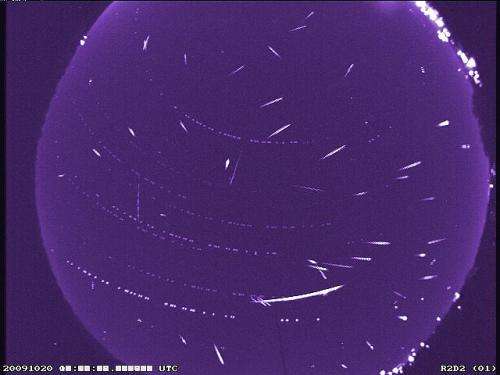
This composite, false-color image shows the Orionids meteor shower, as seen in the skies over Huntsville, Ala. in late October, 2009. Credit: NASA/MSFC

Usually, waking up before sunrise is a good way to get a head start on the day. On Oct. 21st, waking up early could stop you in your tracks.

Blame Halley's Comet. Every year in mid-to-late October, Earth passes through a stream of dusty debris from Comet Halley, and the pre-dawn sky lights up with a pretty display of .

"We expect to see about 25 per hour when the shower peaks on Sunday morning, Oct 21st," says Bill Cooke, the head of NASA's Environment Office. "With no Moon to spoil the show, observing conditions should be ideal."

Because these meteors streak out of the , astronomers call them "Orionids."

"The isn't the strongest, but it is one of the most beautiful showers of the year," notes Cooke.

The reason is its setting: The shower is framed by some of the brightest stars and planets in the heavens. Constellations such as Taurus, Gemini and Orion provide a glittering backdrop for the display. But that's not all. This year, Venus and Jupiter have moved into position with Sirius, the Dog Star, to form a bright triangle in the eastern pre-dawn sky. On the morning of Oct 21st, blazing pieces of Halley's Comet will cut straight through the heart of this celestial triad.

To see the show, Cooke suggests going outside one to two hours before sunrise when the sky is dark and the constellation Orion is high overhead. Lie down on a blanket with a broad view of the heavens. Although Orionids emerge from a small area near the shoulder of Orion, they will spray across the entire sky.

"Be prepared for speed," he adds. "Meteoroids from Halley's Comet strike Earth's atmosphere traveling 148,000 mph. Only the November are faster."

Speed is important because fast meteors have a tendency to explode. Occasionally, Orionid fireballs will leave incandescent streams of debris in their wake that linger for minutes. Such filaments of meteor smoke twisted by into convoluted shapes can be even prettier than the meteors themselves.

"It really is a wonderful morning to be awake," says Cooke. "Just don't plan on going anywhere in a hurry."

Explore further: 2012 Perseid Meteor Shower

Related Stories

Weekend Orionid meteor shower

Oct 21, 2011

Earth is about to pass through a stream of debris from Halley's comet, source of the annual Orionid meteor shower. Forecasters expect more than 15 meteors per hour to fly across the sky on Saturday morning, ...

Orionids Meteor Shower Lights Up the Sky

Oct 21, 2009

Earth is currently passing through a stream of debris from Halley's Comet, lighting up the night sky with the "fireworks" of the annual Orionids meteor shower.

Orionid meteor shower peaks Wednesday

Oct 19, 2009

(PhysOrg.com) -- The annual Orionid meteor shower will peak in the hours before dawn on Oct. 21, according to the editors of StarDate magazine, who said the shower could produce up to 20 meteors per hour.

2012 Perseid Meteor Shower

Aug 10, 2012

On the nights of Aug. 11th through 13th, the best meteor shower of the year will fill pre-dawn skies with hundreds of shooting stars. And that's just for starters. The brightest planets in the solar system are lining up ...

Meteors from Halley's comet

Apr 28, 2011

Looking for an adventure? Get up in the wee hours of the morning May 6th and head out into the country, far from the city lights. You won't be alone. The birds will be up and singing about the coming dawn, ...

Saturday's Draconid meteors may be no-see-ums

Oct 05, 2011

(AP) -- Heads-up, meteor fans. As many as 750 meteors an hour are expected Saturday, as Earth travels through streams of dust and ice from Comet Giacobini-Zinner. The comet passes through the inner solar ...

Recommended for you

Dark, massive asteroid to fly by Earth on May 31

1 hour ago

It's 1.7 miles long. Its surface is covered in a sticky black substance similar to the gunk at the bottom of a barbecue. If it impacted Earth it would probably result in global extinction. Good thing it is ...

Research team explains 'Lazarus' comets

5 hours ago

Astronomers from the University of Antioquia have discovered a graveyard of comets. These once-dormant comets, dubbed by astronomers as "The Lazarus comets," are now rejuvenated.

NASA ships sensors for seafaring satellite to France

5 hours ago

(Phys.org) —Three NASA-built instruments that are integral components of the next in a series of U.S./European ocean altimetry satellites have arrived in France for integration with their spacecraft in ...

Trip into space with DiCaprio costs $1.55m

5 hours ago

Leonardo DiCaprio is going to get closer to stars of a different kind as he heads into space aboard the Virgin Galactic, and a well-heeled bidder at the Cannes Film Festival has paid 1.2 million euros (1.5 million) to be ...

User comments : 0

More news stories

Dark, massive asteroid to fly by Earth on May 31

It's 1.7 miles long. Its surface is covered in a sticky black substance similar to the gunk at the bottom of a barbecue. If it impacted Earth it would probably result in global extinction. Good thing it is ...

Source of life running out: water scientists

The majority of people on Earth people will face severe water shortages within a generation or two if pollution and waste continues unabated, scientists warned at a conference in Bonn Friday.