Britain grants first licence for badger cull
Sep 18, 2012
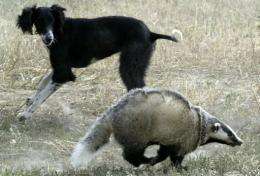
This picture taken in 2007 shows Kyrgyz hunters training a dog to hunt a badger. Up to 3,000 badgers could be killed in England after a government agency on Friday issued the first licence for a pilot cull in a bid to prevent the spread of tuberculosis in cattle.

Up to 3,000 badgers could be killed in England after a government agency on Friday issued the first licence for a pilot cull in a bid to prevent the spread of tuberculosis in cattle.

Natural England issued the licence to allow farmers in Gloucestershire, western England, to kill badgers, which are otherwise a protected species, on around 300 farms.

Farmers say the measure is required to tackle TB in because badgers spread the disease to livestock, costing livestock owners and the taxpayer millions of pounds a year.

The decision was greeted with dismay by the Royal Society for the Prevention of Cruelty to Animals (RSPCA), which called on the government to introduce a vaccination programme instead.

"It needs to look at the science and change their policy to one of vaccination—let's cure and not kill."

Asked if he thought the first pilot culling licence was a positive first step towards a more widespread cull in England, new Environment Secretary Owen Paterson said: "I very much hope so."

Explore further: Research suggests why bovine TB continues to spread

add to favorites email to friend print save as pdf

Related Stories

New thinking required on wildlife disease

Nov 29, 2011

A University of Adelaide scientist says much more could be done to predict the likelihood and spread of serious disease - such as tuberculosis (TB) or foot-and-mouth disease - in Australian wildlife and commercial ...

Research suggests why bovine TB continues to spread

May 22, 2012

The failure of the current bovine tuberculosis (TB) eradication programme could be partly due to a parasitic worm that hinders the tests used to diagnose TB in cows, according to new research published this week.

100,000 Egypt cattle hit by foot-and-mouth: vets

Mar 27, 2012

Nearly 100,000 head of cattle are believed to have been struck by foot-and-mouth disease in Egypt, where a major new outbreak is threatening the entire region, veterinary sources warned on Tuesday.

Recommended for you

Coccoliths thrive despite ocean acidification

1 hour ago

Ocean acidification is damaging some marine species while others thrive, say scientists. An international team studied the effect of ocean acidification on plankton in the North Sea over the past forty years, ...

Australia set to cull 10,000 wild horses

3 hours ago

A controversial cull of up to 10,000 wild horses in Australia's harsh Outback reportedly began Wednesday in a bid to control the feral animals which officials say are destroying the land.

Encouraging signs for bee biodiversity

9 hours ago

Declines in the biodiversity of pollinating insects and wild plants have slowed in recent years, according to a new study. Researchers led by the University of Leeds and the Naturalis Biodiversity Centre in the Netherlands ...

User comments : 3

Adjust slider to filter visible comments by rank

Display comments: newest first

NOM
not rated yet Sep 18, 2012
Couldn't they innoculate the badgers?
TrinityComplex
not rated yet Sep 18, 2012
It would be easier to vaccinate the livestock since their entire lives are closely controlled anyway.
TehDog
not rated yet Sep 18, 2012
NOM, there are badger vaccination programs, need to catch them first though.
Trinity, there isn't an approved vaccine for cattle yet.
For a cull to be successful, they need to stop new badgers from moving in.
Personally, I don't think culling is a long term solution, they'd need to totally exterminate the local population and prevent inward migration.

More news stories

Coral reefs 'ruled by earthquakes and volcanoes'

(Phys.org) —Titanic forces in the Earth's crust explain why the abundance and richness of corals varies dramatically across the vast expanse of the Indian and Pacific Oceans, a world-first study from the ...

Coccoliths thrive despite ocean acidification

Ocean acidification is damaging some marine species while others thrive, say scientists. An international team studied the effect of ocean acidification on plankton in the North Sea over the past forty years, ...

Strawberry fields forever and fungus-free

(Phys.org) —Strawberries are one of the most economically important berry crops in the world, and a high value export crop for the Australian horticultural industry.For the first time, researchers at The ...

Single-cell sequencing

When studying any kind of population—people or cells—averaging is a useful, if flawed, form of measurement. According to the US Census Bureau, the average American household size in 2010 was 2.59. Of ...

Theorists weigh in on where to hunt dark matter

(Phys.org) —Now that it looks like the hunt for the Higgs boson is over, particles of dark matter are at the top of the physics "Most Wanted" list. Dozens of experiments have been searching for them, but ...