Mars crater where rover landed looks 'Earth-like' (Update 2)
Aug 08, 2012 by ALICIA CHANG
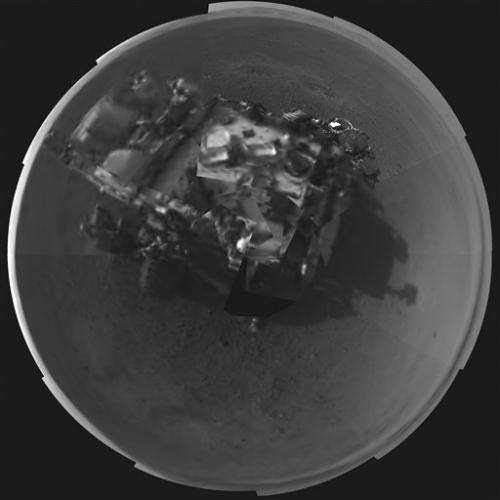
In this image released by NASA on Wednesday, Aug. 8, 2012, a self portrait of NASA's Curiosity rover was taken by its Navigation cameras, located on the now-upright mast. The camera snapped pictures 360-degrees around the rover. (AP Photo/NASA)

(AP) — The ancient Martian crater where the Curiosity rover landed looks strikingly similar to the Mojave Desert in California with its looming mountains and hanging haze, scientists said Wednesday.

"The first impression that you get is how Earth-like this seems looking at that landscape," said chief scientist John Grotzinger of the California Institute of Technology.

Overnight, the car-size rover poked its head out for the first time since settling in Gale Crater, peered around and returned a black-and-white self-portrait and panorama that's still being processed.

It provided the best view so far of its destination since touching down Sunday night after nailing an intricate choreography. During the last few seconds, a rocket-powered spacecraft hovered as cables lowered Curiosity to the ground.
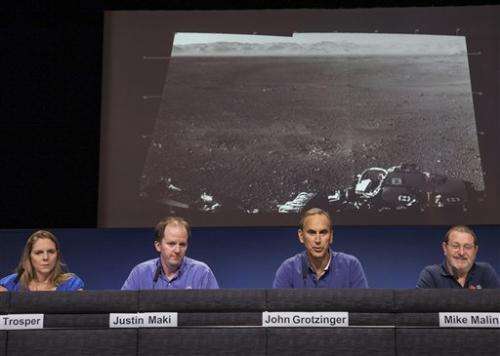
Mars Science Laboratory scientists from left: Jennifer Trosper, MSL Mission Manager, JPL; Justin Maki, MSL Imaging Scientist, JPL; John Grotzinger, MSL project scientist, Cal-Tech and Michael Malin, principal investigator, Mars Descent Imager on MSL, Malin Space Science Systems, discuss the Curiosity's images at NASA's Jet Propulsion Laboratory in Pasadena, Calif., Wednesday, Aug. 8, 2012. Top image is a mosaic of the first two full-resolution images of the Martian surface from the Navigation cameras on Curiosity. (AP Photo/Damian Dovarganes)

In the latest photos, Curiosity looked out toward the northern horizon. Nearby were scour marks in the surface blasted by thrusters, which kicked up a swirl of dust. There were concerns that Curiosity got dusty, but scientists said that was not the case.

"We do see a thin coating of dust, but nothing too bad," said Justin Maki, imaging scientist at NASA's Jet Propulsion Laboratory, which manages the $2.5 billion mission.

Scientists were giddy about the scour marks because they exposed bedrock below — information that should help them better understand the landing site.
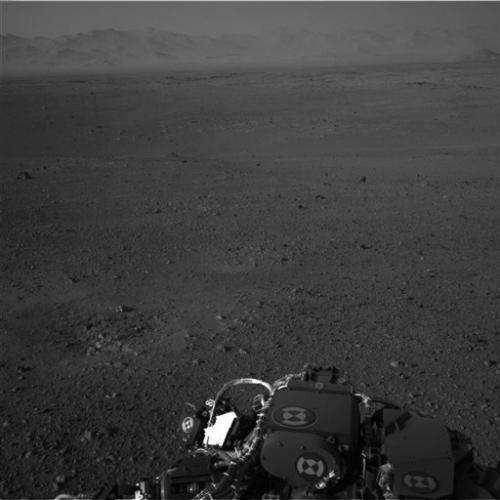
This image released by NASA on Wednesday Aug. 8, 2012 taken by cameras aboard the Curiosity rover shows the Martian horizon. It's one of dozens of images that will be made into a panorama. Curiosity landed on August 5, 2012 on a two-year mission to study whether its landing site ever could have supported microbial life. (AP Photo/NASA)

Since landing, Curiosity has zipped home a stream of low-resolution pictures taken by tiny cameras under the chassis and a camera at the end of its robotic arm, which remained stowed. It also sent back a low-quality video showing the last 2 1/2 minutes of its descent.

The rover successfully raised its mast packed with high-resolution and navigation cameras. With the mast up, it can begin its shutterbug days in force, including taking a 360-degree color view of its surroundings as early as Thursday.
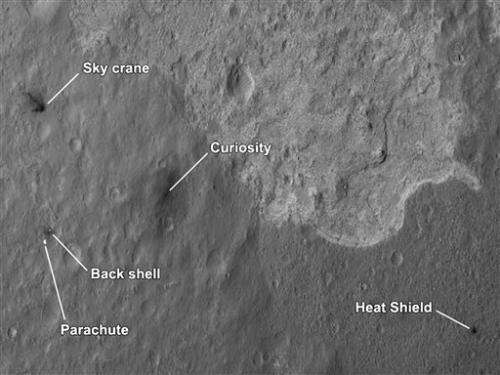
This image released by NASA on Tuesday Aug. 7, 2012 shows where Curiosity and its supporting hardware: Sky crane, Curiosity, Back shell, Parachute, and Heat Shield landed on the Martian surface after its successful landing last Sunday. (AP Photo/NASA)

Grotzinger said he was struck by the Martian landscape, which appeared diverse. There seemed to be harder material underneath the gravelly surface, he said.

"It kind of makes you feel at home," he said. "We're looking at a place that feels really comfortable."
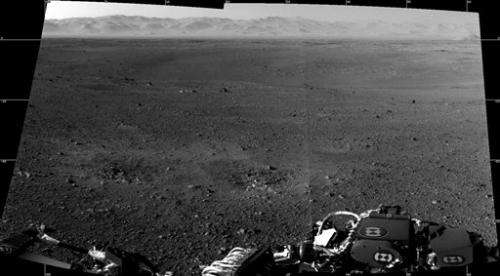
This image released on Wednesday Aug. 8, 2012 by NASA, shows a mosaic of the first two full-resolution images of the Martian surface from the Navigation cameras on NASA's Curiosity rover. The rim of Gale Crater can be seen in the distance beyond the pebbly ground. The foreground shows two distinct zones of excavation likely carved out by blasts from the rover's descent stage thrusters. (AP Photo/NASA)

Mars, of course, is very different from Earth. It's a frigid desert constantly bombarded by radiation. There are geological signs that it was a warmer and wetter place once upon a time. One of the mission's goals is to figure out how Mars transformed.

After sailing 352 million miles (566 million kilometers) and eight months, Curiosity parked its six wheels near the Martian equator, where it will spend the next two years poking into rocks and soil in search of the chemical ingredients of life. It is the most expensive and ambitious mission yet to Mars.
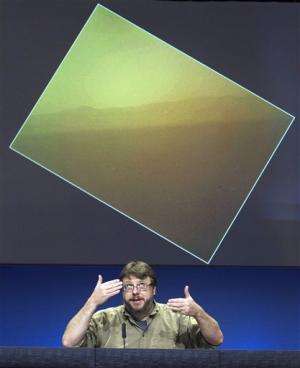
Ken Edgett, principal investigator, Malin Space Science Systems, describes the first view of the north wall and rim of Gale Crater, top, where NASA's rover Curiosity landed Sunday night, during a news briefing at NASA's Jet Propulsion Laboratory in Pasadena, Calif., Tuesday, Aug. 7, 2012. The picture was taken by the rover's camera at the end of its stowed robotic arm and appears fuzzy because of dust on the camera. (AP Photo/Damian Dovarganes)

Its ultimate destination is a mountain towering from the center of the crater floor. Preliminary estimates indicate Curiosity landed four miles away from the base of Mount Sharp, thought to contain intriguing signs of past water — a starting point to learning whether microbial life could exist.

Before the 1-ton, nuclear-powered Curiosity can start roving, it has to undergo several weeks of tedious but essential health checks.
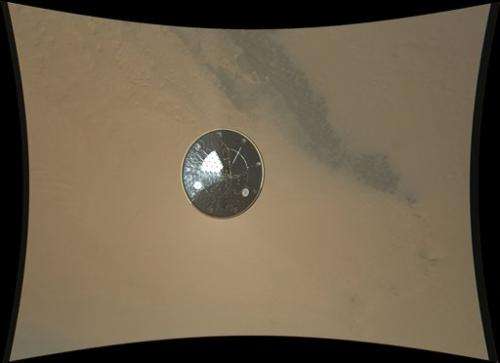
In this image released by NASA on Wednesday, Aug. 8, 2012, an image showing the heat shield of NASA's Curiosity rover, obtained during descent to the surface of Mars. The image was obtained by the Mars Descent Imager instrument known as MARDI and shows the 15-foot diameter heat shield when it was about 50 feet from the spacecraft. (AP Photo/NASA)

Since it was too heavy to land using traditional air bags, it used a heat shield, parachute, rockets and cables. An orbiting spacecraft spotted the discarded spacecraft hardware, including the ballast weights that were shed soon after atmosphere entry.

Explore further: New Mars rover sends higher-resolution image

4.7 /5 (3 votes)
add to favorites email to friend print save as pdf

Related Stories

New Mars rover sends higher-resolution image

Aug 06, 2012

(Phys.org) -- About two hours after landing on Mars and beaming back its first image, NASA's Curiosity rover transmitted a higher-resolution image of its new Martian home, Gale Crater. Mission Control at ...

Mars tugging on approaching Curiosity rover

Aug 05, 2012

(Phys.org) -- The gravitational tug of Mars is now pulling NASA's car-size geochemistry laboratory, Curiosity, in for a suspenseful landing in less than 40 hours.

Next Mars rover nears completion

Apr 07, 2011

(PhysOrg.com) -- Assembly and testing of NASA's Mars Science Laboratory spacecraft is far enough along that the mission's rover, Curiosity, looks very much as it will when it is investigating Mars.

First color image of Mars returned from Curiosity

Aug 07, 2012

(Phys.org) -- This view of the landscape to the north of NASA's Mars rover Curiosity was acquired by the Mars Hand Lens Imager (MAHLI) on the afternoon of the first day after landing. (The team calls this ...

Recommended for you

Dark, massive asteroid to fly by Earth on May 31

5 hours ago

It's 1.7 miles long. Its surface is covered in a sticky black substance similar to the gunk at the bottom of a barbecue. If it impacted Earth it would probably result in global extinction. Good thing it is ...

Research team explains 'Lazarus' comets

8 hours ago

Astronomers from the University of Antioquia have discovered a graveyard of comets. These once-dormant comets, dubbed by astronomers as "The Lazarus comets," are now rejuvenated.

NASA ships sensors for seafaring satellite to France

9 hours ago

(Phys.org) —Three NASA-built instruments that are integral components of the next in a series of U.S./European ocean altimetry satellites have arrived in France for integration with their spacecraft in ...

Trip into space with DiCaprio costs $1.55m

9 hours ago

Leonardo DiCaprio is going to get closer to stars of a different kind as he heads into space aboard the Virgin Galactic, and a well-heeled bidder at the Cannes Film Festival has paid 1.2 million euros (1.5 million) to be ...

User comments : 3

Adjust slider to filter visible comments by rank

Display comments: newest first

GSwift7
not rated yet Aug 08, 2012
Depending on the terrain, the mast camera with the 100mm zoom lense should be able to resolve both the skycrane and parachute crash sites, if they are in direct line of sight. They are definitly in range of the camera. As a matter of fact, the heat shield is too. We might see all three objects in the full res panorama.
PWWM
not rated yet Aug 09, 2012
Curiosity landed four miles (6.5 million kilometers) away from the base of Mount Sharp? Four miles is about 6.5klms not 6,500,000klms.
SleepTech
5 / 5 (1) Aug 09, 2012
Curiosity rockin' the MySpace angle

More news stories

Galaxies fed by funnels of fuel

(Phys.org) —Computer simulations of galaxies growing over billions of years have revealed a likely scenario for how they feed: a cosmic version of swirly straws.

Source of life running out: water scientists

The majority of people on Earth people will face severe water shortages within a generation or two if pollution and waste continues unabated, scientists warned at a conference in Bonn Friday.

Dark, massive asteroid to fly by Earth on May 31

It's 1.7 miles long. Its surface is covered in a sticky black substance similar to the gunk at the bottom of a barbecue. If it impacted Earth it would probably result in global extinction. Good thing it is ...

Google eyes emerging markets networks

Google has become deeply involved in a series of projects to build and operate wireless networks in emerging markets including sub-Saharan Africa and Southeast Asia, a report said Friday.