Super telescope aims to inspire future S. African scientists
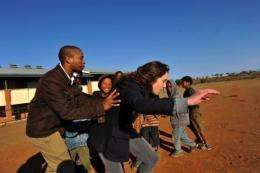
Excitement surges through a school hall set in the vast South African outback as rows of children roar "S-K-A" on a chilly winter morning.
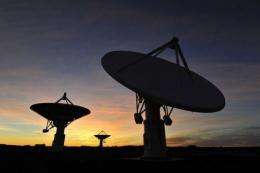
The shout-out is for the world's most powerful radio telescope, the Square Kilometre Array, to be built 80 kilometres (50 miles) from Carnarvon along a dirt road that winds through scrubby, dry farmland into isolation.
The project is still years away. But its young neighbours are being groomed as enthusiasts -- and even potential future staff -- in a town where more than half of the 5,900 residents are jobless and welfare grants are a lifeline.
"We're trying to excite them, show them that maths is easy, science is easy, so that eventually they could take up a bursary with us and become professional astronomers or engineers," said SKA South Africa outreach leader Daphne Lekgwathi.
In a welcome coup for the world's poorest continent, South Africa will host the bulk of the mega-telescope project, which is co-hosted by Australia.
The multi-nation project has been dubbed a "discovery machine" that will investigate the Big Bang, peek at black holes and uncover new frontiers -- possibly even life beyond Earth -- by peering further into the Universe than ever before.
Yet Africa's biggest economy has a dismal science and maths track record in a schools system that still struggles with basic literacy 18 years into multi-racial democracy.
A survey released last year found that primary school maths teachers battled to do simple tasks such as calculating percentages, with half equating the difference between 60 and 75 centimetres as a 15 percent increase.
More than half of the 2011 school leavers who studied mathematics failed their year-end finals and only a third of science pupils scored higher than 40 percent.
The buzz over the telescope is seen as an unrivalled opportunity to inspire a turnaround.
"The SKA will be the biggest project of this century, and the amount of human resources required to analyse these data and make new discoveries is huge," said operations and commissioning scientist Nadeem Oozeer.
"We need youngsters to keep on the work we shall be starting and pass on this passion for science and astronomy to another generation. This is also for the survival of science."
The project is recruiting staff from engineers to senior astronomers, while its funding stretches from research chairs and artisanal training to offering bursaries to more than 400 students so far.
"The SKA will be one of the most exciting experiments I think in this century, so to be included and to see how it functions and is evolving is a great honour," said Sudanese doctoral student Sahba Yahya, a bursary recipient doing a stint on-site.
"Usually people go from Africa to study in Europe. I think in 10 years, people will come to Africa to study astronomy."
The SKA technology is still being designed and the installation will not be fully operational until 2024, for a total investment of 15 billion rand (1.5 billion euros, $1.8 billion).
"Cutting-edge instruent for astronomy"
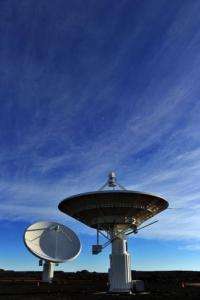
The first phase will include the construction of South Africa's 64-dish MeerKAT telescope, which will be the southern hemisphere's most sensitive. It has already drawn hundreds of requests from scientists around the world to book time on it.
"It's no longer a brain drain. The top scientists in the world want to come to South Africa to work on the project," said chief operator Rupert Spann at the site in the central arid Karoo region.
Eventually 80 percent of 3,000 mid-frequency dishes installed in Africa will be scattered in the stark landscape, linking up with low-frequency antenna in Australia and New Zealand, to become the world's biggest super-eye.
The amount of data it will collect in one day would need nearly two million years to play back on an iPod.
"This is the cutting-edge instrument for astronomy," Spann told AFP. "It's going to clarify a lot of theories on cosmology. It's going to allow us to see the functioning of galaxies which we've never been able to see before. We don't know what we're going to find, but we know we're going to find something."
Grooming Africa's future scientists is no easy task though.
Unlike the primary school's cheerleader-like exuberance, a Carnarvon High School outreach event during school holidays attracted only one scholar apart from the science teacher's son.
"They have that fear for maths and science. That's basically the main problem," science teacher Johannes Hoff told AFP as dozens of SKA-funded university students waited to demonstrate the assembly of an ordinary radio.
The project staff admit that realising their ambitions is a challenge.
But Oozeer says he is seeing small changes, content that students remember last year's experiment of how to skewer a balloon without causing a bang, and that parents were increasingly involved.
The one high schooler who had surprised his teachers by volunteering to attend the special event appears to have caught the science bug. He now wants to be an engineer.
"I feel the change has started already. It will take time to reach full throttle, but once there, we will be flooded by young experts," Oozeer said.
"It is the youngsters who will eventually change this poor track record."
(c) 2012 AFP


