SUMI rocket to study the Sun's magnetic fields
Jul 02, 2012 By Jennifer Rumburg
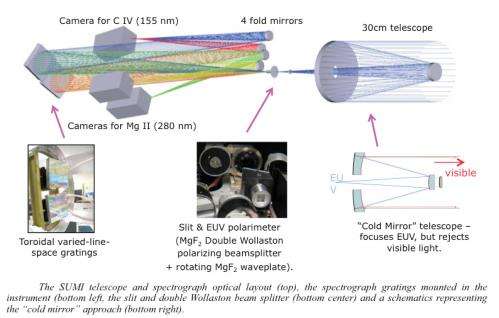
Graphic of SUMI instrument. Credit: NASA

(Phys.org) -- On July 5, NASA will launch a sounding rocket mission called the Solar Ultraviolet Magnetograph Investigation or SUMI, to study the intricate, constantly changing magnetic fields on the sun in a hard-to-observe area of the sun's low atmosphere called the chromosphere.

The primary objective of the SUMI experiment is to test the technologies that have been developed for making magnetic field measurements in the upper chromosphere/ lower transition region. Transition region magnetic field measurements are very important, but the most important Zeeman sensitive lines are in the ultraviolet which are impossible to observe from the Earth. SUMI plans to make exploratory polarization measurements in this region to develop the to analyze and convert our polarization data into vector magnetic field measurements and to use this data in determining the sensitivity requirements for space-based missions.

The inaugural flight of the SUMI instrument occurred on July 30, 2010.

date for this mission is July 5, 2012 from White Sands Missile Range, New Mexico.

Explore further: Hi-C to investigate activity in solar atmosphere

add to favorites email to friend print save as pdf

Related Stories

Taking a Shot at the Sun

Aug 02, 2010

(PhysOrg.com) -- This July, for a thrilling eight minutes, NASA researchers will get a peek at one of the sun's most mysterious regions.

Hi-C to investigate activity in solar atmosphere

Jun 22, 2012

(Phys.org) -- NASA's Marshall Space Flight Center in Huntsville, Ala. is leading an international effort to develop and launch the High Resolution Coronal Imager, or Hi-C, on a sounding rocket from the White ...

NRL refurbishes VAULT2.0 for reflight

Oct 27, 2011

Scientists at the Naval Research Laboratory (NRL) are refurbishing the Very-high Angular resolution ULtraviolet Telescope (VAULT) in preparation for two launches aboard NASA sounding rockets from the Navy's ...

SDO helps measure magnetic fields on the sun's surface

Jan 20, 2012

(PhysOrg.com) -- Science nuggets are a collection of early science results, new research techniques, and instrument updates that further our attempt to understand the sun and the dynamic space weather system ...

A new way to measure Earth's magnetosphere

Jan 04, 2012

US researchers have demonstrated the potential use of a new way to measure properties of Earth's magnetosphere, the magnetic bubble that surrounds the planet.

Recommended for you

Mice, gerbils perish in Russia space flight

14 hours ago

A number of mice and eight gerbils sent into space in a Russian capsule destined to find out how well organisms can withstand extended flights perished during their journey, scientists said Sunday as the ...

Mars rover Opportunity examines clay clues in rock

May 18, 2013

(Phys.org) —NASA's senior Mars rover, Opportunity, is driving to a new study area after a dramatic finish to 20 months on "Cape York" with examination of a rock intensely altered by water.

NASA's STEREO detects a CME from the sun

May 17, 2013

On 5:24 a.m. EDT on May 17, 2013, the sun erupted with an Earth-directed coronal mass ejection or CME, a solar phenomenon that can send billions of tons of solar particles into space that can reach Earth ...

Nine-year-old Mars rover passes 40-year-old record

May 17, 2013

While Apollo 17 astronauts Eugene Cernan and Harrison Schmitt visited Earth's moon for three days in December 1972, they drove their mission's Lunar Roving Vehicle 19.3 nautical miles (22.210 statute miles ...

Bright explosion on the Moon

May 17, 2013

For the past 8 years, NASA astronomers have been monitoring the Moon for signs of explosions caused by meteoroids hitting the lunar surface. "Lunar meteor showers" have turned out to be more common than anyone ...

User comments : 0

More news stories

Heat-related deaths in Manhattan projected to rise

Residents of Manhattan will not just sweat harder from rising temperatures in the future, says a new study; many may die. Researchers say deaths linked to warming climate may rise some 20 percent by the 2020s, ...

Mice, gerbils perish in Russia space flight

A number of mice and eight gerbils sent into space in a Russian capsule destined to find out how well organisms can withstand extended flights perished during their journey, scientists said Sunday as the ...

Kinks and curves at the nanoscale

One of the basic principles of nanotechnology is that when you make things extremely small—one nanometer is about five atoms wide, 100,000 times smaller than the diameter of a human hair—they are going ...

Honeybees trained in Croatia to find land mines

(AP)—Mirjana Filipovic is still haunted by the land mine blast that killed her boyfriend and blew off her left leg while on a fishing trip nearly a decade ago. It happened in a field that was supposedly ...