Lemurs the world's most threatened mammal: study
Jul 14, 2012
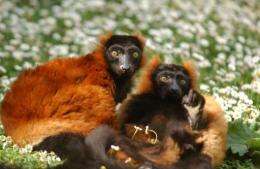
Two red Madagascan lemurs, an endangered species, frolic in a daisy bed at Doué-la-Fontaine zoo in western France. Lemurs are the most endangered mammals on Earth, an International Union for Conservation of Nature conference found.

Lemurs, the furry apes brought to fame by the Disney animation film "Madagascar", are the most endangered mammals on Earth, an International Union for Conservation of Nature conference found.

An IUCN workshop met in Madagascar this week to discuss the world's 103 lemur species as conservation deteriorates amid political turmoil that has lasted three years.

"Madagascar has, by far, the highest proportion of threatened species of any primate habitat region or any one country in the world. As a result, we now believe that lemurs are probably the most endangered of any group of vertebrates," said Christoph Schwitzer, one of the conference organisers.

Over 90 percent of the world's lemur species -- found only on the Indian Ocean island -- were upgraded to critically endangered, endangered, or vulnerable on the IUCN's Threatened Species list.

The destruction of the primates' tropical and an upsurge in bushmeat hunting have depleted lemur numbers since conservation efforts broke down after a coup in 2009, the body said in a statement late on Friday.

"Following this coup, there has been a serious breakdown of protective measures, with two key protected areas in northern Madagascar, Masoala National Park and Marojejy National Park, both of them part of a UNESCO complex of ."

"Political uncertainty has increased poverty and accelerated illegal logging. Hunting of these animals has also emerged as a more serious threat than previously imagined," it found.

The bush meat trade also affected tortoises and other species.

Madagascar's lemurs represent 20 percent of all primates, concentrated in an area less than one percent of global land area where apes roam.

These include the world's smallest primate at 30 grams, Madame Berthe's , and the blue-eyed black lemur, the only with blue eyes besides humans -- both endangered.

Since 2000, 40 new lemur species have been discovered.

Explore further: Why we need to put the fish back into fisheries

add to favorites email to friend print save as pdf

Related Stories

Lemur's evolutionary history may shed light on our own

Feb 25, 2008

After swabbing the cheeks of more than 200 lemurs and related primates to collect their DNA, researchers at the Duke Institute for Genome Sciences & Policy (IGSP) and Duke Lemur Center now have a much clearer ...

Sir Richard's possible folly

Apr 25, 2011

Moving animals, like the ring-tailed lemur, from one continent to another to save the species hasn't been done often and typically isn’t successful.

Recommended for you

Unkempt, weedy land unintentionally boosts wildlife

5 hours ago

Parts of the farm landscape that look overgrown and 'scruffy' are more important in supporting wildlife than they first appear, according to new research published today in Ecology Letters.

Why we need to put the fish back into fisheries

12 hours ago

Overfishing has reduced fish populations and biodiversity across much of the world's oceans. In response, fisheries are increasingly reliant on a handful of highly valuable shellfish. However, new research by the University ...

User comments : 0

More news stories

Intestinal bacteria protect against E. coli O157:H7

A cocktail of non-pathogenic bacteria naturally occurring in the digestive tract of healthy humans can protect against a potentially lethal E. coli infection in animal models according to research presented today at the 11 ...

Protein study suggests drug side effects are inevitable

A new study of both computer-created and natural proteins suggests that the number of unique pockets – sites where small molecule pharmaceutical compounds can bind to proteins – is surprisingly small, meaning drug side ...

Do salamanders hold the solution to regeneration?

Salamanders' immune systems are key to their remarkable ability to regrow limbs, and could also underpin their ability to regenerate spinal cords, brain tissue and even parts of their hearts, scientists have ...