Lausanne's statues - in 3D
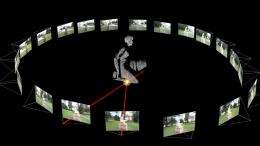
During a semester, a class of EPFL Master’s students took photographs of Lausanne’s statues and then modeled them in three dimensions to create a virtual museum.
Armed with ordinary digital cameras, 24 EPFL students roamed Lausanne taking pictures of the city’s statues, and then displayed them in three dimensions in a virtual museum exhibit. To give depth to their images, they used an algorithm developed by Pix4D, a spin-off of the Computer Vision Laboratory (CVLab).
To carry out this project of this scope, the group participated in defining objectives, organizing and planning the various stages. The students from EPFL’s Computer Graphics and Geometry Laboratory (LGG) then put their expertise into practice in the streets of Lausanne, tracking down statuary and photographing them from a variety of angles.
Statues with black holes
Even though the software does a lot of the work, making the task seem simple on paper, in reality, the work was far from straightforward. Christophe Chiche, like all the students in the group, had to try out several methods before finding one that was satisfactory: “Initially we took 30 to 40 pictures of a statue, but the program only needed about 15 to reconstruct the image.”
The algorithm generates a cloud of points that must then be reworked and reconstructed. The program cannot reconstruct all the hidden elements that don’t appear on a photograph, such as the top of a statue’s head, or the underside of its arms or shoulders. “In their place we had black holes, so we had to calibrate programs in other algorithms in order to fill in the missing parts; it was a mess.”
Capturing the texture was another challenge. “We had several possibilities,” explains Michael Barroco, another student. “Either we glued the photo onto the 3D image, or we reworked the entire texture, which we had to do several times because some statues had been defaced by graffiti. Some even sported handsome sprayed-on mustaches.”
Collaboration with the department of culture
This artistic idea was the brainchild of professor Mark Pauly, an amateur art enthusiast. He had dreamed of using Pix4D to model the details of Lausanne cathedral’s porch. But that would have required installing way too much equipment. Instead, he chose to model human-sized sculptures, spread around the city. The initiative led to an unexpected collaboration with Lausanne’s department of culture. “When I asked them about it, they didn’t know exactly how many sculptures the city owned, or where they all were. Our project allowed them to start an inventory of Lausanne’s public artwork.”
Enter a 3D city
Pix4D has extensive experience in using aerial photography to generate three-dimensional images. The spin-off modeled Lausanne’s old town using photographs taken by a micro-drone flying over the city. It was a lengthy project, requiring 500 aerial photographs.
The company hadn’t yet done anything on a small scale. “We take photographs from an altitude of 100m. This time, the students took pictures at just a few meters away from their model. Their work on the ground helped us improve our software, which hadn’t allowed this level of precision before,” explains one of Pix4D’s founders, Olivier Küng. He also hopes to be able to integrate these improvements into ordinary cameras.
This collaboration has been a real transfer of technology. “Our dream,” he continues, “would be not only to get a bird’s eye view of a city in three dimensions, but to glide among its buildings and wander through its streets.”
Lausanne’s cathedral
The collaboration between Pix4D and the LGG is not over. The cathedral’s porch will be photographed and modeled in 3D by the next crop of students, using a combination of photographs taken on the ground and in the air by small, remote-controlled helicopters.
More information: lgg.epfl.ch/statues
Provided by Ecole Polytechnique Federale de Lausanne


