Landsat data continuity mission becomes an observatory
Jul 17, 2012 By Rani Gran

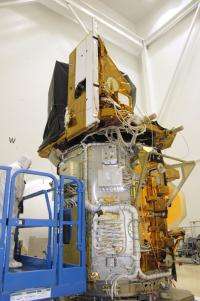
(Phys.org) -- Engineers at Orbital Sciences Corporation, Gilbert, Ariz., have installed the Thermal Infrared Sensor (TIRS) instrument back onto to the Landsat Data Continuity Mission (LDCM) spacecraft. With both the Operational Land Imager (OLI) and TIRS instruments now on the spacecraft, LDCM is a complete observatory.

After the TIRS instrument was shipped to Orbital in February, engineers discovered that helium had leaked from the TIRS cryogenic cooler. The cooler keeps the detectors extremely cold, which is required for the instrument to detect thermal emitted from Earth. The leak was quickly repaired, the cooler was re-pressurized with helium, and TIRS was re-installed onto the instrument deck of the spacecraft. Once the TIRS instrument is electrically connected later this month, TIRS will be ready to begin environmental testing with the rest of the observatory.

The engineering team at NASA's Goddard Space Flight Center in Greenbelt, Md., built TIRS on an accelerated schedule, going from a design on paper to a completed instrument in 43 months. An instrument of this type usually takes another year to complete.

Under contract to NASA, Orbital is responsible for providing the , installing the and performing system-level integration and testing of the Observatory prior to launch. Ball Aerospace & Technologies Corp. built the OLI. The USGS developed the LDCM ground system.

LDCM is on schedule for launch on Feb. 11, 2013.

Explore further: First Gagarin film turns Soviet idol into new Russian hero

add to favorites email to friend print save as pdf

Related Stories

Critical milestone reached for 2012 Landsat Mission

Aug 09, 2011

The Operational Land Imager (OLI), built by Ball Aerospace & Technologies Corp., Boulder, Colo., has been approved by NASA Goddard Space Flight Center for shipment to Orbital Sciences Corporation, Gilbert, ...

Instrument integration begins at Goddard on MMS spacecraft

Jun 08, 2012

(Phys.org) -- The decks have arrived. Engineers working on NASA'S Magnetospheric Multiscale (MMS) mission have started integrating instruments on the first of four instrument decks in a newly fabricated cleanroom ...

Recommended for you

Super-hurricane-force winds on Venus are getting stronger

23 hours ago

(Phys.org) —As the closest planet to Earth, Venus is a relatively easy object to observe. However, many mysteries remain, not least the super-rotation of Venus' atmosphere, which enables high altitude winds ...

ExoMars 2016 set to complete construction

Jun 18, 2013

ESA's mission to Mars in 2016 has entered the final stage of construction with the signature of a contract today with Thales Alenia Space at the Paris Air & Space Show.

Australian team maps Moon's hidden craters

Jun 18, 2013

Australian scientists Tuesday said they had identified a possible 280 additional craters on the Moon, a finding they said could shed light on the history of the Earth's natural satellite.

User comments : 1

Adjust slider to filter visible comments by rank

Display comments: newest first

So Hows Going
not rated yet Jul 17, 2012
All except the SSR, which should be re-integrated later this week. Had to remove from some spurious readings, but looks to be A-OK to go back on.

More news stories

EUROnu project recommends building Neutrino Factory

(Phys.org) —The European Union's Seventh Framework Programme, EUROnu, has submitted its findings to a panel at CERN. Charged with choosing a project to study the nature of matter and antimatter, the project ...

Antioxidant shows promise in Parkinson's disease

Diapocynin, a synthetic molecule derived from a naturally occurring compound (apocynin), has been found to protect neurobehavioral function in mice with Parkinson's Disease symptoms by preventing deficits in motor coordination.