Design for a long duration, deep space mission habitat
Jul 13, 2012 by Andy Tomaswick, Universe Today
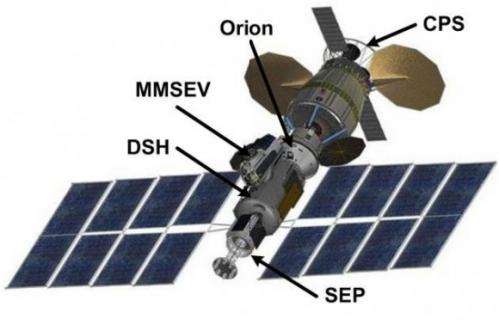
The integrated vehicle stack for a deep space human mission concept. Credit: NASA

There are all sorts of details to take into consideration when traveling in deep space, such as where to go, what to do, and how to get back. Since starry-eyed dreamers often don’t take into account the practical realities of putting a human into such an environment, steely-eyed engineers are left to decide the gritty details of such a mission, such as how many pairs of socks are needed. Fortunately, NASA employs engineers who are both steely-eyed and starry-eyed, and their work has just produced an interesting report discussing the human side of deep-space exploration.

The paper, written by Michelle Rucker and Shelby Thompson of Johnson Center, focuses on the requirements of a ship that will take the first wave of human explorers to a near Earth asteroid (NEA), hopefully in the near future. The team stressed that they were only looking at very basic requirements and the paper only provides a basis to work from for more specialized teams that will design individual sub-systems.

To develop the basics, the team had to make some assumptions, and these assumptions are revealing for anyone interested in NASA’s future human exploration plans. The team assumed a 380 day round-trip mission to a NEA, crewed by 4 people, with just 30 days of the mission spent at the asteroid. They assumed the availability of a variety of mission-specific vehicles as well as the ability to perform extra-vehicular activities and dock with the Orion crew module, still under development at NASA. Nevertheless, such assumptions could lead to an exciting mission if they hold throughout the design process.
Design for a long duration, deep space mission habitat
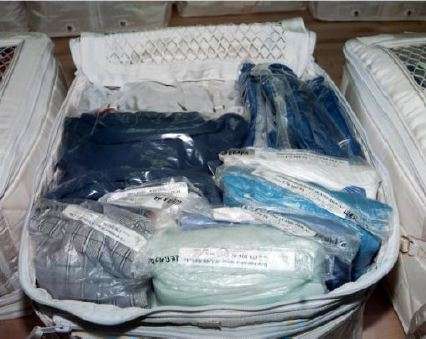
Two weeks worth of clothing in a crew transport bag. Credit: NASA

In addition to the assumptions, the team took advantage of knowledge gained from years of working on the International Space Station, and helped in considering details like how many packets of powdered drinks are needed for the duration of the trip as well as how much toothpaste a person uses daily in space. All of these numbers were crunched to derive overall dimensions for the craft.

Although, the sum of these volumes produced an over-sized spacecraft, the team evaluated activity frequency and duration to identify functions that could share a common volume without conflict, reducing the total volume by 24%. After adding 10% for growth, the resulting functional pressurized volume was calculated to be a minimum of 268 cu m (9,464 cu ft) distributed over the functions.

Those dimensions resulted in a 4 story structure totaling almost 280 cubic meters (10,000 cubic feet) of pressurized space that looks like it could have come right off the set of Prometheus.
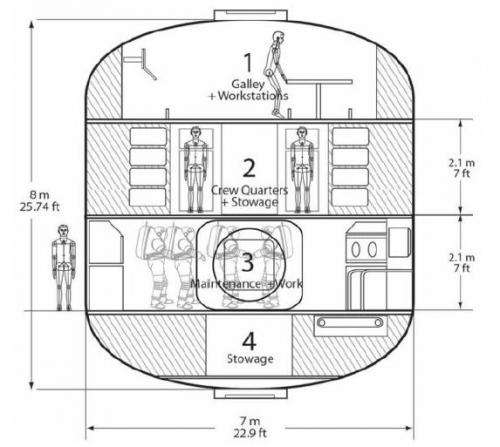
Conceptual Deep Space Habitat layout. Credit: NASA/Michelle Rucker and Shelby Thompson.

The various subsystems can be broken into seven different categories. The largest is the equipment section, which takes up 22% of the spacecraft. This space would include things like the environmental control panel and navigation and communications equipment. However, the designers thought that the propulsion system, most likely a solar electric propulsion system, and all required control equipment would be part of an attachable module and would not make up part of the main living space of the habitat.

Mission Operations and Spacecraft Operations make up the next largest chunks of the habitable space, each clocking in at 20%. These areas are reserved for mission specific tasks that are not yet defined and general tasks that are necessary no matter what type of mission the habitat is launched on, such as basic maintenance and repair.
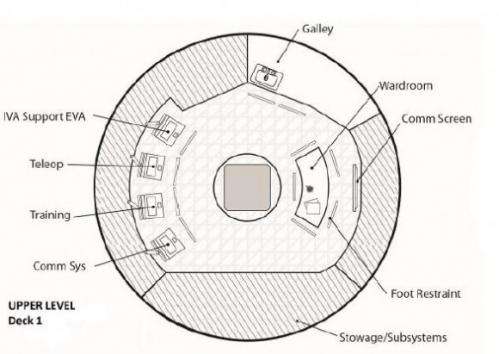
Group living and operations area of a conceptual deep space habitat module. Credit: NASA/Michelle Rucker and Shelby Thompson.

Much consideration was given to the psychological and privacy needs of the inhabitants of the ship and as such about 30% of the total habitable space is devoted to the care of the people on board, with 18% going to “individual” care and 12% going to “group” care.

Individual care includes basics such as beds, full body cleansing and toilets. Group care is more for multi-person activities, such as a dining hall, food prep and meeting areas. The last 2% of the area on board was allotted to “contingency” planning. It fits its namesake well, as the design team hopes never to have to use the space whose primary purpose is to deal with cabin depressurization, crew fatality or other unforeseeable disaster. There is also a shielded area in the interior of the habitat for refuge for the crew during a solar radiation event.

With the basics laid out, it is now up to the specialist teams to develop the next set of requirements for the sub-systems. The final design will only be completed after a long and iterative process of calculation and re-calculation, design and re-design. Assuming the teams persevere, and the space agency receives adequate funding for developing a deep to an asteroid, NASA’s detail-oriented engineers will have developed a very flexible habitat module to use on the next step of human space exploration that dreamers everywhere can get excited about.

Explore further: Orion test flight: A look at SLS hardware, integration

More information: NASA Technical Report: Developing a Habitat for Long Duration, Deep Space Mission

add to favorites email to friend print save as pdf

Related Stories

NASA Refines Design For Crew Exploration Vehicle

Jan 13, 2006

NASA's Constellation Program is making progress toward selecting a prime contractor to design, develop and build the Crew Exploration Vehicle (CEV), America's first new human spacecraft in 30 years.

Orion test flight: A look at SLS hardware, integration

Jul 02, 2012

(Phys.org) -- When NASA conducts its first test launch of the Orion spacecraft in 2014, the crew module's designers will record invaluable data about its performance -- from launch and flight, to re-entry ...

CU students to help NASA develop astronaut food

Jun 06, 2012

(Phys.org) -- University of Colorado Boulder students and faculty have been selected to develop a remotely operable, robotic garden to support future astronauts in deep space.

NASA's undersea mission submerges in the Atlantic

Jun 12, 2012

An international crew of aquanauts is settling into its home on the ocean floor, where the team will spend 12 days testing concepts for a potential asteroid mission. The expedition is the 16th excursion of the NASA Extreme ...

NASA finishes Orion system review

Nov 21, 2006

NASA has completed the first systems review of the Orion spacecraft, moving a step closer to the launch of the United States' next human space vehicle.

Recommended for you

Mice, gerbils perish in Russia space flight

22 hours ago

A number of mice and eight gerbils sent into space in a Russian capsule destined to find out how well organisms can withstand extended flights perished during their journey, scientists said Sunday as the ...

Mars rover Opportunity examines clay clues in rock

May 18, 2013

(Phys.org) —NASA's senior Mars rover, Opportunity, is driving to a new study area after a dramatic finish to 20 months on "Cape York" with examination of a rock intensely altered by water.

NASA's STEREO detects a CME from the sun

May 17, 2013

On 5:24 a.m. EDT on May 17, 2013, the sun erupted with an Earth-directed coronal mass ejection or CME, a solar phenomenon that can send billions of tons of solar particles into space that can reach Earth ...

Nine-year-old Mars rover passes 40-year-old record

May 17, 2013

While Apollo 17 astronauts Eugene Cernan and Harrison Schmitt visited Earth's moon for three days in December 1972, they drove their mission's Lunar Roving Vehicle 19.3 nautical miles (22.210 statute miles ...

User comments : 21

Adjust slider to filter visible comments by rank

Display comments: newest first

patnclaire
3.7 / 5 (3) Jul 13, 2012
The best, most thoroughly thought out deep space vehicle was the Discovery in 2001: A Space Odyessy. http://2001.wikia...covery_1
rwinners
1 / 5 (2) Jul 13, 2012
Agreed, pat. This is pitiful. If we want human beings to do long term travels in space, something MUCH more robust is needed.
We need to learn to live in space for indefinite periods before attempting to send humans outside the orbit of earth.
jimsecor
2.3 / 5 (3) Jul 13, 2012
Well...the movie is a movie and therefor "romantic." It is telling of our society that individual toilets and showers are seen as mandatory rather than one that is used by all PRN--or maybe 2. You can't begin at the top, for there' then nowhere to go. Send me: I've lived without bathroom or shower and would love to fly over some certain people's homes and toss out my waste with the assurance it would hit the target. If waste was ejected as with airplanes, what would you call space shit??? Oh. I'm sorry. Is a warped sense of humor allowed here? (pun unintended)
myxel_plex
1.3 / 5 (3) Jul 13, 2012
I bet the only way to accomplish this aside from the obvious needs (i.e. food, sanitation, etc)is via human cloning technology. First you should send humans that are 1) in the early stages of terminal illness with the skills to operate the ship and survive the mission. 2)They should have spend their everyday working and perfecting the cloning and birthing technology to 'grow' a new generation of cloned humans and train them to complete the mission. 3) Along with the aforementioned, each generation should spend their time learning and studying their Earthly history and ancestors, while performing and operating the needed functions of the ship. Over time, the social need for outside inter-human connection will be filtered out and only the mission will be the 'culture' of the ship's inhabitants. There should be some method to send back data to Earth or place "informational bread-crumbs" along their path of travel, or else it will be useless if they extend their lives elsewhere.
rwinners
1 / 5 (2) Jul 14, 2012
Well, myxel, first we will need a ship. And I mean SHIP, not a small canister in which are inserted human beings. A ship, like a small ocean liner designed specifically for the needs presented by airless weightlessness.
And the weightless thing is the first problem on the agenda.
Here's a thought. I understand that at the end of it's 'life', the space station is to be "re-entered".
Why not stuff it with all the consumables it can hold, attach a set of boosters to it and launch it (with your 'terminal' humans at Mars...
Sad thing about the SS is no gravity. Too bad. But (part of) the mass of the space station could be used as a counter weight to provide artificial gravity to a better designed living area.
Neurons_At_Work
5 / 5 (2) Jul 14, 2012
Okay, I have a nerdy math question for someone substantially smarter than I--so everyone just jump on in here. The ISS currently has 2 large sets of solar arrays which rotate, paddlewheel style, doing 360 deg. every 92 minutes as the station orbits the planet. Here is the question: If the ISS were out of earth orbit so that the panels could stay locked on the Sun, how much 'gravity' in G's would be generated at the farthest ends of the station if the whole station rotated end-over-end at the same 92 minute cycle. In other words, the solar arrays do not move end-over-end so-to-speak, the station does. I'm sure the station length is on Wikipedia, and knowing then the speed of revolution how much centripetal force is generated, would the 'deep space' astronauts even feel it? If not, how fast would the rotation have to be to get, say, .5 G? I know--goofy question. Blame rwinners above.
nkalanaga
not rated yet Jul 14, 2012
International Space Station Size & Mass (from NASA)
Module Length: 167.3 feet (51 meters)
Truss Length: 357.5 feet (109 meters)
Solar Array Length: 239.4 feet (73 meters)

From the picture, it appears that the Module Length is the inhabitable portion, with the Truss at right angles to that. If so, the effective radius is 25 meters. This site
http://www.cthree...h1.shtml
gives a period of 10 seconds for 1G and a radius of 25 meters. You'd only get the full gravity at the end, but both ends would have at least a quarter G over most of the module length.

On the other hand, the truss length is twice that, so the solar panels would be pulling 2 Gs, which would probably not work, if the station spun like a fan. If the station rotated around the truss, with one end pointed at the Sun, the outer ends of the panels would still be under 1.5 Gs.
rwinners
5 / 5 (1) Jul 14, 2012
Onward! What is the mass of the SS? Think about this. We spend gazillions putting mass in space. I think letting it burn up on re-entry is awfully wasteful, particularly because all those modules have attachment points. We are also dumping perfectly good mass into the ocean when it could be used to fill empty transport vehicles and stored for future use.
One thought: the SS is modular. There is no reason that the length cannot be increased.
As for power, anything going into space to stay will need a nuclear reactor. Forget the solar, it is unwieldy and looses effectiveness with distance. OTOH, those panels can be retraced and stored for future use.
nkalanaga
5 / 5 (2) Jul 15, 2012
Nuclear power isn't a bad idea. It could be used for propulsion, and supply station power while under thrust, then the panels could be unfurled during coasting and orbital phases of the mission. Having two independent power sources would also provide a safety factor.
antialias_physorg
5 / 5 (1) Jul 15, 2012
With a 380 days roundtrip mission (as stated in the article) you do not need artificial gravity.

Along with the aforementioned, each generation should spend their time learning and studying their Earthly history

Why? If you're not going to return to Earth what's the point in learning about Earth customs/history (apart from the few things you shouldn't repeat)?

Sad thing about the SS is no gravity

There is not much gravity on Mars, either (about 1/3 of Earth norm). So even if you pull 1g in your spacecraft to prevent bone loss you'll get it (just a tad bit slower) once you are on Mars. And likely any offspring born will get it from birth. Which means that humans are - even in an oxygenated/enclosed environment - not viable on Mars for longer durations in any case.
ShotmanMaslo
1 / 5 (1) Jul 15, 2012
. So even if you pull 1g in your spacecraft to prevent bone loss you'll get it (just a tad bit slower) once you are on Mars.


We dont actually know, some think 1/3 G will be enough to prevent most of bone loss. And with some medication and exercise, it may be an non-issue:

http://forum.nasa...=27465.0

Besides microgravity, radiation is also tought to cause bone loss.
ShotmanMaslo
3.7 / 5 (3) Jul 15, 2012
As for the article, they should just use off the shelf Bigelow BA-330 inflatable habitat for the mission. It meets the 268 m3 requirement with room to spare, and weighs far less than equivalent rigid "tin can" habitat.
antialias_physorg
not rated yet Jul 15, 2012
And with some medication and exercise, it may be an non-issue:

How exactly will you do that for infants? Pump them full of steroids?
rwinners
1 / 5 (1) Jul 15, 2012
@antialias > You miss my point. I think we need to learn to live in space robustly. I mean, mom can't tell the kids to go outside and play, but the environment should be robust enough to keep the kids happy inside. By long time, I mean we need to best space so that living there indefinitely is 'comfortable'.
With that taken care of, exploration will be next.
InterestedAmateur
5 / 5 (1) Jul 15, 2012
If waste was ejected as with airplanes, what would you call space shit???


Airlines are not permitted to dump toilet waste. The waste is kept in tanks until landing and then the ground crew pumps out the tanks and hauls the waste to a treatment facility.

From the Chicago O'Hare Flight Standards District Office:

Many people are of the assumption that aircraft lavatories dump overboard when they are flushed, this is not the case. Lavatory waste is contained on the aircraft in a holding tank until the aircraft lands. When the aircraft is safely on the ground, only
ground crew personnel may operate the valve to dump the waste tank.
While in flight it is physically impossible for the pilots to dump the waste water because the valve is usually located on the exterior of the aircraft.
nkalanaga
3 / 5 (1) Jul 16, 2012
Gravity may be less on Mars, but any outside activity will require suits, which will add body mass. Thus, the bones will be supporting more mass than the gravity would indicate. As for indoors, design the habitat to require walking, and the occupants will probably get more exercise than many Earthlings.

If it was my ship, I'd start with 1 G, then lower it as the trip progressed. Coming back, start with Martian gravity and raise it to Earth's. That way, adaptation would be gradual, and the crew would be less likely to have problems on arrival.
antialias_physorg
3 / 5 (1) Jul 16, 2012
You miss my point. I think we need to learn to live in space robustly.

And the point I'm trying to make is that there is more to 'living' than having food and clothes. Gravity is important. Low radiation levels are important. You can't just 'reengineer' humans for such environments as the Moon or Mars. We're still far, FAR away from that capability.

Unless we go to the trouble of hollowing out and spinning up asteroids there's really no place for us in the solar system where we can live (planetside/permanently) besides Earth.

As for going outside the solar system: My guess will be that we won't go there in biological form (why would we? Our biological form will most certainly not be adapted to anything we find, so why lug it along?) Granted: Finding a way of making artificial consciousness will be hard...but once that is accomplished it solves most of the other showstoppers (size of craft, duration of journey, availability of supplies, survivability at destination, ... )
antialias_physorg
not rated yet Jul 16, 2012
...So really. we should sidestep the entire problem of moving biological mass from A to B. Biological forms are tools adapted to survive in the environment they evolved in. What's the point of taking them to another? We should focus on what matters. getting information.

Gravity may be less on Mars, but any outside activity will require suits, which will add body mass.

Gravity acts on the body 24/7. Outside activity will only be a microsciopic fraction of that. Especially during infant years - where gravity is crucial for proper bone development - I see no way to have them exposed to that. Or do you think sticking them in tiny/heavy suits will do much good? It'll just cause deformities.

And as noted: for a roundtrip to Mars with a brief exploratory stay you don't need to solve any gravity problems at all. For that the trip is short enough that you can spend it in 0g (which we'll have to do to save fuel, anyhow. Continuous 1g acceleration is fantasy with current tech).
ShotmanMaslo
1 / 5 (1) Jul 16, 2012
And with some medication and exercise, it may be an non-issue:

How exactly will you do that for infants? Pump them full of steroids?


Not steroids, but anti-osteoporosis drugs.

Besides, some bone loss is only a problem if you plan to return to Earth. True colonists, that would live their whole life on Mars or on a space station would not need such strong bones as Earthlings. In that context, is bone loss even a problem?
antialias_physorg
not rated yet Jul 16, 2012
Not steroids, but anti-osteoporosis drugs.

I did my PhD thesis on bone structure and bone remodeling due to stress (well actually bone remodelling due to arthritic changes which induce a person to put less stress on the affected knee). The aim was to see if a drug used in osteoporosis treatment was effective for osteoarthritis treatment - and we wanted to see if the efect would show up as difference in bone mineralisation/structure in CT images.

That drug was one of the typical ones that are given for osteoporosis (strontium renalate). The thing is: Drugs can affect bone mineralisation (density). But the thing that defines the trabecular structure inside are the stresses you put on the bone.

And it's the trabecular structure that defines stability much more than bulk mass (a frame house can be much more stable for the same amount of material than just putting it down in bulk)

If you lack those stresse the bone will remodel to something much less stable.
antialias_physorg
not rated yet Jul 16, 2012
Bones are formed according to the activity of two types of cells osteoclasts (which eat away at the bone) and osteoblasts (which put down bone material). Osteablasts are very susceptible to stress (i.e. they don't do anything if no stress is present).

What osteoporosis drugs do is suppress osteoclast activity - so the net balance is shifted towards osteoblasts. But in martian gravity osteoblasts won't work at all (only if you put the body under artificial stress - like the daily, hard training done on the ISS. And even that isn't enough to maintain bone mass)

Additionally bones have other functions. Just saying "OK, they'll just have less bone mass" is not good. Bones are a vital storage/buffer for calcium (which is, among other things also a buffer for pH levels in our system)

You see. it's not quite as easy as just 'living with a bit less bone stability'. Any major change in body content has system-wide ramifications. (E.g. Low bone density will lead to loss of teeth)

More news stories

Cracking the ice code

(Phys.org) —What happened the last time a vegetated Earth shifted from an extremely cold climate to desert-like conditions? And what does it tell us about climate change today?

Engineers' nanoantennas improve infrared sensing

(Phys.org) —A team of University of Pennsylvania engineers has used a pattern of nanoantennas to develop a new way of turning infrared light into mechanical action, opening the door to more sensitive infrared ...

Mapping a route to stem cell therapies

Monash University researchers are shedding light on the complex processes that underpin the creation and differentiation of stem cells, bringing closer the promise of 'miracle' therapies.

Lymphatic fluid takes detour

When tumours metastasise, they can block lymphatic vessels, as researchers from ETH Zurich have discovered using a new method. The lymphatic fluid subsequently has to find a new path through the tissue. Such ...