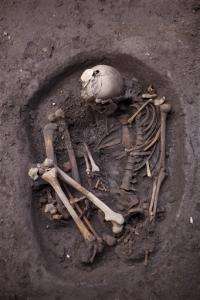
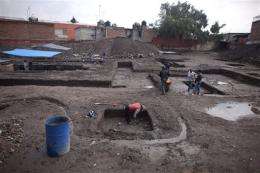
An unearthed skeleton dating back about 700 years is seen at a recently discovered archeological site in Mexico City, Friday, July 13, 2012. According to Mexico's National Institute of Anthropology and History, INAH, the site is about 700 years old and is a neighborhood of Tepaneca merchants. (AP Photo/Alexandre Meneghini)
(AP) Archaeologists in Mexico City have unearthed the skulls and other bones of 15 people, most of them the children of traveling merchants during Aztec times.
Researcher Alejandra Jasso Pena says they also found ceramic flutes, bowls, incense burners, the remains of a dog that was sacrificed to accompany a child in the afterlife and other artifacts of a pre-Columbian civilization.
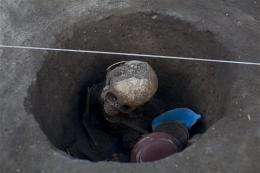
An unearthed skeleton of a child dating back about 700 years is seen at a recently discovered archeological site in Mexico City, Friday, July 13, 2012. According to Mexico's National Institute of Anthropology and History, INAH, the site is about 700 years old and is a neighborhood of Tepaneca merchants. (AP Photo/Alexandre Meneghini)
Jasso Pena said Friday that construction was about to start on five buildings in a Mexico City neighborhood when the National Institute of Anthropology and History asked to carry out an excavation of the site first.

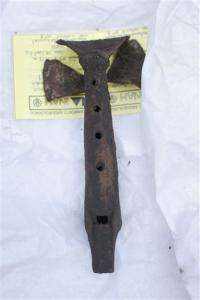
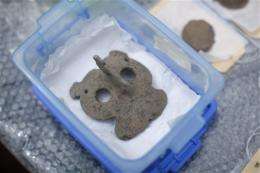
Pictured is an unearthed ceramic object from a recently discovered archeological site in Mexico City, Friday, July 13, 2012. According to Mexico's National Institute of Anthropology and History, INAH, the site is about 700 years old and is a neighborhood of Tepaneca merchants. (AP Photo/Alexandre Meneghini)
Experts suspected the site was an important ceremonial center for the Tepanec tribe between 1200 and 1300. The influential traders living there were called Pochtecas.
Archaeologists say excavation is continuing at the site.
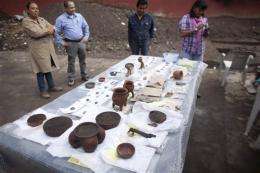
Archeologists stand next to a table displaying objects unearthed from a recently discovered archeological site in Mexico City, Friday, July 13, 2012. According to Mexico's National Institute of Anthropology and History, INAH, the site is about 700 years old and is a neighborhood of Tepaneca merchants. (AP Photo/Alexandre Meneghini)
Pictured is a mask unearthed from a recently discovered archeological site in Mexico City, Friday, July 13, 2012. According to Mexico's National Institute of Anthropology and History, INAH, the site is about 700 years old and is a neighborhood of Tepaneca merchants. (AP Photo/Alexandre Meneghini)
Pictured is an unearthed flute from a recently discovered archeological site in Mexico City, Friday, July 13, 2012. According to Mexico's National Institute of Anthropology and History, INAH, the site is about 700 years old and is a neighborhood of Tepaneca merchants. (AP Photo/Alexandre Meneghini)
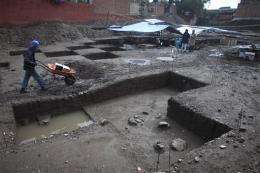
A worker pushes a wheelbarrow through a recently discovered archeological site in Mexico City, Friday, July 13, 2012. According to Mexico's National Institute of Anthropology and History, INAH, the site is about 700 years old and is a neighborhood of the Tepaneca merchants. (AP Photo/Alexandre Meneghini)
Workers clean an area of a recently discovered archeological site in Mexico City, Friday, July 13, 2012. According to Mexico's National Institute of Anthropology and History, INAH, the site is about 700 years old and is a neighborhood of the Tepaneca merchants. (AP Photo/Alexandre Meneghini)
An 800-year-old, pre-Columbian burial ground with baskets full of human remains was unearthed at a building site outside San Jose, National Museum archaeologists said Tuesday.
(AP) -- Mexican researchers said Wednesday they have identified jaw bones found in the pre-Hispanic ruins of Teotihuacan as those of wolf-dogs that were apparently crossbred as a symbol of the city's warriors.
Archaeologists announced Tuesday that they dug to the very core of Mexico's tallest pyramid and found what may be the original ceremonial offering placed on the site of the Pyramid of the Sun before construction began.
(AP) Archaeologists in Greece's second-largest city have uncovered a 70-meter (230-foot) section of an ancient road built by the Romans that was city's main travel artery nearly 2,000 years ago.
(AP) -- Mexican archaeologists have found an 1,100-year-old tomb from the twilight of the Maya civilization that they hope may shed light on what happened to the once-glorious culture.
A rare clay seal found under Jerusalem's Old City appears to be linked to religious rituals practiced at the Jewish Temple 2,000 years ago, Israeli archaeologists said Sunday.
A new study conducted at the University of Bristol and published online today in the Journal of Evolutionary Biology sheds light on how the brain and inner ear developed in dinosaurs.
Cambridge archaeologists are illuminating some of the oldest graphic art of the past, by applying some of the most advanced graphic technology of the present.
(Phys.org) —A 20 million-year-old fossil skull identified as a 'pocket-sized' ancestor of the bandicoot will give insights into the future of Australia's modern endangered animals.
A scientist has discovered an ancient extinct creature with 'scissor hand-like' claws in fossil records and has named it in honour of his favourite movie star.
Fish fossils that are about 23 million years old give unprecedented insight into the evolutionary history of the gobioid order, one of the most species-rich groups among the modern bony fishes.
(Phys.org) —A University of Otago-led multidisciplinary team of scientists have shed new light on the diet, lifestyles and movements of the first New Zealanders by analysing isotopes from their bones and teeth.
(Phys.org) —The National Academy of Sciences recently released an updated national vision for K-12 science education learning goals. Known as the Next Generation Science Standards, the goals outline a vision for what all ...
(Phys.org) —Wellcome Trust Monitor, an independent nationwide survey, highlights the important role of science teachers in encouraging young people to learn science and as a source of careers advice.
Cambridge archaeologists are illuminating some of the oldest graphic art of the past, by applying some of the most advanced graphic technology of the present.
(Phys.org) —The corporate social responsibility programs of big mining companies in remote towns are often disconnected from community needs, reactive and ad hoc.
A new study conducted at the University of Bristol and published online today in the Journal of Evolutionary Biology sheds light on how the brain and inner ear developed in dinosaurs.
Food industries are now turning meat left-over into high-protein content ingredients for food supplements, or to be added to processed food. But a EU-wide regulation covering them is still lacking.
(Medical Xpress)—In a recent subgroup analysis of the largest blood pressure treatment trial in history, University of Alabama at Birmingham (UAB) researchers found that women and men react the same to ...
An ESA business incubation start-up company is helping major car manufacturers to develop electric vehicle concepts and improve safety systems by turning ideas quickly into virtual prototypes.
In April, when the Hubble Space Telescope looked out towards Jupiter's orbit and observed what has been billed as the "Comet of the Century" – Comet C/2012 S1 ISON – the space telescope photographed a ...
An article published on the journal Nature describes the major role that Pyruvate dehydrogenase (PDH) —an enzyme of cellular energy metabolism— plays in the regulation of the cellular senescence induce ...