Toxic legacy in Malaysia rare-earths village
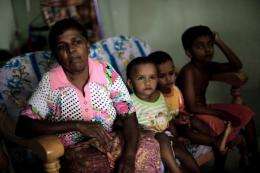
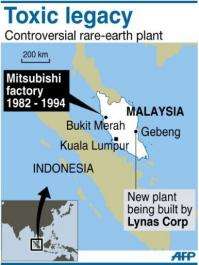
Thirty years have passed since Japan's Mitsubishi Chemicals opened a rare-earths refinery in the Malaysian village of Bukit Merah, but although the plant is gone, its toxic legacy persists.
The facility was embraced by authorities as an advanced foreign investment that would help create jobs in poor Perak state in the country's north.
But a rise in leukaemia and other health problems has left the site, now abandoned, as a silent warning to Malaysia as it touts a controversial new foreign rare-earths plant being built in the country's east by Australia's Lynas Corp.
"Look at my hands. The skin is peeling," said a 68-year-old local resident who gave only his surname, Ng.
"When I go to a local bar, the women just take off, afraid that if I touch them they will be infected," he said angrily of a mystery skin disorder he has endured for years.
Ng, who ran a hauling business, was awarded a contract to dispose of radioactive waste from the then-new facility in 1982. The plant's Japanese operators told him it could be used as fertiliser.
But the waste that he casually hauled away and disposed of in fields and rivers around Bukit Merah, home to 15,000 people, contained thorium, a carcinogenic radioactive chemical.
Lynas is putting the finishing touches on its $800 million rare-earths processing facility in Pahang state, a project billed by the government as an economic boost for the relatively undeveloped east coast.
Analysts say the plant, which will refine rare-earth ore brought from a Lynas mine in Australia, could help break China's stranglehold on the mineral elements, which are used in high-tech gadgets ranging from iPods to missiles.
China's control of about 95 percent of world supply has raised concerns.
But Lynas has been dogged by protests by environmentalists and residents who fear a repeat of Bukit Merah, and the anti-Lynas sentiment has galvanised a nascent "green" movement in Malaysia.
Lynas vows the facility will be safe, but opponents say the risks are clear at Bukit Merah, a once-idyllic farming community that today is marked by dilapidated brown wooden houses and a falling population.
Residents and activists say the village and surrounding areas have seen increased rates of leukaemia, birth defects, infant deaths, congenital diseases, miscarriages and lead poisoning in the years following the plant's opening.
"Mitsubishi's rare-earth refinery is Malaysia's worst industrial tragedy," said T. Jayabalan, a public health consultant who lived in Bukit Merah in the late 1980s, fighting for the plant's closure and documenting leukaemia cases.
Jayabalan said he had documented at least 11 deaths due to blood poisoning, brain tumours and leukaemia.
When the plant opened, villagers immediately complained of a stinging smoke and foul odour. Local ignorance meant that waste disposal was carried out with shocking recklessness.
"At one time, we dug a pit near a river in Bukit Merah and buried the waste," said Ng.
"Occasionally, lumps of wet thorium sludge would fall off the lorry and school children would walk pass it."
Mitsubishi Chemicals closed the plant in 1994 after a mounting public outcry, but the government has neither admitted nor denied radiation poisoning in the village.
The only payout by the company was a 500,000-ringgit ($158,000) lump sum to the local community to aid victims in 1994.
A tacit understanding was reached under which Mitsubishi Chemicals would shut the facility in exchange for a moratorium on lawsuits.
The plant has since been dismantled, cows grazing on grass where it once stood, surrounded by a crumbling concrete wall.
Radioactive waste that was previously kept in rusting metal drums has been removed and buried in an isolated limestone hills nearby. But environmentalists say the dump site remains a health threat.
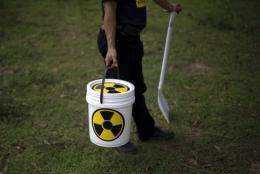
Bukit Merah spotlights the conundrum surrounding rare-earths processing -- consumers clamour for the products that contain them but there are major concerns over the environmental impact of processing the minerals.
Opponents of the Lynas plant have seized upon such fears to challenge the new facility.
It was due to open late in 2011 but has been delayed in part by government hesitation in granting an operating licence to start production following protests by thousands.
A licence was awarded in February but the government froze that pending a review by a parliamentary panel.
The panel, dominated by Malaysia's ruling party, ruled on June 19 that the plant was safe. It was not immediately clear when the licence would be issued.
"We should not repeat the mistakes made at Bukit Merah. There is no such thing as a safe threshold for radiation which is cancer-causing," Jayabalan said.
S. Panchavarnam, 56, remembers vividly the pungent, choking smell she endured working at a timber mill adjacent to the plant in 1987. Pregnant at the time, she frequently fell ill.
"The Mitsubishi factory has caused a lot of pain. We are suffering in silence," she said.
Malaysia's frequent heavy rains caused carelessly dumped waste from the refinery to flow into the timber yard. She cleaned it up with no protective gear and soon suffered swelling in her legs and hands.
Panchavarnam said her daughter Kasturi, now 24, has been plagued by health problems since birth, dropping out of college at 19 as a result.
Kasturi was born with just one kidney, has short neck and a pair of low set eyes and continues to undergo treatment for persistent headaches.
Panchavarnam said Kasturi suffers from frequent dizzy and fainting spells.
"The rare earths factory has brought pain to our lives. When she comes home from work, she will just sit in the corner of the room quietly," said Panchavarnam.
(c) 2012 AFP


