Mysterious noctilucent clouds as seen from the international space station
Jun 26, 2012 By Nancy Atkinson, Universe Today
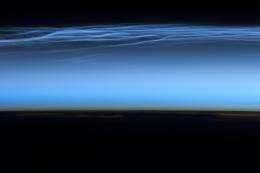
Lead image caption: Noctilucent or Polar Mesospheric clouds captured by the crew of the ISS on June 13, 2012. Credit: NASA

Mysterious “night shining” or noctilucent clouds are beautiful to behold, and this stunning image offers an unusual view of these clouds as seen by astronauts on board the International Space Station. Also called polar mesospheric clouds, these clouds are puzzling scientists with their recent dramatic changes. They used to be considered rare, but now the clouds are growing brighter, are seen more frequently, are visible at lower and lower latitudes than ever before, and sometimes they are even appearing during the day.

The astronauts were also able to take a time-lapse sequence of these on June 5, 2012, as seen below. According to NASA, it is first such sequence of images of the phenomena taken from orbit.

The sequence in this video was taken while the ISS was passing over western Asia. By focusing on the limb of the Earth at night with the Sun illuminating it, the crew was able to capture some movement to these mysterious clouds.

This video is not supported by your browser at this time.

There is quite a bit of debate for the cause of noctilucent clouds. Dust from meteors, global warming, and rocket exhaust have all been tagged as contributors, but the latest research suggests that changes in atmospheric gas composition or temperature has caused the clouds to become brighter over time.

Noctilucent clouds are usually seen during the summertime, appearing at sunset. They are thin, wavy ice clouds that form at very high altitudes (between 76 to 85 kilometers (47 to 53 miles) above Earth’s surface and reflect sunlight long after the Sun has dropped below the horizon. They appear in both the Northern and Southern Hemisphere and appear as delicate, shining wispy clouds against the dark sky.

The top image from the ISS was taken on June 13, 2012, as the passed over the Tibetan Plateau. At the same time, polar mesospheric clouds were also visible to aircraft flying over Canada. In addition to the noctilucent/polar mesospheric clouds trending across the center of the image, lower layers of the atmosphere are also illuminated. The lowest layer of the atmosphere visible in this image—the stratosphere—is indicated by dim orange and red tones near the horizon.

Explore further: 2012 noctilucent cloud season begins

add to favorites email to friend print save as pdf

Related Stories

Mysterious noctilucent clouds as seen from space

Feb 10, 2011

Mysterious "night shining" or noctilucent clouds are beautiful to behold, and are usually seen during the summertime, appearing at sunset. They are thin, wavy ice clouds that form at very high altitudes and ...

A noctilucent masterpiece

Aug 09, 2011

Night-shining “noctilucent” clouds create a magical glow in the night skies over Reykjavíc, Iceland in this beautiful photo by Örvar Atli Þorgeirsson, taken on August 6. In the ...

Night Time Artificial Cloud Study Conducted

Sep 21, 2009

A rocket experiment that may shed light on the highest clouds in the Earth's atmosphere was conducted September 19 from NASA's Wallops Flight Facility in Virginia.

2012 noctilucent cloud season begins

Jun 19, 2012

(Phys.org) -- Data from NASA's AIM spacecraft show that noctilucent clouds (NLCs) are like a great "geophysical light bulb". They turn on every year in late spring, reaching almost full intensity over a period ...

AIM to Clear Up Mystery of Elusive Clouds at Edge Of Space

Apr 11, 2007

NASA is preparing to launch the Aeronomy of Ice in the Mesosphere (AIM) spacecraft, the first mission dedicated to exploration of mysterious ice clouds that dot the edge of space in Earth's polar regions. These clouds have ...

Recommended for you

Mice, gerbils perish in Russia space flight

3 hours ago

A number of mice and eight gerbils sent into space in a Russian capsule destined to find out how well organisms can withstand extended flights perished during their journey, scientists said Sunday as the ...

Mars rover Opportunity examines clay clues in rock

May 18, 2013

(Phys.org) —NASA's senior Mars rover, Opportunity, is driving to a new study area after a dramatic finish to 20 months on "Cape York" with examination of a rock intensely altered by water.

NASA's STEREO detects a CME from the sun

May 17, 2013

On 5:24 a.m. EDT on May 17, 2013, the sun erupted with an Earth-directed coronal mass ejection or CME, a solar phenomenon that can send billions of tons of solar particles into space that can reach Earth ...

Nine-year-old Mars rover passes 40-year-old record

May 17, 2013

While Apollo 17 astronauts Eugene Cernan and Harrison Schmitt visited Earth's moon for three days in December 1972, they drove their mission's Lunar Roving Vehicle 19.3 nautical miles (22.210 statute miles ...

Bright explosion on the Moon

May 17, 2013

For the past 8 years, NASA astronomers have been monitoring the Moon for signs of explosions caused by meteoroids hitting the lunar surface. "Lunar meteor showers" have turned out to be more common than anyone ...

User comments : 1

Adjust slider to filter visible comments by rank

Display comments: newest first

Mauibrad
not rated yet Jun 28, 2012
Chemtrails.

More news stories

Mice, gerbils perish in Russia space flight

A number of mice and eight gerbils sent into space in a Russian capsule destined to find out how well organisms can withstand extended flights perished during their journey, scientists said Sunday as the ...

Fracking risks to ground water assessed

(Phys.org) —Extraction of "unconventional" gas from sedimentary rocks such as shale could provide a clean energy source and help some regions to become energy independent, but concerns have been raised ...

Honeybees trained in Croatia to find land mines

(AP)—Mirjana Filipovic is still haunted by the land mine blast that killed her boyfriend and blew off her left leg while on a fishing trip nearly a decade ago. It happened in a field that was supposedly ...

German energy shift faces headwinds

Tense engineers have their eyes peeled on complex colour-coded diagrams on a wall-sized screen that makes their control room look like the inside of a spaceship.

Internet in 'coma' as Iran election looms

Iran is tightening control of the Internet ahead of next month's presidential election, mindful of violent street protests that social networkers inspired last time around over claims of fraud, users and ...