Warhol crater gets its 15 minutes of fame
May 15, 2012 by Jason Major, Universe Today
Warhol crater, one of 23 recently named craters on Mercury

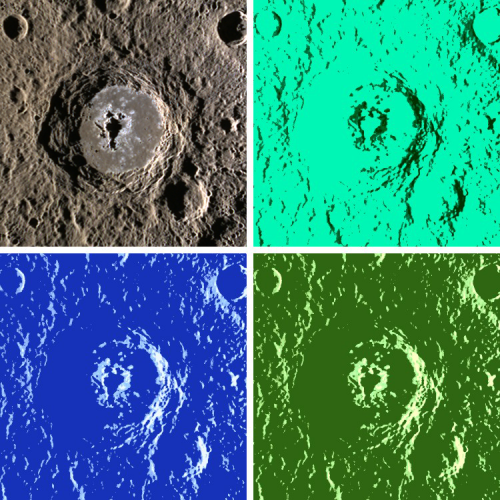
As pop art icon Andy Warhol said, “In the future everyone will be famous for fifteen minutes,”  and so here’s an image of the crater on Mercury that now bears his name, set up in the style of one of his multicolored silkscreens.

Warhol is one of 23 craters on to be recently approved for names by the International Astronomical Union (IAU), joining other notable artists, authors and musicians like Gustav Holst, Rene Magritte and Dr. Seuss who now have craters named in their honor on the first rock from the Sun.

95 km (59 miles) in diameter, Warhol features a large, elongated central peak, stepped walls and many of the curious erosions known as hollows.

The original image, seen at top left, was acquired by NASA’s MESSENGER spacecraft on October 21, 2011, using its Wide-Angle Camera Mercury Dual Imaging System (MDIS) instrument.

With the new list of 23 named craters, there are now 76 officially (and artistically) titled craters on Mercury since MESSENGER’s first pass of the planet in January 2008.

See the original release by the MESSENGER mission team here.

“I’m bored with that line. I never use it anymore. My new line is “In 15 minutes everybody will be famous.”
– Andy Warhol (1928 – 1987)

Explore further: Dark, massive asteroid to fly by Earth on May 31

add to favorites email to friend print save as pdf

Related Stories

Bright peaks, dark shadows

Feb 20, 2012

The 68-mile (109-km) -wide Amaral crater on Mercury reveals its brightly-tipped central peaks in this image, acquired by NASA’s MESSENGER spacecraft on Feb. 4, 2012. Long shadows are cast by the crater’s ...

More 'hollowed ground' on Mercury

Jan 05, 2012

The latest featured image from NASA’s MESSENGER spacecraft, soon to complete its first year in orbit around Mercury, shows the central peak of the 78-mile (138-km) – wide crater Eminescu surrounded ...

Mercury down under

Feb 27, 2012

NASA’s MESSENGER spacecraft, about to wrap up its first full year in orbit around Mercury, captured this view of the planet’s heavily-cratered southern hemisphere on August 28, 2011. Because of its ...

MESSENGER gets it Donne

Apr 09, 2012

Named after the 17th-century metaphysical poet, Mercury’s Donne crater was captured in this image by NASA’s MESSENGER spacecraft. The 53-mile (83-km) -wide crater features a large, rounded central ...

A peek at a pitch-black pit

Mar 20, 2012

MESSENGER captured this high-resolution image of an elongated pit crater within the floor of the 355-km (220-mile) -wide crater Tolstoj on Mercury on Jan. 11, 2012. The low angle of sun illumination puts the ...

Kuiper's color close-up

Feb 14, 2012

The pale-orange coloration around the 39-mile (62-km) -wide Kuiper crater on Mercury is evident in this image, a color composition made from targeted images acquired by NASA’s MESSENGER spacecraft on ...

Recommended for you

Dark, massive asteroid to fly by Earth on May 31

9 hours ago

It's 1.7 miles long. Its surface is covered in a sticky black substance similar to the gunk at the bottom of a barbecue. If it impacted Earth it would probably result in global extinction. Good thing it is ...

Research team explains 'Lazarus' comets

13 hours ago

Astronomers from the University of Antioquia have discovered a graveyard of comets. These once-dormant comets, dubbed by astronomers as "The Lazarus comets," are now rejuvenated.

NASA ships sensors for seafaring satellite to France

13 hours ago

(Phys.org) —Three NASA-built instruments that are integral components of the next in a series of U.S./European ocean altimetry satellites have arrived in France for integration with their spacecraft in ...

Trip into space with DiCaprio costs $1.55m

13 hours ago

Leonardo DiCaprio is going to get closer to stars of a different kind as he heads into space aboard the Virgin Galactic, and a well-heeled bidder at the Cannes Film Festival has paid 1.2 million euros (1.5 million) to be ...

User comments : 0

More news stories

Galaxies fed by funnels of fuel

(Phys.org) —Computer simulations of galaxies growing over billions of years have revealed a likely scenario for how they feed: a cosmic version of swirly straws.

Dark, massive asteroid to fly by Earth on May 31

It's 1.7 miles long. Its surface is covered in a sticky black substance similar to the gunk at the bottom of a barbecue. If it impacted Earth it would probably result in global extinction. Good thing it is ...

Source of life running out: water scientists

The majority of people on Earth people will face severe water shortages within a generation or two if pollution and waste continues unabated, scientists warned at a conference in Bonn Friday.

Google eyes emerging markets networks

Google has become deeply involved in a series of projects to build and operate wireless networks in emerging markets including sub-Saharan Africa and Southeast Asia, a report said Friday.