Jungle cats caught on camera in Belize
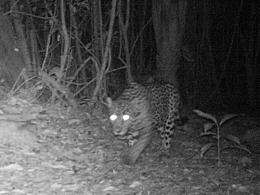
A camera trap survey, set up by scientists from Ya’axché Conservation Trust, has caught pictures of Central America’s two big cats: the jaguar and the puma (known locally as the red tiger).
Both species are threatened by habitat loss and unsustainable hunting of their prey, and it is thought that only around 250-400 jaguars now remain in the Maya Mountains.
“Although local people appreciate the beauty of jaguars, these cats are coming under increasing pressure from agricultural expansion, which is pushing people into their territory,” said Lee Mcloughlin, Protected Area Manager at Ya’axché Conservation Trust.
“This is not only resulting in habitat loss and fragmentation, but also leading to conflict between jaguars and people, who are fearful of the danger these animals can pose to livestock and pets.
“Inevitably, the jaguars come off worse in this battle.”
Who’s there?
Today, the only protected broadleaf forest link between Maya Mountains and the forested coastal plains falls within the 320,000 acre Maya Golden Landscape. This remaining wildlife corridor is particularly important for jaguars and other large mammals (such as tapirs and peccaries), as it allows cross-breeding between two increasingly isolated populations.
Ya’axché Conservation Trust (Fauna & Flora International’s partner in Belize) is working hard to protect the Maya Golden Landscape by engaging with the communities, farmers and private landowners living in and around the Maya Golden Landscape.
To help ensure that Ya’axché’s conservation work really benefits biodiversity in the area, the ranger team set up a number of camera traps (automatic, motion-detecting cameras, supplied by IdeaWild) in the area, to help them learn more about which species inhabit the corridor.
In addition to jaguar and puma, the cameras have captured images of red brocket deer, possum, great currasow, white-lipped and collared peccary and agouti – all of which are prey species for the jaguar and puma.
The survey complements Ya’axché’s long-term biodiversity monitoring work which has been running since 2006, with technical support from Fauna & Flora International. The images will also be used as part of Ya’axché’s ongoing education and community outreach work.
The team is now planning a follow-up survey in partnership with Panthera that will aim to estimate jaguar distribution and abundance in the Maya Golden Landscape with a view to initiating the establishment of a southern wildlife corridor in Belize.
Provided by Fauna & Flora International


