42,000-year-old baby mammoth on show in Hong Kong
Apr 11, 2012
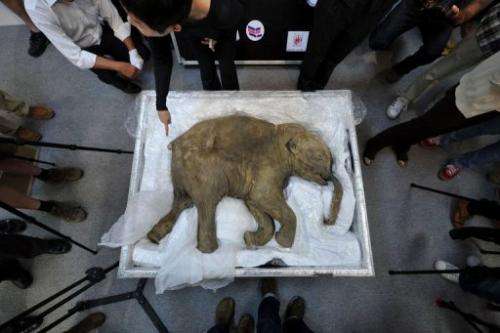
The carcass of the world's most well-preserved baby mammoth, named Lyuba, is displayed in Hong Kong. Lyuba, whose carcass is 42 thousand years old was found by a reindeer herder in Yamal Peninsula in Russia on 2007.

The world's best-preserved mammoth, buried about 42,000 years ago, will go on display in Hong Kong this week, the organiser of its first exhibition in Asia said Wednesday.

Discovered in the of Russia's Yamal Peninsula in 2007 by a reindeer herder, the female baby mammoth named Lyuba remained almost fully intact with organs and eyelashes preserved.

Only her toenails, part of her tail, right ear and were missing.

Traces of her mother's milk were even found in Lyuba's stomach, said the IFC mall, the city's posh harbourfront shopping centre, which will showcase the animal for a month from Thursday.

Lyuba, which means "love" in Russian, has previously toured North America.

Scientists have said they believe the ice-age was only a few months old when she probably drowned in a mudslide, which "pickled" her in near-perfect condition.

Explore further: Actor Johnny Depp immortalized in ancient fossil find

add to favorites email to friend print save as pdf

Related Stories

Baby mammoth preserved in frozen soil heads to Chicago

Oct 04, 2009

Sucked to her death in a muddy river bed, a baby woolly mammoth spent 40,000 years frozen in the Siberian permafrost where her body was so perfectly preserved traces of her mother's milk remained in her belly.

Scans became a mammoth project

Feb 22, 2010

Lyuba was not typical of the subjects Jason Polzin examines with X-ray, CT or MRI machines at GE Healthcare.

Japan, Russia see chance to clone mammoth

Dec 04, 2011

Scientists from Japan and Russia believe it may be possible to clone a mammoth after finding well-preserved bone marrow in a thigh bone recovered from permafrost soil in Siberia, a report said Saturday.

Recommended for you

The eloquence of the otoliths

May 16, 2013

Fish fossils that are about 23 million years old give unprecedented insight into the evolutionary history of the gobioid order, one of the most species-rich groups among the modern bony fishes.

Light cast on lifestyle and diet of first New Zealanders

May 16, 2013

(Phys.org) —A University of Otago-led multidisciplinary team of scientists have shed new light on the diet, lifestyles and movements of the first New Zealanders by analysing isotopes from their bones and teeth.

mtDNA study shows Minoans came from Europe not Africa

May 15, 2013

(Phys.org) —A new study conducted by a team of American and Greek researchers has found that the people of the ancient Minoan civilization living on the island of Crete most likely came from Europe. In ...

User comments : 2

Adjust slider to filter visible comments by rank

Display comments: newest first

WorldJunkie
3 / 5 (2) Apr 11, 2012
"Lyuba" doesn't mean "love" in Russian. " Lyubov' " does, and it can also be a female name. "Lyuba" is a diminutive of it, but only in its name, not noun, context.
Burnerjack
not rated yet Apr 11, 2012
Can it be cloned?

More news stories

Evolution of lying

(Phys.org) —Ultimately, our ability to convincingly lie to each other may have evolved as a direct result of our cooperative nature.

Morocco to harness the wind in energy hunt

Morocco is ploughing ahead with a programme to boost wind energy production, particularly in the southern Tarfaya region, where Africa's largest wind farm is set to open in 2014.

Galaxy's Ring of Fire

Johnny Cash may have preferred this galaxy's burning ring of fire to the one he sang about falling into in his popular song. The "starburst ring" seen at center in red and yellow hues is not the product of ...