Scientists suggest evidence of recent lunar volcanism
Apr 16, 2012 By Jason Major
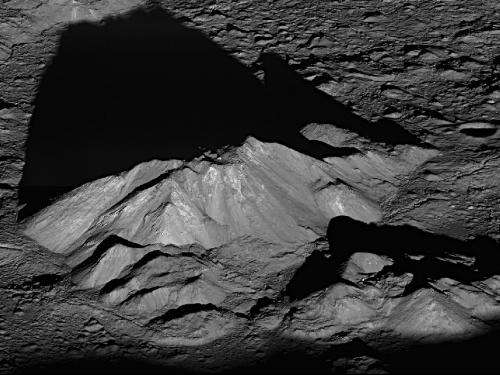
The central peak of Tycho crater may hold volcanic clues, according to a report from an Indian research team. Credit: NASA Goddard/Arizona State University

A team of researchers at India’s Physical Research Laboratory (PRL) claims it has found evidence of relatively recent volcanic activity on the Moon, using data from NASA’s Lunar Reconnaissance Orbiter and the Chadrayaan-1 spacecraft. According to the findings the central peak of Tycho crater contains features that are volcanic in origin, indicating that the Moon was geologically active during the crater’s formation 110 million years ago.

In an article by the Deccan Herald, a Bangalore-based  publication, the PRL researchers claim that vents, lava channels and solidified flows of inner crustal material found within Tycho were made as recently as 100 million years ago — after the creation of the crater.

This could indicate that there was pre-existing volcanic activity within the Moon at the site of the Tycho impact, lending credence to the idea that the Moon was recently geologically active.

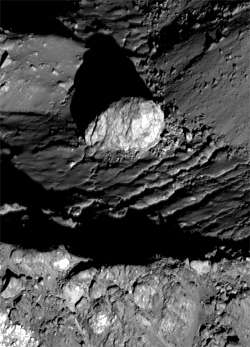
In addition, large boulders ranging in size from 33 meters to hundreds of yards across have been spotted on Tycho’s central peaks by LRO, including one 400-foot (120-meter) -wide specimen nestled atop the highest summit. How did such large boulders get there and what are they made of?
Scientists suggest evidence of recent lunar volcanism
A 400-foot-wide boulder within the central peak of Tycho. Credit: NASA/GSFC/LROC

The researchers hint that they may also be in origin.

“A surprise findings revealed the  presence of large boulders–about 100 meter in size –on top of the peak. Nobody knew how did they reach the top,” said Prakash Chauhan, a PRL scientist.

Without further studies it’s difficult to determine the exact origin and ages of these lunar formations. The team awaits future research by Chandrayaan-II, which will examine the from orbit as well as land a rover onto the lunar surface. Chandrayaan-II is expected to launch in early 2014.

The PRL team’s findings were published in the April 10 issue of Current Science.

Read the article in the Deccan Herald here.

Explore further: Mice, gerbils perish in Russia space flight

add to favorites email to friend print save as pdf

Related Stories

Sunrise view of Tycho crater's peak

Jun 30, 2011

(PhysOrg.com) -- On June 10, 2011, NASA's Lunar Reconnaissance Orbiter spacecraft angled its orbit 65° to the west, allowing the LRO Camera NACs to capture a dramatic sunrise view of Tycho crater.

Face-to-face with some shattered lunar boulders

Feb 28, 2012

Breaking up may be hard to do, but these two lunar boulders seem to have succeeded extremely well! Imaged by the Lunar Reconnaissance Orbiter Camera (LROC) in October of 2009, this crumbled couple was recently ...

LRO lets you stand on the rim of Aristarchus crater

Dec 30, 2011

Have you ever you looked up at the bright, cavernous Aristarchus Crater on the Moon through a telescope or binoculars and wondered what it would be like to stand on the rim and peer inside? Spectacular new ...

Gravity changes along the Moon

Apr 06, 2012

Using detailed topographic information from NASA’s Lunar Reconnaissance Orbiter mission, Curtin’s Western Australian School of Mines (WASM) spatial scientists, Dr. Christian Hirt and Professor Will ...

Does Mars still shake, rattle and roll?

Mar 13, 2012

Compared to Earth, Mars is a relatively quiet planet, geologically speaking. Actually, very quiet, as in pretty much dead. While it has volcanoes much larger than any here, they have been inactive ...

Recommended for you

Mice, gerbils perish in Russia space flight

22 hours ago

A number of mice and eight gerbils sent into space in a Russian capsule destined to find out how well organisms can withstand extended flights perished during their journey, scientists said Sunday as the ...

Mars rover Opportunity examines clay clues in rock

May 18, 2013

(Phys.org) —NASA's senior Mars rover, Opportunity, is driving to a new study area after a dramatic finish to 20 months on "Cape York" with examination of a rock intensely altered by water.

NASA's STEREO detects a CME from the sun

May 17, 2013

On 5:24 a.m. EDT on May 17, 2013, the sun erupted with an Earth-directed coronal mass ejection or CME, a solar phenomenon that can send billions of tons of solar particles into space that can reach Earth ...

Nine-year-old Mars rover passes 40-year-old record

May 17, 2013

While Apollo 17 astronauts Eugene Cernan and Harrison Schmitt visited Earth's moon for three days in December 1972, they drove their mission's Lunar Roving Vehicle 19.3 nautical miles (22.210 statute miles ...

User comments : 0

More news stories

Cracking the ice code

(Phys.org) —What happened the last time a vegetated Earth shifted from an extremely cold climate to desert-like conditions? And what does it tell us about climate change today?

Engineers' nanoantennas improve infrared sensing

(Phys.org) —A team of University of Pennsylvania engineers has used a pattern of nanoantennas to develop a new way of turning infrared light into mechanical action, opening the door to more sensitive infrared ...

Mapping a route to stem cell therapies

Monash University researchers are shedding light on the complex processes that underpin the creation and differentiation of stem cells, bringing closer the promise of 'miracle' therapies.

Lymphatic fluid takes detour

When tumours metastasise, they can block lymphatic vessels, as researchers from ETH Zurich have discovered using a new method. The lymphatic fluid subsequently has to find a new path through the tissue. Such ...