Satellite beacon mission suggested for asteroid Apophis
Apr 10, 2012 By Nancy Atkinson, Universe Today
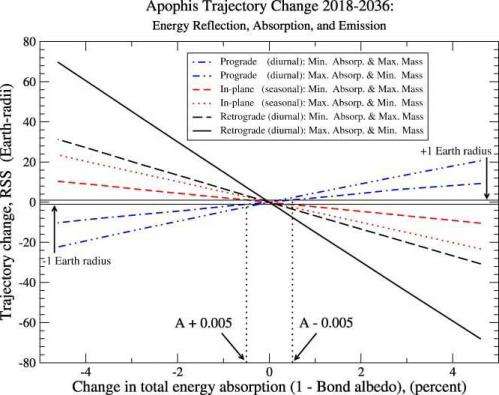
The potential change in Apophis' position by 2036 caused by altering energy absorption for the extreme spin pole and mass combinations shown (the most effective and least effective cases) starting in 2018. Credit: J. Giorgini (JPL)

According to a Russian news story, a report just released by the Russian Academy of Sciences suggests sending a satellite with a radio beacon to asteroid 99942 Apophis for better determining its trajectory and finding out how big of a threat it might be to Earth in passes the asteroid will make in 2036 and 2068.

“From the technical point of view, the mission could be started for implementation from 2015,” the Academy said in the report.

Apophis is expected to make a record-setting — but harmless — close approach to Earth on Friday, April 13, 2029 when it comes no closer than 29,450 km from Earth (18,300 miles), well within. Astronomers have ruled out any possibility of an impact in 2029, but that close pass could alter its for subsequent close passes. Right now, astronomers estimate the probability of Apophis impacting Earth on its following pass in 2036 is about 1 in 250,000. Another encounter by the asteroid with Earth in 2068 currently has a chance of impact at approximately 1 in 333,000, as of the estimates released in October of 2009.

Like all preliminary estimates, NASA says it is expected that the 2068 encounter will diminish in probability as more information about the 2029 pass by Apophis is acquired.

The Russian report said the core target of the possible mission would be to clarify the exact trajectory of Apophis for up to 2036. The could be equipped with a radioisotope power source with a buffer battery.

Other scientists have suggested missions to place equipment on the Apophis’ surface, which could for the first time study an asteroid’s interior. Because the torque caused by the Earth’s gravitational pull will cause surface and interior disruption to Apophis, scientists have a unique opportunity to observe its otherwise inaccessible mechanical properties.

Apophis is approximately Its diameter is approximately 270 meters (885 ft), the size of two-and-a-half football fields.

Initially, when first discovered in 2004, Apophis was thought to have a 2.7 percent chance of impacting Earth in 2029, but as scientists have made better and more detailed observations, they were able to recalculate the path of Apophis, determining that there was no chance it would hit Earth in 2029 and significantly downgrading the odds of it hitting on future passes.

“The refined orbital determination further reinforces that Apophis is an we can look to as an opportunity for exciting science and not something that should be feared,” said Don Yeomans, manager of the NEO Program Office at JPL. “The public can follow along as we continue to study Apophis and other near-Earth objects by visiting us on our AsteroidWatch Web site and by following us on the @AsteroidWatch Twitter feed.”

See more information from NASA’s NEO office.

Explore further: Field tests in Mojave Desert pave way for human exploration of small bodies

add to favorites email to friend print save as pdf

Related Stories

NASA Refines Asteroid Apophis' Path Toward Earth

Oct 07, 2009

(PhysOrg.com) -- Using updated information, NASA scientists have recalculated the path of a large asteroid. The refined path indicates a significantly reduced likelihood of a hazardous encounter with Earth ...

NASA Statement on Student Asteroid Calculations

Apr 17, 2008

The Near-Earth Object Program Office at NASA's Jet Propulsion Laboratory in Pasadena, Calif., has not changed its current estimates for the very low probability (1 in 45,000) of an Earth impact by the asteroid ...

Chinese propose method for deflecting asteroid Apophis

Aug 22, 2011

(PhysOrg.com) -- Chinese scientist Shengping Gong and associates at Tsinghua University in Beijin have proposed an alternative method of deflecting the asteroid Apophis to ensure that it does not strike the ...

Astronomers continue to monitor asteroid Apophis

Mar 11, 2011

Asteroid Apophis continues to be an object of interest for astronomers. Even though the possibility of an Earth impact by the now-famous asteroid has been ruled out during its upcoming close encounter on April ...

Recommended for you

Mars rover Opportunity examines clay clues in rock

May 18, 2013

(Phys.org) —NASA's senior Mars rover, Opportunity, is driving to a new study area after a dramatic finish to 20 months on "Cape York" with examination of a rock intensely altered by water.

NASA's STEREO detects a CME from the sun

May 17, 2013

On 5:24 a.m. EDT on May 17, 2013, the sun erupted with an Earth-directed coronal mass ejection or CME, a solar phenomenon that can send billions of tons of solar particles into space that can reach Earth ...

Nine-year-old Mars rover passes 40-year-old record

May 17, 2013

While Apollo 17 astronauts Eugene Cernan and Harrison Schmitt visited Earth's moon for three days in December 1972, they drove their mission's Lunar Roving Vehicle 19.3 nautical miles (22.210 statute miles ...

Bright explosion on the Moon

May 17, 2013

For the past 8 years, NASA astronomers have been monitoring the Moon for signs of explosions caused by meteoroids hitting the lunar surface. "Lunar meteor showers" have turned out to be more common than anyone ...

User comments : 1

Adjust slider to filter visible comments by rank

Display comments: newest first

ScottyM23
1 / 5 (1) Apr 10, 2012
I am a science-fiction author and about four years ago I wrote a short story that is almost this exact same thing...the same countries are involved, too. Of course there are some differences regarding the plot and such, but it revolves around the same concept, techniques, and idea.

More news stories

Galaxy's Ring of Fire

Johnny Cash may have preferred this galaxy's burning ring of fire to the one he sang about falling into in his popular song. The "starburst ring" seen at center in red and yellow hues is not the product of ...