Envisat - biggest environment satellite - goes silent
Apr 12, 2012
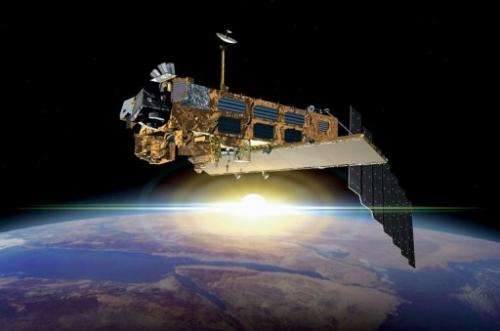
An artist's impression of Envisat, the Earth observation satellite launched on March 2002. The European Space Agency has said it had lost contact with Envisat, the biggest Earth-monitoring satellite in history.

The European Space Agency said Thursday it had lost contact with Envisat, the biggest Earth-monitoring satellite in history.

Designed to operate for only five years, Envisat was launched in March 2002, carrying 10 instruments to monitor the planet's oceans, ice, land and atmosphere.

The giant 8.2-tonne, 10.5-metre (34.1-foot) craft carried on working for a decade, racking up a total of 2.25 billion kilometres (1.4 billion miles), or more than 50,000 orbits, ESA said.

The satellite failed to make a radio call on April 8 as it passed over a ground station at Kiruna in Sweden, the agency said.

It has assembled a "recovery team" of engineers, scientists and mission operators in the hope of restoring contact with Envisat, which remains in a stable orbit.

Envisat's data has been used in 4,000 science projects in 70 countries, including landmark research into climate change.

Its study of was used last year to simulate dispersal of nuclear pollution from the Fukushima accident, and it gained real-time images of the in the Gulf of Mexico in 2010.

It has also been an important tool in tackling illegal fishing.

ESA had hoped to keep Envisat going until its seven replacements, the so-called Sentinel satellites, start being launched in 2013.

Explore further: Field tests in Mojave Desert pave way for human exploration of small bodies

add to favorites email to friend print save as pdf

Related Stories

Envisat still going strong after five successful years

Feb 28, 2007

Launched from Kourou in French Guiana on the night of 28 February 2002, ESA’s Envisat spacecraft marks its fifth year in space. Having orbited Earth more than 26 000 times, the world’s largest and most ...

The new home of Envisat

Oct 28, 2010

ESA’s Earth-observing satellite Envisat has moved to a lower orbit in order to conserve fuel and extend its life by three years, and is once again delivering invaluable data to thousands of scientists.

ESA extends Envisat satellite mission

Jun 05, 2009

(PhysOrg.com) -- ESA Member States have unanimously voted to extend the Envisat mission through to 2013. Envisat - the world’s largest and most sophisticated satellite ever built - has been providing scientists ...

Happy birthday, Envisat

Mar 02, 2012

(PhysOrg.com) -- In the early hours of 1 March 2002, the largest Earth observation satellite ever built soared into orbit from ESA’s launch base in Kourou, French Guiana. For a decade, Envisat has been ...

Explore planet Earth in near-real time

Dec 05, 2006

Have you ever wanted to track natural events in progress, such as fires, floods and volcanic eruptions, or simply explore the planet through the eyes of a satellite? ESA has created a website, MIRAVI, which ...

Recommended for you

Mars rover Opportunity examines clay clues in rock

17 hours ago

(Phys.org) —NASA's senior Mars rover, Opportunity, is driving to a new study area after a dramatic finish to 20 months on "Cape York" with examination of a rock intensely altered by water.

NASA's STEREO detects a CME from the sun

May 17, 2013

On 5:24 a.m. EDT on May 17, 2013, the sun erupted with an Earth-directed coronal mass ejection or CME, a solar phenomenon that can send billions of tons of solar particles into space that can reach Earth ...

Nine-year-old Mars rover passes 40-year-old record

May 17, 2013

While Apollo 17 astronauts Eugene Cernan and Harrison Schmitt visited Earth's moon for three days in December 1972, they drove their mission's Lunar Roving Vehicle 19.3 nautical miles (22.210 statute miles ...

Bright explosion on the Moon

May 17, 2013

For the past 8 years, NASA astronomers have been monitoring the Moon for signs of explosions caused by meteoroids hitting the lunar surface. "Lunar meteor showers" have turned out to be more common than anyone ...

User comments : 1

Adjust slider to filter visible comments by rank

Display comments: newest first

axemaster
not rated yet Apr 12, 2012
Oh great... Who wants to bet it got hit by orbital debris?

Well, either that or big disk shaped spaceships are going to be hovering over our cities this time tomorrow. Upload the virus!

More news stories

Galaxy's Ring of Fire

Johnny Cash may have preferred this galaxy's burning ring of fire to the one he sang about falling into in his popular song. The "starburst ring" seen at center in red and yellow hues is not the product of ...

Alaska volcano shoots ash 15,000 feet into the air

(AP)—One of Alaska's most restless volcanoes has shot an ash cloud 15,000 feet into the air in an ongoing eruption that has drawn attention from a nearby community but isn't expected to threaten air traffic.

Chinese, Indian airlines face EU pollution fines

Eight Chinese and two Indian airlines face fines of up to several million euros for not paying for their greenhouse gas emissions during flights within the bloc, the European Commission said on Friday.

US seizes Bitcoin operator accounts

US authorities seized the accounts of a Bitcoin digital currency exchange operator, claiming it was functioning as an "unlicensed money service business," court documents showed Friday.

Morocco to harness the wind in energy hunt

Morocco is ploughing ahead with a programme to boost wind energy production, particularly in the southern Tarfaya region, where Africa's largest wind farm is set to open in 2014.