Cassini plasma spectrometer resumes operations
Mar 19, 2012
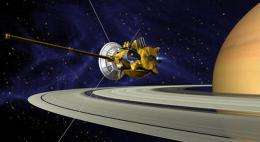
Artist concept of Cassini spacecraft. Image credit: NASA/JPL

(PhysOrg.com) -- The Cassini plasma spectrometer instrument (CAPS) aboard NASA's Cassini spacecraft at Saturn has resumed operations. Mission managers received confirmation on Friday, March 16, that it was turned on. They plan to monitor the instrument for any unusual behavior.

Last June, short circuits in the instrument led to unexpected voltage shifts on the spacecraft. As a precaution, mission managers turned off the CAPS instrument while engineers investigated the issue. The investigation led to the conclusion that tin plating on electronics components had grown "whiskers."

The whiskers were very small, less than the diameter of a human hair, but they were big enough to contact another conducting surface and carry electrical current. Researchers are still trying to understand why whiskers grow on tin and other metals, but they know now that whiskers can grow in space and on Earth. It is believed that these or additional tin whiskers that may grow on Cassini cannot carry enough current to cause problems, but will burn out on their own like a lightweight fuse.

Cassini launched in 1997 and has been exploring the Saturn system since 2004. The project completed its original prime mission in 2008 and has been extended twice. Cassini is now in its solstice mission, which will enable scientists to observe seasonal change in the Saturn system through the northern summer solstice.

Explore further: NASA's STEREO detects a CME from the sun

add to favorites email to friend print save as pdf

Related Stories

Journey to Saturn From Your Computer

Feb 01, 2008

Want a peek at Saturn as seen from space? A new interactive 3-D viewer that uses a game engine and allows users to travel to Saturn and see it the way the Cassini spacecraft sees it is now online at http://saturn.jpl.nasa.gov/multimedia/CASSIE ...

Cassini testing part of its radio system

Jan 13, 2012

Engineers with NASA's Cassini mission are conducting diagnostic testing on a part of the spacecraft's radio system after its signal was not detected on Earth during a tracking pass in late December. The spacecraft ...

The secrets of Saturn's moons

Apr 13, 2010

(PhysOrg.com) -- Saturn's moons have become a source of increasing fascination thanks to a stream of data from the Cassini-Huygens spacecraft.

Engineers assessing Cassini spacecraft

Nov 05, 2010

Engineers at NASA's Jet Propulsion Laboratory, Pasadena, Calif., are working to understand what caused NASA's Cassini spacecraft to put itself into "safe mode," a precautionary standby mode. Cassini entered ...

Cassini delivers holiday treats from Saturn

Dec 22, 2011

(PhysOrg.com) -- No team of reindeer, but radio signals flying clear across the solar system from NASA’s Cassini spacecraft have delivered a holiday package of glorious images. The pictures, from Cassini’s ...

Recommended for you

NASA's STEREO detects a CME from the sun

12 hours ago

On 5:24 a.m. EDT on May 17, 2013, the sun erupted with an Earth-directed coronal mass ejection or CME, a solar phenomenon that can send billions of tons of solar particles into space that can reach Earth ...

Nine-year-old Mars rover passes 40-year-old record

21 hours ago

While Apollo 17 astronauts Eugene Cernan and Harrison Schmitt visited Earth's moon for three days in December 1972, they drove their mission's Lunar Roving Vehicle 19.3 nautical miles (22.210 statute miles ...

Bright explosion on the Moon

22 hours ago

For the past 8 years, NASA astronomers have been monitoring the Moon for signs of explosions caused by meteoroids hitting the lunar surface. "Lunar meteor showers" have turned out to be more common than anyone ...

User comments : 3

Adjust slider to filter visible comments by rank

Display comments: newest first

Tangent2
2.3 / 5 (3) Mar 19, 2012
"An investigation pointed to "tin whiskers" growing on electronic components as the culprit, causing a short. NASA says these tiny metal filaments can grow in space just like on Earth."

So how did they remove the tin and fixed the problem?
ACW
not rated yet Mar 19, 2012
They did seem to be a bit short with the remedy of the problem...
PieRSquare
not rated yet Mar 19, 2012
It's been there since 2004. The mission was extended in 2008.

More news stories

Chinese, Indian airlines face EU pollution fines

Eight Chinese and two Indian airlines face fines of up to several million euros for not paying for their greenhouse gas emissions during flights within the bloc, the European Commission said on Friday.

Alaska volcano shoots ash 15,000 feet into the air

(AP)—One of Alaska's most restless volcanoes has shot an ash cloud 15,000 feet into the air in an ongoing eruption that has drawn attention from a nearby community but isn't expected to threaten air traffic.

Bright explosion on the Moon

For the past 8 years, NASA astronomers have been monitoring the Moon for signs of explosions caused by meteoroids hitting the lunar surface. "Lunar meteor showers" have turned out to be more common than anyone ...

Earth's iron core is surprisingly weak, researchers say

The massive ball of iron sitting at the center of Earth is not quite as "rock-solid" as has been thought, say two Stanford mineral physicists. By conducting experiments that simulate the immense pressures deep in the planet's ...

US seizes Bitcoin operator accounts

US authorities seized the accounts of a Bitcoin digital currency exchange operator, claiming it was functioning as an "unlicensed money service business," court documents showed Friday.

Temporal processing in the olfactory system

The neural machinery underlying our olfactory sense continues to be an enigma for neuroscience. A recent review in Neuron seeks to expand traditional ideas about how neurons in the olfactory bulb might encode information about ...