Canadian Arctic to lead national growth
Mar 14, 2012
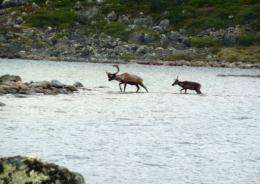
Reindeers crossing a lake in Quebec's tundra, in 2011. Canada's northern territories will lead the nation in growth in the next two years, buoyed by high commodities prices and a ramping up of new mines, a report said Wednesday.

Canada's northern territories will lead the nation in growth in the next two years, buoyed by high commodities prices and a ramping up of new mines, a report said Wednesday.

The Conference Board of Canada in its Territorial Outlook study forecast real gross domestic product in the Yukon, Northwest Territories and Nunavut to collectively grow by more than seven percent in both 2012 and 2013, outpacing the Canadian average of 2.1 percent this year.

It points to an Arctic exploration boom with spending topping $700 million last year, several large projects proposed for this decade, and expanded production of gold, silver, copper, diamonds, iron ore, and , along with new railways, power plants and ports.

"While the global economy is facing challenges that dampen the outlook for many Canadian industries and provinces, demand for metals and non-metals is expected to hold up," said Marie-Christine Bernard, the report's lead author.

A relatively stable Canadian economy, low financing rates and an elevated Canadian dollar should also help convince business leaders to keep boosting capital investments, the report said.

Mining companies, however, must contend with environmental concerns, such as a planned rail route crossing environmentally sensitive hunting grounds used by nearby communities, harsh Arctic conditions -- a kitchen fire forced the evacuation of 300 workers at Agnico-Eagle's Meadowbank gold mine last year -- and a skilled labor shortage.

The Northwest Territories' diamond production declined last year but is expected to rebound as demand outstrips supply.

The report notes that not all the mining projects have the green light for development, but have made sufficient progress to be included in the board's analysis.

Avalon Rare Metal's Nechalacho rare earth elements project near Thor Lake, for example, is now ranked as the largest rare earth deposit outside of China, but production will not start until 2015.

The outlook also assumes EU nations will not default on sovereign debt, the US economy will grow at a modest pace, and both Latin America and the Asia-Pacific region will only experience a slight dip in growth.

Explore further: Astonishing hi-resolution satellite views of the destruction from the Moore, Oklahoma tornado

add to favorites email to friend print save as pdf

Related Stories

Canada hunts for rare earth metals as China cuts back

Dec 21, 2011

A steep decline in Chinese exports of rare earth metals used in many hi-tech gadgets has forced a global search for new crucial supplies and hopes are high for major finds in Canada, analysts say.

Latin America mining boom clashes with conservation

Feb 12, 2012

Latin America is experiencing a mining boom as prices rise fuelled by a hike in global demand, but the region is also being hit by a wave of violent protests, strikes and rallies by environmentalists.

Rare-earth mining operation to revive in US

Dec 21, 2010

After signing deals with major Japanese trading houses that have been rushing to secure new sources of rare earths, mining company Molycorp Inc. plans to restart its rare-earth mining in California by the end of the year.

Recommended for you

Strong earthquake at exceptional depth

May 24, 2013

This morning at 05:45 CEST, the earth trembled beneath the Okhotsk Sea in the Pacific Northwest. The quake, with a magnitude of 8.2, took place at an exceptional depth of 605 kilometers. Because of the great ...

Marine forecasting on the horizon for Indian Ocean Rim

May 24, 2013

Nearly all of the member countries of the Indian Ocean Rim Association for Regional Cooperation (IOR-ARC) will attend the week-long workshop to further cooperation and understanding on international ocean ...

Russia evacuates drifting Arctic research station

May 23, 2013

Russia has ordered the urgent evacuation of the 16-strong crew of a drifting Arctic research station after ice floe that hosts the floating laboratory began to disintegrate, officials said Thursday.

User comments : 0

More news stories

Galaxies fed by funnels of fuel

(Phys.org) —Computer simulations of galaxies growing over billions of years have revealed a likely scenario for how they feed: a cosmic version of swirly straws.

Century-old science helps confirm global warming

(Phys.org) —Ocean measurements taken more than 135 years ago during the scientific expedition of HMS Challenger have provided further confirmation of human-produced global warming over the past century.