Giving research a boost with cheaper biochips
Mar 14, 2012 By Sarah Perrin

An EPFL invention has drastically reduced the cost of producing biochips, which are used to measure glucose and drug levels in the blood and to detect biomolecules and cellular signals. This development could make it possible to carry out analyses that are currently considered too expensive, and thus boost many areas of research.

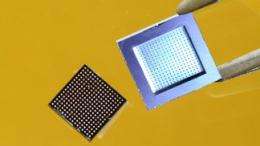
Biochips, used to diagnose , detect tumor markers and measure substances in the blood such as glucose, drugs or doping agents, have become widespread in the medical world over the past 20 years. Scientists in EPFL’s Laboratory of Life Sciences Electronics (CLSE) have recently completely re-engineered the design of these semiconductor biochips, coming up with a way to make them re-usable. This in turn reduces their cost by a factor of ten, which otherwise would correspond to hundreds of francs a piece. The was recently described in an article and an interview in the scientific journal Electronics Letters.

“The advance that we are proposing could seriously boost research in several fields,” says CLSE director Carlotta Guiducci. “Many projects, such as those looking at new ways to analyze various molecules, thus become possible, even though right now they’re difficult to carry out because experimentation using CMOS biochips is simply too expensive.”

This video is not supported by your browser at this time.

In the core of the biochip, the risk of contact between samples containing the material to be tested – DNA, molecules, neurons or cells – and the electronics has up to now obliged users to throw them away after a single use. “The electronics aren’t compatible with the liquid environment of the sample; they can be easily damaged and the reliability of the analysis results can be compromised,” explains Yuksel Temiz, a PhD student in CLSE. “This limits their usefulness and has prevented large scale commercialization.”

To solve this problem, the EPFL scientists looked at how they could separate the liquids that needed to be analyzed from the electronic circuits. In the Center for Micronanotechnologies (CMi) cleanrooms, they developed a procedure to manufacture a component that is placed on top of the electronics, like a kind of cap. The sample of biological material, placed in the cap, never enters into contact with the circuits. Its electrical impulses are transmitted to the circuit by an array of electrodes passing through the silicon layer of the cap.

Once the analysis is done, the cap is thrown away. The caps are easy to manufacture in large quantities in cleanrooms, can be customized for the needs of each laboratory, and are very cheap – only two francs each. And because the circuits have been protected from the liquid sample, they can be re-used several times. Researchers hope to be able to use a circuit at least ten times instead of just once. This will also allow more extended measurements and thus longer and more complete analyses.

Explore further: Amazon expands Kindle tablet sale to 170 countries (Update)

More information: Electronics Letters, "Semiconductors in Personalised Medicine"Electronics Letters, interview with Carlotta Guiducci

Provided by Ecole Polytechnique Federale de Lausanne

5 /5 (1 vote)

Related Stories

A new motor for the watch of tomorrow

Aug 04, 2011

An electromagnetic three-phase motor, invented by EPFL’s Integrated Actuators Laboratory, will enable the watchmaking industry to build watches that are three times more efficient and that can include ...

First molybdenite microchip

Dec 05, 2011

(PhysOrg.com) -- Molybdenite, a new and very promising material, can surpass the physical limits of silicon. EPFL scientists have proven this by making the first molybdenite microchip, with smaller and more ...

A touchscreen you can really feel (w/ video)

Nov 16, 2011

(PhysOrg.com) -- Swiss researchers have invented a new generation of tactile surfaces with relief effects – users can feel actual raised keys under their fingers. This technology could have many applications, particularly ...

Bits of life, drop by drop

Jan 16, 2012

(PhysOrg.com) -- Swiss scientists are working on creating artificial living tissues using a very special kind of inkjet printer. Still in its initial stages, this technology could nonetheless soon provide ...

Recommended for you

Review: HP Sleekbook 15 combines size, style

3 hours ago

My experience with Windows 8 has been limited to a few devices, including the Microsoft Surface, so I was happy to get the opportunity to review the Hewlett-Packard Pavilion Sleekbook 15, a fairly inexpensive ...

First Look: New Xbox elegant, but much unknown

May 22, 2013

Will gamers want One? After four years of development, Microsoft unveiled the Xbox One entertainment console and touted it as an all-in-one solution for playing games, watching TV and doing everything in ...

The new consoles from Microsoft, Nintendo and Sony

May 21, 2013

Microsoft is the last of the three big video game console makers to unveil its latest gaming system. Tuesday's unveiling comes nearly eight years after the Xbox 360 went on sale. It follows last fall's de ...

User comments : 0

More news stories

Review: HP Sleekbook 15 combines size, style

My experience with Windows 8 has been limited to a few devices, including the Microsoft Surface, so I was happy to get the opportunity to review the Hewlett-Packard Pavilion Sleekbook 15, a fairly inexpensive ...

Expectations high for next Xbox

It's almost time for a new Xbox. Eight years have passed since Microsoft unveiled the Xbox 360, double the amount of time between the original Xbox debut in 2001 and its high-definition successor's launch ...

First Look: New Xbox elegant, but much unknown

Will gamers want One? After four years of development, Microsoft unveiled the Xbox One entertainment console and touted it as an all-in-one solution for playing games, watching TV and doing everything in ...

Galaxies fed by funnels of fuel

(Phys.org) —Computer simulations of galaxies growing over billions of years have revealed a likely scenario for how they feed: a cosmic version of swirly straws.

Google eyes emerging markets networks

Google has become deeply involved in a series of projects to build and operate wireless networks in emerging markets including sub-Saharan Africa and Southeast Asia, a report said Friday.