New research reveals why fishermen keep fishing despite dwindling catches
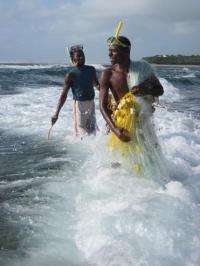
Half of fishermen would not give up their livelihood in the face of drastically declining catches according to research led by the University of East Anglia (UEA).
A new report, published today by PLoS ONE, challenges previously held notions about poverty and adaptation by investigating why fishermen in developing countries stick with their trade.
Lead author Dr Tim Daw from UEA's School of International Development and the Stockholm Resilience Centre said: "We found that half of fishermen questioned would not be tempted to seek out a new livelihood – even if their catch declined by 50 per cent. But the reasons they cling on to their jobs are influenced by much more than simple profitability."
Fisheries are challenged by the combined effects of overfishing, climate change, deteriorating ecosystems and conservation policies. Understanding how fishermen respond to these changes is critical to managing fisheries.
The research project is the largest of its kind and was undertaken as a joint project with the Wildlife Conservation Society, the School of Marine Science and Technology at Newcastle University, and the ARC Centre of Excellence for Coral Reef Studies at James Cook University in Australia.
Researchers surveyed almost 600 fishers across Kenya, Tanzania, the Seychelles, Mauritius and Madagascar about how they would respond to hypothetical catch declines.
They then investigated how social and economic conditions, such as local culture and socioeconomic development, influenced whether fishermen were willing to give up their trade.
"Surprisingly, fishermen in the more vibrant and developed economies were less likely to give up their trade – despite having more economically fruitful opportunities open to them," said co-author Dr Joshua Cinner from the ARC Centre of Excellence for coral reef Studies in Australia.
"This is the reverse of the common belief that poor communities are less likely to adapt than wealthy ones. We suspect that this may be in part due to the perverse impacts of subsidies in more developed countries encouraging people to stay in the fishery which would otherwise not be profitable."
Dr Daw said: "But reduced profitability was certainly not the only deciding factor. Fishers often have an occupational attachment, job satisfaction, family tradition, culture, and a sense of identity, which makes them reluctant to stop fishing – even when it would be an economically rational decision."
The research demonstrates the complexity of decision making and how willingness to adapt is influenced by a range of factors.
"We have found that willingness to adapt to change is influenced by characteristics of the individual fishermen, their households, and most importantly, the local conditions where they live and work," said Dr Daw.
"Previous studies have been too small to offer insights into larger scale factors. Undertaking such a large study in multiple countries across a gradient of wealth, has allowed us to compare the importance of these factors at different scales for the first time.
Tim McClanahan from the Wildlife Conservation Society said: "It is important to understand why and when fishers will leave a fishery, as the creation of parks, management restrictions, and ecological disasters require that fishers change or leave their fishing practices.
"One of the unexpected findings was that fishermen in a poor country like Madagascar would leave the fishery sooner than those in wealthier countries such as Seychelles. The reason seems to be that they already have diversified livelihoods, while fishermen in wealthier countries may be locked into this occupation.
"This is contrary to many arguments about the impacts of management and climate change on poor people, so will surprise many people working in this field and on resource and disaster management policies"
The findings add to a growing raft of literature which identifies multiple interlocking and dynamic factors which affect people's capacity to deal with environmental change. It is hoped they will help identify points of intervention for conservation policies that aim to reduce fishing effort. They could also help communities become more adaptive to change.
It also highlights the importance of understanding resource-based livelihoods, such as fishing and farming, in the context of the wider economy and society.
More information: 'To Fish or Not to Fish: Factors at Multiple Scales Affecting Artisanal Fishers' Readiness to Exit a Declining Fishery' is published by PLoS ONE on February 9.
Provided by University of East Anglia


