Mn-doped ZnS is unsuitable to act as a dilute magnetic semiconductor
Dilute magnetic semiconductors (DMS) have recently been a major focus of magnetic semiconductor research. A laboratory from the University of Science and Technology of China explored the feasibility of doping manganese (Mn) into zinc sulfide (ZnS) to obtain magnetic semiconductors.
Hideo Ohno and his group at the Tohoku University, Japan, were the first to measure ferromagnetism in transition metal-doped semiconductors such as indium arsenide and gallium arsenide doped with Mn. Ever since, researchers have attempted to obtain semiconductor hosts doped with different transition metals that exhibit ferromagnetic properties.
A team of researchers from Hefei National Laboratory for Physical Sciences at the Microscale, University of Science and Technology of China, discovered that Mn-doped ZnS (ZnS:Mn) shows paramagnetic behavior and is not suitable for use as a DMS. Their work entitled "Structure Characterization, Magnetic and Photoluminescence Properties of Mn-Doped ZnS Nanocrystalline" was published in SCIENCE CHINA Physics, Mechanics & Astronomy, 2012, Vol 55(2) .
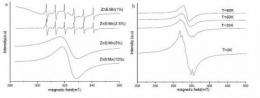
Electron spin resonance (ESR) spectra (Figure 1a) of nanocrystalline ZnS:Mn show that at lower concentrations of Mn, a typical sextet centered at a g-value of 2 is associated with the allowed (Δms=±1, ΔmI=0) magnetic dipole transitions between the hyperfine-split Zeeman levels of the 6S5/2 ground state of the Mn2+ 3d electrons. The hyperfine structure arises from the interaction between the S=5/2 spin of the unpaired 3d electrons with I= 5/2 spin of the 55Mn nucleus. This indicates that Mn ions are distributed in the ZnS nanocrystalline lattice so that they are isolated from each other. At higher concentrations of Mn, the ions assemble together and are localized in the ZnS crystal lattice, decreasing the Mn-Mn atomic distance and increasing the dipole-dipole interaction. This causes the hyperfine structure to merge into one broad resonance. Further ESR experiments (Figure 1b) at low temperature also suggested that the sample was not ferromagnetic. All of the results indicated that ZnS:Mn is paramagnetic and not suitable for DMS.
More information: Zuo M, Tan S, Li G P, et al.Structure characterization,magnetic and photoluminescence properties of Mn doped ZnS nanocrystalline. SCIENCE CHINA Physics, Mechanics & Astronomy,2012,55: 219-223
Provided by Science in China Press


