500 elephants killed in Cameroon park in 2 months
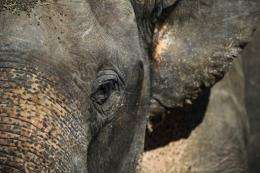
Nearly 500 elephants have been killed in a Cameroon national park in less than two months by poachers from Sudan and Chad, a park official told AFP on Thursday.
"As of today we estimate that 480 elephants have been slaughtered in our park," said Mathieu Fometa of the Bouba Ndjida National Park in northern Cameroon, near the border with Chad, where the animals roam freely.
"Formally, we did count 458 carcasses," he said, but he cautioned that "these figures may be an underestimate because the park covers 220,000 hectares (540,000 acres) and it isn't easy to travel to get accurate information."
On Thursday an AFP reporter saw 12 elephant carcasses at three sites in the park, some of them having been shot Tuesday according to sources.
Between Sunday and Tuesday "our teams counted at least 20 elephants killed" in those three days, said Fometa, who added that the killers were still in the park, having said in January they would stay for three months.
The government has taken no visible steps to secure the park.
The killers are "dozens of Sudanese and Chadian poachers armed with machine guns and operating in gangs on horseback," said International Fund for Animal Welfare official Celine Sissler-Bienvenu on the IFAW website.
"Nothing seems to be able to stop their reckless pursuit of ivory that began in mid-November in the Central African Republic, carried on in Chad in December, and ended in Cameroon in January."
Poaching in Cameroon wildlife parks has been on the rise in recent months, sources say, with the ivory mainly bound for Asia.
The IFAW said earlier that many orphaned elephant calves had been spotted abandoned following the shootings and concerns were high the babies may soon die of hunger and thirst.
(c) 2012 AFP
-
From lemons to lemonade: Reaction uses carbon dioxide to make carbon-based semiconductor,
32 comments
-
Thioridazine kills cancer stem cells in human while avoiding toxic side-effects of conventional cancer treatments,
3 comments
-
SpaceX private rocket blasts off for space station (Update),
42 comments
-
Climate scientists say they have solved riddle of rising sea,
31 comments
-
Landmark calculation clears the way to answering how matter is formed,
55 comments
-
osmotic pressure vs diffusion
3 hours ago
-
What would stain as translucent on light-coloured fabric?
May 26, 2012
-
How do I identify different bacteria on culture plates?
May 26, 2012
-
Why Do Dogs do Strange things...
May 25, 2012
-
What does exophillic and endophillic mean in terms of mosquito and their control?
May 24, 2012
-
Semen stains glows under black lights (uv light)?
May 23, 2012
- More from Physics Forums - Biology
More news stories
Manufacturing genes to attack flu virus
An international research team has manufactured a new protein that can combat deadly flu epidemics.
11 hours ago |
not rated yet |
0
|
Scientist: Evolution debate will soon be history
(AP) -- Richard Leakey predicts skepticism over evolution will soon be history. Not that the avowed atheist has any doubts himself.
May 26, 2012 |
3.4 / 5 (21) |
98
More plant species responding to global warming than previously thought
(Phys.org) -- Far more wild plant species may be responding to global warming than previous large-scale estimates have suggested.
May 22, 2012 |
4.6 / 5 (14) |
18
|
For monogamous sparrows, it doesn't pay to stray (but they do it anyway)
It's quite common for a female song sparrow to stray from her breeding partner and mate with the male next door, but a new study shows that sleeping around can be costly.
May 22, 2012 |
5 / 5 (2) |
8
|
Thousands of shellfish found dead in Peru
Thousands of crustaceans were found dead off the coast of Lima following the mystery mass death of dolphins and pelicans, the Peruvian Navy said Friday.
May 26, 2012 |
4.7 / 5 (7) |
7
'Unzipped' carbon nanotubes could help energize fuel cells, batteries
Multi-walled carbon nanotubes riddled with defects and impurities on the outside could replace some of the expensive platinum catalysts used in fuel cells and metal-air batteries, according to scientists at ...
Change in developmental timing was crucial in the evolutionary shift from dinosaurs to birds: study
At first glance, it's hard to see how a common house sparrow and a Tyrannosaurus Rex might have anything in common. After all, one is a bird that weighs less than an ounce, and the other is a dinosaur that ...
Computer model used to pinpoint prime materials for efficient carbon capture
When power plants begin capturing their carbon emissions to reduce greenhouse gases and to most in the electric power industry, it's a question of when, not if it will be an expensive undertaking.
T cells 'hunt' parasites like animal predators seek prey, study shows
By pairing an intimate knowledge of immune-system function with a deep understanding of statistical physics, a cross-disciplinary team at the University of Pennsylvania has arrived at a surprising finding: T cells use a movement ...
Yale study concludes public apathy over climate change unrelated to science literacy
Are members of the public divided about climate change because they don't understand the science behind it? If Americans knew more basic science and were more proficient in technical reasoning, would public consensus match ...
Land and sea species differ in climate change response: study
(Phys.org) -- Marine and terrestrial species will likely differ in their responses to climate warming, new research by Simon Fraser University and Australia’s University of Tasmania has found.