Cold and spellbinding: An alignment of planets in the sunset sky
February 20, 2012 By Dr. Tony Phillips
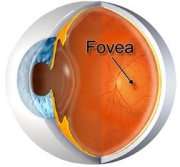
The fovea is responsible for our central, sharpest vision.
Note to sky watchers: Put on your winter coats. What youre about to read might make you feel an uncontrollable urge to dash outside.
The brightest planets in the solar system are lining up in the evening sky, and you can see the formationsome of it at leasttonight.
Go out at sunset and look west. Venus and Jupiter pop out of the twilight even before the sky fades completely black. The two brilliant planets surrounded by evening blue is a beautiful sight.
If you go out at the same time tomorrow, the view improves, because Venus and Jupiter are converging. In mid-February they are about 20 degrees apart. By the end of the month, the angle narrows to only 10 degreesso close that you can hide them together behind your outstretched palm. Their combined beauty grows each night as the distance between them shrinks.
A special night to look is Saturday, Feb. 25th, when the crescent Moon moves in to form a slender heavenly triangle with Venus, Jupiter and the Moon as vertices (sky map). One night later, on Sunday, Feb. 26th, it happens again (sky map). This arrangement will be visible all around the world, from city and countryside alike. The Moon, Venus and Jupiter are the brightest objects in the night sky; together they can shine through urban lights, fog, and even some clouds.
This video is not supported by your browser at this time.
After hopping from Venus to Jupiter in late February, the Moon exits stage left, but the show is far from over.In March, Venus and Jupiter continue their relentless convergence until, on March 12th and 13th, the duo lie only three degrees aparta spectacular double beacon in the sunset sky (sky map). Now youll be able to hide them together behind a pair of outstretched fingertips.
Theres something mesmerizing about stars and planets bunched together in this wayand, no, youre not imagining things when it happens to you. The phenomenon is based on the anatomy of the human eye.
"Your eye is a bit like a digital camera," explains optometrist Dr. Stuart Hiroyasu of Bishop, California. "There's a lens in front to focus the light, and a photo-array behind the lens to capture the image. The photo-array in your eye is called the retina. It's made of rods and cones, the organic equivalent of electronic pixels."
Theres a tiny patch of tissue near the center of the retina where cones are extra-densely packed. This is called the fovea.
"Whatever you see with the fovea, you see in high-definition," Hiroyasu says. The fovea is critical to reading, driving, watching television. The fovea has the brain's attention.
The field of view of the fovea is only about five degrees wide. Most nights in March, Venus and Jupiter will fit within that narrow cone. And when they dopresto! Its spellbinding astronomy.
Standing outdoors, mesmerized by planets aligned in a late winter sunset, you might just forget how cold you feel. Bring a coat anyway...
Provided by Science@NASA
-
From lemons to lemonade: Reaction uses carbon dioxide to make carbon-based semiconductor,
32 comments
-
Thioridazine kills cancer stem cells in human while avoiding toxic side-effects of conventional cancer treatments,
3 comments
-
SpaceX private rocket blasts off for space station (Update),
42 comments
-
Climate scientists say they have solved riddle of rising sea,
31 comments
-
Landmark calculation clears the way to answering how matter is formed,
55 comments
-
Distance of planets from stars and revolution
11 hours ago
-
revamping general concept and cosmological principle
May 25, 2012
-
Transiting Exoplanet Light Curve
May 25, 2012
-
Math behind Theoretical Physics
May 24, 2012
-
Do we know whats at the center of galaxies yet?
May 23, 2012
-
Structure of the Milky Way?
May 20, 2012
- More from Physics Forums - General Astronomy
More news stories
Yale study concludes public apathy over climate change unrelated to science literacy
Are members of the public divided about climate change because they don't understand the science behind it? If Americans knew more basic science and were more proficient in technical reasoning, would public consensus match ...
11 hours ago |
4.8 / 5 (6) |
27
|
Land and sea species differ in climate change response: study
(Phys.org) -- Marine and terrestrial species will likely differ in their responses to climate warming, new research by Simon Fraser University and Australia’s University of Tasmania has found.
9 hours ago |
4 / 5 (5) |
6
|
10 million years needed to recover from mass extinction
It took some 10 million years for Earth to recover from the greatest mass extinction of all time, latest research has revealed.
Space & Earth / Earth Sciences
11 hours ago |
4.2 / 5 (5) |
2
|
Sophisticated simulations predict future warming
The chances of our planet being hit by a global warming of 3 degrees Celsius by 2050 is as likely as it being hit by an increase of 1.4 degrees, new research shows. Presented in the journal Nature Geoscience, the British study ...
Space & Earth / Earth Sciences
May 22, 2012 |
3.8 / 5 (11) |
51
Kyoto Protocol architect 'frustrated' by climate dialogue
UN climate talks are going nowhere, as politicians dither or bicker while the pace of warming dangerously speeds up, one of the architects of the Kyoto Protocol told AFP.
May 23, 2012 |
3.4 / 5 (8) |
42
'Unzipped' carbon nanotubes could help energize fuel cells, batteries
Multi-walled carbon nanotubes riddled with defects and impurities on the outside could replace some of the expensive platinum catalysts used in fuel cells and metal-air batteries, according to scientists at ...
Change in developmental timing was crucial in the evolutionary shift from dinosaurs to birds: study
At first glance, it's hard to see how a common house sparrow and a Tyrannosaurus Rex might have anything in common. After all, one is a bird that weighs less than an ounce, and the other is a dinosaur that ...
Computer model used to pinpoint prime materials for efficient carbon capture
When power plants begin capturing their carbon emissions to reduce greenhouse gases and to most in the electric power industry, it's a question of when, not if it will be an expensive undertaking.
T cells 'hunt' parasites like animal predators seek prey, study shows
By pairing an intimate knowledge of immune-system function with a deep understanding of statistical physics, a cross-disciplinary team at the University of Pennsylvania has arrived at a surprising finding: T cells use a movement ...
Stunning image of smallest possible five-ringed structure
Scientists have created and imaged the smallest possible five-ringed structure about 100,000 times thinner than a human hair and you'll probably recognise its shape.
Browser wars flare in mobile space
The browser wars are heating up again, but this time the fight is for dominance of the mobile Internet.
Feb 20, 2012
Rank: 5 / 5 (1)