Asteroid Vesta floats in space in high resolution 3-D
February 6, 2012 By Ken Kremer, Universe Today
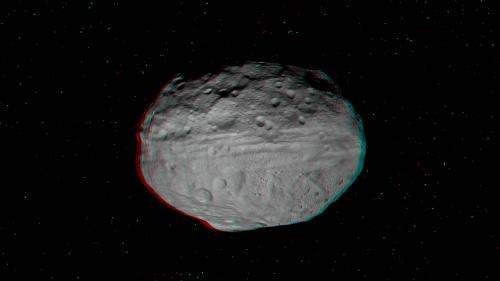
Vesta’s Eastern Hemisphere Floats in Space in 3-D This anaglyph shows the varied topography of Vesta’s eastern hemisphere from craters in the north, the equatorial troughs and the huge mountain protruding out the Rheasilvia impact basin (lower left) at the South Pole. Does water ice lurk beneath the South Pole? Credit: NASA/JPL-Caltech/UCLA/MPS/DLR/IDA.
The giant Asteroid Vesta literally floats in space in a new high resolution 3-D image of the battered bodies Eastern Hemisphere taken by NASAs Dawn Asteroid Orbiter.
Haul out your red-cyan 3-D anaglyph glasses and lets go whirling around Vesta and sledding down mountains to greet the alien Snowman! The sights are fabulous!
The Dawn imaging group based at the German Aerospace Center (DLR), in Berlin, Germany and led by team member Ralf Jaumann has released a trio of new high resolution 3-D images that are the most vivid anaglyphs yet published by the international science team.
The lead anaglyph shows the highly varied topography of the Eastern Hemisphere of Vesta and was taken during the final approach phase as Dawn was about 5,200 kilometers (3,200 miles) away and preparing to achieve orbit in July 2011.
The heavily cratered northern region is at top and is only partially illuminated because of Vestas tilted angle to the Sun at that time of year. Younger craters are overlain onto many older and more degraded craters. The equatorial region is dominated by the mysterious troughs which encircle most of Vesta and may have formed as a result of a gargantuan gong, eons ago.
The southern hemisphere exhibits fewer craters than in the northern hemisphere. Look closely at the bottom left and youll see the huge central mountain complex of the Rheasilvia impact basin visibly protruding out from Vestas south polar region.
The Mount Everest of Vesta in 3-D. This anaglyph shows the central complex and huge mountain in Vesta’s Rheasilvia impact basin at the South Pole. Does water ice lurk beneath the South Pole? Credit: NASA/JPL-Caltech/UCLA/MPS/DLR/IDA.
This next 3-D image shows a close-up of the South Pole Mountain at the center of the Rheasilvia Impact basin otherwise known as the Mount Everest of Vesta.The central complex is approximately 200 kilometers (120 miles) in diameter and is approximately 20 kilometers (12 miles) tall and is therefore about two and a half times taller than Earths Mount Everest!
Be sure to take a long look inside the deep craters and hummocky terrain surrounding Mount Everest.
A recent study concludes that, in theory, Vestas interior is cold enough for water ice to lurk beneath the North and South poles.
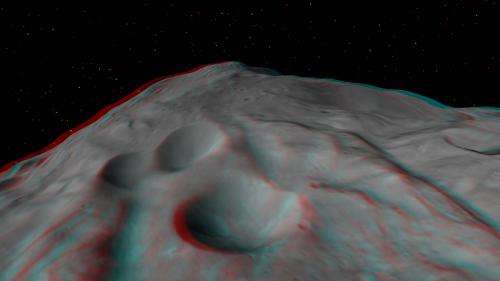
Finally lets gaze at the trio of craters that make up the Snowman in the 3-D image snapped in August 2011 as Dawn was orbiting at about 2,700 kilometers (1,700 miles) altitude. The three craters are named Minucia, Marcia and Calpurnia from top to bottom. Their diameters respectively are; 24 kilometers (15 miles), 53 kilometers (33 miles) and 63 kilometers (40 miles).
It is likely that Marcia and Calpurnia formed from the impact of a binary asteroid and that Minucia formed in a later impact. The smooth region around the craters is the ejecta blanket.
Vesta is the second most massive asteroid in the main Asteroid Belt between Mars and Jupiter. It is 330 miles (530 km) in diameter.
Dawn is the first spacecraft from Earth to visit Vesta. It achieved orbit in July 2011 for a year long mission. Dawn will fire up its ion propulsion thrusters in July 2012 to spiral out of orbit and sail to Ceres, the biggest asteroid of them all !
Vesta and Ceres are also considered to be protoplanets.
Source: Universe Today
-
From lemons to lemonade: Reaction uses carbon dioxide to make carbon-based semiconductor,
32 comments
-
Thioridazine kills cancer stem cells in human while avoiding toxic side-effects of conventional cancer treatments,
3 comments
-
SpaceX private rocket blasts off for space station (Update),
42 comments
-
Climate scientists say they have solved riddle of rising sea,
31 comments
-
Landmark calculation clears the way to answering how matter is formed,
55 comments
-
Distance of planets from stars and revolution
11 hours ago
-
revamping general concept and cosmological principle
May 25, 2012
-
Transiting Exoplanet Light Curve
May 25, 2012
-
Math behind Theoretical Physics
May 24, 2012
-
Do we know whats at the center of galaxies yet?
May 23, 2012
-
Structure of the Milky Way?
May 20, 2012
- More from Physics Forums - General Astronomy
More news stories
Yale study concludes public apathy over climate change unrelated to science literacy
Are members of the public divided about climate change because they don't understand the science behind it? If Americans knew more basic science and were more proficient in technical reasoning, would public consensus match ...
11 hours ago |
4.8 / 5 (6) |
27
|
Land and sea species differ in climate change response: study
(Phys.org) -- Marine and terrestrial species will likely differ in their responses to climate warming, new research by Simon Fraser University and Australia’s University of Tasmania has found.
9 hours ago |
4 / 5 (5) |
6
|
10 million years needed to recover from mass extinction
It took some 10 million years for Earth to recover from the greatest mass extinction of all time, latest research has revealed.
Space & Earth / Earth Sciences
11 hours ago |
4.2 / 5 (5) |
2
|
Sophisticated simulations predict future warming
The chances of our planet being hit by a global warming of 3 degrees Celsius by 2050 is as likely as it being hit by an increase of 1.4 degrees, new research shows. Presented in the journal Nature Geoscience, the British study ...
Space & Earth / Earth Sciences
May 22, 2012 |
3.8 / 5 (11) |
51
Kyoto Protocol architect 'frustrated' by climate dialogue
UN climate talks are going nowhere, as politicians dither or bicker while the pace of warming dangerously speeds up, one of the architects of the Kyoto Protocol told AFP.
May 23, 2012 |
3.4 / 5 (8) |
42
'Unzipped' carbon nanotubes could help energize fuel cells, batteries
Multi-walled carbon nanotubes riddled with defects and impurities on the outside could replace some of the expensive platinum catalysts used in fuel cells and metal-air batteries, according to scientists at ...
Change in developmental timing was crucial in the evolutionary shift from dinosaurs to birds: study
At first glance, it's hard to see how a common house sparrow and a Tyrannosaurus Rex might have anything in common. After all, one is a bird that weighs less than an ounce, and the other is a dinosaur that ...
Computer model used to pinpoint prime materials for efficient carbon capture
When power plants begin capturing their carbon emissions to reduce greenhouse gases and to most in the electric power industry, it's a question of when, not if it will be an expensive undertaking.
T cells 'hunt' parasites like animal predators seek prey, study shows
By pairing an intimate knowledge of immune-system function with a deep understanding of statistical physics, a cross-disciplinary team at the University of Pennsylvania has arrived at a surprising finding: T cells use a movement ...
Stunning image of smallest possible five-ringed structure
Scientists have created and imaged the smallest possible five-ringed structure about 100,000 times thinner than a human hair and you'll probably recognise its shape.
Browser wars flare in mobile space
The browser wars are heating up again, but this time the fight is for dominance of the mobile Internet.

Feb 06, 2012
Rank: not rated yet
body's
Feb 06, 2012
Rank: not rated yet
Well done...