Russian space probe to crash to Earth within hours
January 15, 2012 By VLADIMIR ISACHENKOV , Associated Press
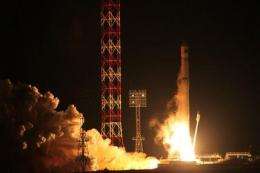
In this Wednesday, Nov. 9, 2011 file photo, the Zenit-2SB rocket with the Phobos-Ground probe blasts off from its launch pad at the Cosmodrome Baikonur, Kazakhstan. Some of the recent failures of Russian spacecraft may have been caused by hostile interference, Roscosmos chief Vladimir Popovkin said. Popovkin made the comment when asked about the failure of the unmanned Phobos-Ground probe, which was to explore one of the Mars twin moons, Phobos, but became stranded while orbiting Earth after its Nov. 9 launch. The spacecraft is expected to fall to Earth around Jan. 15. ( (AP Photo/File)
(AP) -- A failed Russian probe designed to travel to a moon of Mars but stuck in Earth orbit will come crashing down within hours, likely in a shower of fragments that survive the fiery re-entry.
The unmanned Phobos Ground is one of the heaviest and most toxic space derelicts ever to crash to Earth, but space officials and experts say the risks are minimal as its orbit is mostly over water and most of the probe's structure will burn up in the atmosphere anyway.
Russia's space agency Roscosmos said the Phobos-Ground will crash between 1641 and 2105 GMT (11:41 a.m. and 4:05 p.m. EST). It could come down anywhere along the route of its next few orbits, which would include Europe, southeast Asia, Australia and South America. The U.S., Canada and much of Russia are outside the risk zone.
"The resulting risk isn't significant," said Prof. Heiner Klinkrad, Head of The European Space Agency's Space Debris Office that is monitoring the probe's descent.
He wouldn't say where exactly the probe may enter the atmosphere, but said that "most of Europe is excluded from an impact risk."
Roscosmos predicts that only between 20 and 30 fragments of the Phobos probe with a total weight of up to 200 kilograms (440 pounds) will survive the re-entry and plummet to Earth.
Klinkrad agreed with that assessment, adding that about 100 metric tons of space junk fall on Earth every year. "This is 200 kilograms out of these 100 tons," he said.
Thousands of pieces of derelict space vehicles orbit Earth, occasionally posing danger to astronauts and satellites in orbit, but as far as is known, no one has ever been hurt by falling space debris.
The Phobos-Ground weighs 13.5 metric tons (14.9 tons), and that includes a load of 11 metric tons (12 tons) of highly toxic rocket fuel intended for the long journey to the Martian moon of Phobos. It has been left unused as the probe got stuck in orbit around Earth shortly after its Nov. 9 launch.
Roscosmos says all of the fuel will burn up on re-entry, a forecast Klinkrad said was supported by calculations done by NASA and the ESA. He said the craft's tanks are made of aluminum alloy that has a very low melting temperature, and they will burst at an altitude of more than 100 kilometers.
"These tanks are expected to release the fuel above 100 kilometers, and then the fuel is going to burn in the atmosphere and later the tanks are going to burn themselves as well," Klinkrad said in a telephone interview from his office in Berlin.
The space era has seen far larger spacecraft to crash. NASA's Skylab space station that went down in 1979 weighed 77 metric tons (85 tons) and Russia's Mir space station that deorbited in 2001 weighed about 130 metric tons (143 tons). Their descent fueled fears around the world, but the wreckage of both fell far away from populated areas.
The $170-million Phobos-Ground was Russia's most expensive and the most ambitious space mission since Soviet times. The spacecraft was intended to land on the crater-dented, potato-shaped Martian moon, collect soil samples and fly them back to Earth, giving scientists precious materials that could shed more light on the genesis of the solar system.
Russia's space chief has acknowledged the Phobos-Ground mission was ill-prepared, but said that Roscosmos had to give it the go-ahead so as not to miss the limited Earth-to-Mars launch window.
Its predecessor, Mars-96, which was built by the same Moscow-based NPO Lavochkin company, also suffered an engine failure and crashed shortly after its launch in 1996. Its crash drew strong international fears because of some 200 grams of plutonium onboard. The craft eventually showered its fragments over the Chile-Bolivia border in the Andes Mountains, and the pieces were never recovered.
The worst ever radiation spill from a derelict space vehicle came in January 1978 when the nuclear-powered Cosmos 954 satellite crashed over northwestern Canada. The Soviets claimed the craft completely burned up on re-entry, but a massive recovery effort by Canadian authorities recovered a dozen fragments, most of which were radioactive.
The Phobos-Ground also contains a tiny quantity of the radioactive metal Cobalt-57 in one of its instruments, but Roscosmos said it poses no threat of radioactive contamination.
©2012 The Associated Press. All rights reserved. This material may not be published, broadcast, rewritten or redistributed.
-
From lemons to lemonade: Reaction uses carbon dioxide to make carbon-based semiconductor,
32 comments
-
Thioridazine kills cancer stem cells in human while avoiding toxic side-effects of conventional cancer treatments,
3 comments
-
SpaceX private rocket blasts off for space station (Update),
42 comments
-
Climate scientists say they have solved riddle of rising sea,
31 comments
-
SpaceX capsule has 'new car' smell, astronauts say (Update),
4 comments
-
Distance of planets from stars and revolution
8 hours ago
-
revamping general concept and cosmological principle
May 25, 2012
-
Transiting Exoplanet Light Curve
May 25, 2012
-
Math behind Theoretical Physics
May 24, 2012
-
Do we know whats at the center of galaxies yet?
May 23, 2012
-
Structure of the Milky Way?
May 20, 2012
- More from Physics Forums - General Astronomy
More news stories
Land and sea species differ in climate change response: study
(Phys.org) -- Marine and terrestrial species will likely differ in their responses to climate warming, new research by Simon Fraser University and Australia’s University of Tasmania has found.
6 hours ago |
3.8 / 5 (4) |
5
|
Yale study concludes public apathy over climate change unrelated to science literacy
Are members of the public divided about climate change because they don't understand the science behind it? If Americans knew more basic science and were more proficient in technical reasoning, would public consensus match ...
8 hours ago |
4.8 / 5 (5) |
20
|
10 million years needed to recover from mass extinction
It took some 10 million years for Earth to recover from the greatest mass extinction of all time, latest research has revealed.
Space & Earth / Earth Sciences
8 hours ago |
4 / 5 (4) |
1
|
Sophisticated simulations predict future warming
The chances of our planet being hit by a global warming of 3 degrees Celsius by 2050 is as likely as it being hit by an increase of 1.4 degrees, new research shows. Presented in the journal Nature Geoscience, the British study ...
Space & Earth / Earth Sciences
May 22, 2012 |
3.8 / 5 (11) |
51
Aliens don't want to eat us, says former SETI director
Alien life probably isnt interested in having us for dinner, enslaving us or laying eggs in our bellies, according to a recent statement by former SETI director Jill Tarter.
Space & Earth / Space Exploration
May 25, 2012 |
4.4 / 5 (15) |
41
Stunning image of smallest possible five-ringed structure
Scientists have created and imaged the smallest possible five-ringed structure about 100,000 times thinner than a human hair and you'll probably recognise its shape.
'Unzipped' carbon nanotubes could help energize fuel cells, batteries
Multi-walled carbon nanotubes riddled with defects and impurities on the outside could replace some of the expensive platinum catalysts used in fuel cells and metal-air batteries, according to scientists at ...
Change in developmental timing was crucial in the evolutionary shift from dinosaurs to birds: study
At first glance, it's hard to see how a common house sparrow and a Tyrannosaurus Rex might have anything in common. After all, one is a bird that weighs less than an ounce, and the other is a dinosaur that ...
Computer model used to pinpoint prime materials for efficient carbon capture
When power plants begin capturing their carbon emissions to reduce greenhouse gases and to most in the electric power industry, it's a question of when, not if it will be an expensive undertaking.
T cells 'hunt' parasites like animal predators seek prey, study shows
By pairing an intimate knowledge of immune-system function with a deep understanding of statistical physics, a cross-disciplinary team at the University of Pennsylvania has arrived at a surprising finding: T cells use a movement ...
Scientists develop ultra-sensitive test that detects diseases in their earliest stages
Scientists have developed an ultra-sensitive test that should enable them to detect signs of a disease in its earliest stages, in research published today in the journal Nature Materials.
Jan 15, 2012
Rank: 1.2 / 5 (13)
Jan 15, 2012
Rank: 4 / 5 (1)
Fobos-Grunt station carries small amount of radioactive materials too. Radioactive sources are serving for the MIMOS II Mosbauer spectrometer designed for identifying iron and its quantity in the Phobos soil. The half-decay period for Cobalt-57 is around nine months.
An anonymous (expert) source indicated this may force reform in the Russian space agency, Roscosmos. Also, "a number of positions of responsible persons" could face jail time.
Jan 15, 2012
Rank: 1.2 / 5 (13)