Russia's space chief says failures may be sabotage
January 10, 2012 By VLADIMIR ISACHENKOV , Associated Press
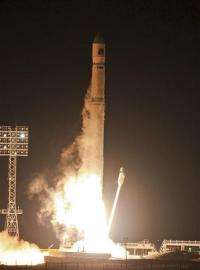
In this Wednesday, Nov. 9, 2011 file photo, the Zenit-2SB rocket with the Phobos-Ground probe blasts off from its launch pad at the Cosmodrome Baikonur, Kazakhstan. Some of the recent failures of Russian spacecraft may have been caused by hostile interference, Roscosmos chief Vladimir Popovkin said. Popovkin made the comment when asked about the failure of the unmanned Phobos-Ground probe, which was to explore one of the Mars twin moons, Phobos, but became stranded while orbiting Earth after its Nov. 9 launch. The spacecraft is expected to fall to Earth around Jan. 15. (AP Photo/Oleg Urusov, Pool, File)
(AP) -- Some recent Russian satellite failures may have been the result of sabotage by foreign forces, Russia's space chief said Tuesday, in comments apparently aimed at the United States.
Roscosmos chief Vladimir Popovkin stopped short of accusing any specific country of disabling Russian satellites, but in an interview in the daily Izvestia he said some Russian craft had suffered "unexplained" malfunctions while flying over another side of the globe beyond the reach of his nation's tracking facilities.
Popovkin spoke when asked about the failure of the $170-million unmanned Phobos-Ground probe, which was to explore one of Mars' two moons, Phobos, but became stranded while orbiting Earth after its Nov. 9 launch. Engineers in Russia and the European Space Agency have failed to propel the spacecraft toward Mars, and it is expected to fall back to Earth around Jan. 15.
Roscosmos spokesman Alexei Kuznetsov refused to elaborate on Popovkin's comments, which marked the first time a senior Russian government official has claimed that foreign sabotage has been used to disable one of the country's satellites.
Popovkin said modern technology makes spacecraft vulnerable to foreign influences.
"I wouldn't like to accuse anyone, but today there exists powerful means to influence spacecraft, and their use can't be excluded," he said.
James Oberg, a NASA veteran who has written books on the Russian space program and now works as a space consultant, said Popovkin's comments were a sad example of the Russian cultural instinct to 'blame foreigners.'
"It's a feature of space launch trajectories that orbital adjustments must be made halfway around the first orbit to circularize and stabilize subsequent orbits," Oberg said in e-mailed comments.
"The Russians must know that simple geography - not evildoers lurking in shadows - dictate where their communications 'blind spots' are. But the urge to shift blame seems strong," he said.
The failed Phobos mission was the latest in a series of recent Russian launch failures that have raised concerns about the condition of the country's space industries and raised pressure on Popovkin. Space officials have blamed the failures on obsolete equipment and an aging work force.
Popovkin also said in 2013, Russia will launch three new communications satellites that will be able to retransmit signals from other Russian spacecraft as they fly over another hemisphere.
A retired Russian general alleged last November that the Phobos-Ground might have been incapacitated by a powerful U.S. radar. Nikolai Rodionov, who previously was in charge of Russia's early warning system, was quoted as saying that a powerful electromagnetic impulse generated by U.S. radar in Alaska might have affected the probe's control system.
Popovkin said experts have so far failed to determine why the Phobos-Ground probe's engines failed to fire, but admitted the program had suffered from funding shortages that led to some "risky technological solutions."
The spacecraft was supposed to collect soil samples on Phobos and fly them back to Earth in one of the most challenging unmanned interplanetary missions ever. It was Russia's first foray beyond the Earth orbit since a botched 1996 robotic mission to Mars, which failed when the probe crashed shortly after the launch due to an engine failure.
Scientists had hoped that studies of Phobos' surface could help solve the mystery of its origin and shed more light on the genesis of the solar system. Some believe the crater-dented moon is an asteroid captured by Mars' gravity, while others think it's a piece of debris from when Mars collided with another celestial object.
©2012 The Associated Press. All rights reserved. This material may not be published, broadcast, rewritten or redistributed.
-
From lemons to lemonade: Reaction uses carbon dioxide to make carbon-based semiconductor,
32 comments
-
Thioridazine kills cancer stem cells in human while avoiding toxic side-effects of conventional cancer treatments,
3 comments
-
SpaceX private rocket blasts off for space station (Update),
42 comments
-
Climate scientists say they have solved riddle of rising sea,
31 comments
-
SpaceX capsule has 'new car' smell, astronauts say (Update),
4 comments
-
Distance of planets from stars and revolution
8 hours ago
-
revamping general concept and cosmological principle
May 25, 2012
-
Transiting Exoplanet Light Curve
May 25, 2012
-
Math behind Theoretical Physics
May 24, 2012
-
Do we know whats at the center of galaxies yet?
May 23, 2012
-
Structure of the Milky Way?
May 20, 2012
- More from Physics Forums - General Astronomy
More news stories
Land and sea species differ in climate change response: study
(Phys.org) -- Marine and terrestrial species will likely differ in their responses to climate warming, new research by Simon Fraser University and Australia’s University of Tasmania has found.
6 hours ago |
3.8 / 5 (4) |
5
|
Yale study concludes public apathy over climate change unrelated to science literacy
Are members of the public divided about climate change because they don't understand the science behind it? If Americans knew more basic science and were more proficient in technical reasoning, would public consensus match ...
8 hours ago |
4.8 / 5 (5) |
20
|
10 million years needed to recover from mass extinction
It took some 10 million years for Earth to recover from the greatest mass extinction of all time, latest research has revealed.
Space & Earth / Earth Sciences
8 hours ago |
4 / 5 (4) |
1
|
Sophisticated simulations predict future warming
The chances of our planet being hit by a global warming of 3 degrees Celsius by 2050 is as likely as it being hit by an increase of 1.4 degrees, new research shows. Presented in the journal Nature Geoscience, the British study ...
Space & Earth / Earth Sciences
May 22, 2012 |
3.8 / 5 (11) |
51
Aliens don't want to eat us, says former SETI director
Alien life probably isnt interested in having us for dinner, enslaving us or laying eggs in our bellies, according to a recent statement by former SETI director Jill Tarter.
Space & Earth / Space Exploration
May 25, 2012 |
4.4 / 5 (15) |
41
Stunning image of smallest possible five-ringed structure
Scientists have created and imaged the smallest possible five-ringed structure about 100,000 times thinner than a human hair and you'll probably recognise its shape.
'Unzipped' carbon nanotubes could help energize fuel cells, batteries
Multi-walled carbon nanotubes riddled with defects and impurities on the outside could replace some of the expensive platinum catalysts used in fuel cells and metal-air batteries, according to scientists at ...
Change in developmental timing was crucial in the evolutionary shift from dinosaurs to birds: study
At first glance, it's hard to see how a common house sparrow and a Tyrannosaurus Rex might have anything in common. After all, one is a bird that weighs less than an ounce, and the other is a dinosaur that ...
Computer model used to pinpoint prime materials for efficient carbon capture
When power plants begin capturing their carbon emissions to reduce greenhouse gases and to most in the electric power industry, it's a question of when, not if it will be an expensive undertaking.
T cells 'hunt' parasites like animal predators seek prey, study shows
By pairing an intimate knowledge of immune-system function with a deep understanding of statistical physics, a cross-disciplinary team at the University of Pennsylvania has arrived at a surprising finding: T cells use a movement ...
Scientists develop ultra-sensitive test that detects diseases in their earliest stages
Scientists have developed an ultra-sensitive test that should enable them to detect signs of a disease in its earliest stages, in research published today in the journal Nature Materials.
Jan 10, 2012
Rank: 5 / 5 (4)
Jan 10, 2012
Rank: 5 / 5 (2)
http://www.aether...tory.gif
Jan 10, 2012
Rank: not rated yet
http://www.aether...ory1.gif
Jan 10, 2012
Rank: 1.7 / 5 (11)
Jan 10, 2012
Rank: not rated yet
Jan 10, 2012
Rank: not rated yet
Jan 11, 2012
Rank: 3 / 5 (5)
Strange how the Russians seem to have been quite successful in their other launches. I'm sure they were aware of the need to adjust orbits, otherwise they'd have to be simpletons.
I must confess I also strongly suspected outside interference the day that the news was announced. I still do, because the Russians have far too much experience with more critical missions to slip up so badly - in spite of "new technological risks".
Jan 11, 2012
Rank: not rated yet
Jan 11, 2012
Rank: not rated yet
This statement may just be a test-balloon. Trying to povoke some telling reaction from a possibly guilty party (US, China, ... )
Jan 11, 2012
Rank: 5 / 5 (1)
Wouldn't that make the US and/or China incredibly clever (or really stupid), seeing both countries had experiments aboard Phobos-Grunt!
http://en.wikiped...periment
http://en.wikiped...inghuo-1
Jan 11, 2012
Rank: not rated yet
There are a lot of possible parties that could have an interest in doing so. Nation states are just one of them. Fledgeling commercial carriers may also be involved. Heck, it could even be some rival faction withing Roskosmos that wants to take it over.
As for the experiments aboard the craft: Such cooperation happens on the level of NASA/Roskosmos - not on a political level. Political agendas may be at odds (and often are) with scientific ones. We shouldn't assume that any nation is so streamlined so as to expect that every part of its apparat knows (and supports) everything every other part does.