Up to 6.7 million bats dead from fungus: US
Jan 17, 2012
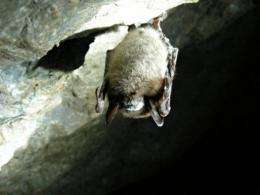
An undated photo courtesy of the US Fish & Wildlife Service shows the little brown bat hanging at Greeley Mine in Stockbridge, Vermont affected by the white-nose syndrome. Between 5.7 and 6.7 million bats have died in North America due to a fungus known as white-nose syndrome (WNS) since the disease first appeared in 2006, US authorities said.

Between 5.7 and 6.7 million bats have died in North America due to a fungus known as white-nose syndrome (WNS) since the disease first appeared in 2006, US authorities said on Tuesday.

The count is a vast increase over the one million bats believed dead according to the last estimate in 2009, and in some areas has meant that nearly all of the bat population is gone, wildlife expert Jeremy Coleman told AFP.

"In states like New York and Vermont and southern Ontario, we anticipate that the overall population is probably impacted on the order of 90-plus percent," said Coleman, national white-nose syndrome coordinator at the Fish and Wildlife Service.

The figures were compiled using data from state biologists and mathematical models to project losses across geographical areas where the disease is known to have spread.

"This startling new information illustrates the severity of the threat that white-nose syndrome poses for bats, as well as the scope of the problem facing our nation," said Director Dan Ashe.

"Bats provide tremendous value to the US economy as natural pest control for American farms and forests every year, while playing an essential role in helping to control insects that can spread disease to people."

Bats are in important natural pesticide worth at least 3.7 billion dollars per year to farmers, a recent study calculated.

The first known outbreak of WNS has been traced to a colony of bats in upstate New York, and has spread 2,000 kilometers (1,200 miles) across the United States and into Canada.

It has now been documented in 16 states and four Canadian provinces.

The syndrome is particularly lethal for winter colonies of species that hibernate, including little , northern long-eared bats and the endangered Indiana bat, according to the United States Geological Survey.

A study published late last year confirmed that the disease is caused by a called Geomyces destructans, but experts are stumped as to how to stop it.

Explore further: Bittersweet: Bait-averse cockroaches shudder at sugar

add to favorites email to friend print save as pdf

Related Stories

Culling can't control deadly bat disease

Feb 14, 2011

Culling will not stop the spread of a deadly fungus that is threatening to wipe out hibernating bats in North America, according to a new mathematical model.

Interim protections sought for little brown bats

Dec 20, 2010

Scientists and conservation groups filed a formal request today asking the U.S. Fish and Wildlife Service to determine if little brown bats, once the most common bat species in the Northeast, need protection under the Endangered ...

Recommended for you

Scientists take a new look at an ancient crop

38 minutes ago

Though the price makes you wince, you might just buy that bottle of your favorite olive oil anyway. Perhaps it's exactly what you want for the salad dressing you're making tonight and for your special stir-fry ...

Bittersweet: Bait-averse cockroaches shudder at sugar

18 hours ago

Sugar isn't always sweet to German cockroaches, especially to the ones that avoid roach baits. In a study published May 24 in the journal Science, North Carolina State University entomologists show the ne ...

White tiger mystery solved

20 hours ago

White tigers today are only seen in zoos, but they belong in nature, say researchers reporting new evidence about what makes those tigers white. Their spectacular white coats are produced by a single change ...

User comments : 1

Adjust slider to filter visible comments by rank

Display comments: newest first

Telekinetic
not rated yet Jan 17, 2012
Heartbreaking that there isn't something that can be done. I hope the biochemists stumble on an anti-fungal that could be sprayed where they congregate. They eat the mosquitoes that spread West Nile virus. We can expect more human diseases when the bat populations dwindle.

More news stories

Scientists take a new look at an ancient crop

Though the price makes you wince, you might just buy that bottle of your favorite olive oil anyway. Perhaps it's exactly what you want for the salad dressing you're making tonight and for your special stir-fry ...

The long road to the 2000-watt society

The vision of a society in which each inhabitant of the earth manages to consume only 2000 watts has already been around for 15 years. During this time, there has been a steady increase in environmental awareness ...