New research casts doubt on the late heavy bombardment
January 6, 2012 By Irene Antonenko, Universe Today

New research casts doubt on the late heavy bombardment

Enlarge

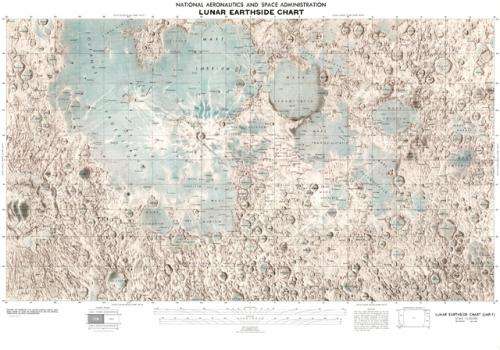
What if the Apollo 17 samples didn't come from the Serenitatis basin, where the astronauts collected them, but rather from the Imbrium basin, located some 600 km away? Studies from the new Lunar Reconnaissance Orbiter Camera suggest this may be the case. If true, this means Serenitatis is much older than the Imbrium basin and a solar system-wide impact catastrophe is not needed to explain the uncannily close ages of the Imbrium and Serenitatis basins. Credit: NASA

Was the early solar system bombarded with lots of big impacts? This is a question that has puzzled scientists for over 35 years. And it’s not just an academic one. We know from rocks on Earth that life began to evolve very early on, at least 3.8 billion years ago. If the Earth was being pummeled by large impacts at this time, this would certainly have affected the evolution of life. So, did the solar system go through what is known as the Late Heavy Bombardment (LHB)? Exciting new research, using data from the Lunar Reconnaissance Orbiter Camera (LROC) may cast some doubt on the popular LHB theory.

It’s actually quite a heated debate, one that has polarized the science community for quite some time. In one camp are those that believe the experienced a cataclysm of large impacts about 3.8 billion years ago. In the other camp are those that think such impacts were spread more evenly over the time of the from approximately 4.3 to 3.8 billion years ago.

The controversy revolves around two large impact basins, which are found fairly close to each other on the Moon. The Imbrium basin is one of the youngest basins on the near side of the Moon, while the Serenetatis basin is thought to be one of the oldest. Both are flooded with volcanic basalts and are big enough to be seen from Earth with the naked eye.

Scientists know the relative ages of such lunar basins because of a concept called superposition. Basically, superposition states that what is on top must be younger than what is beneath. Using such relationships, scientists can determine which basins are older and which are younger.

To get an absolute age, though, scientists need actual bits of rock, so they can use radiometric dating techniques. The lunar samples returned by the Apollo program provided exactly that.  But, the Apollo samples suggest that the Imbrium and Serenitatis basins are barely 50 million years apart.

Relative age dating tells us there are over 30 other basins that formed within that time frame.  This means that roughly one major impact occurred every 1.5 million years! Now, 1.5 million years may sound like a long time. But consider the last large impact that happened on Earth, the Chicxulub event 65 million years ago, which is thought to have exterminated the dinosaurs. Imagine another 40 dinosaur-killing impacts occurring since then. It would be surprising if any life survived such a barrage!
New research casts doubt on the late heavy bombardment
Enlarge

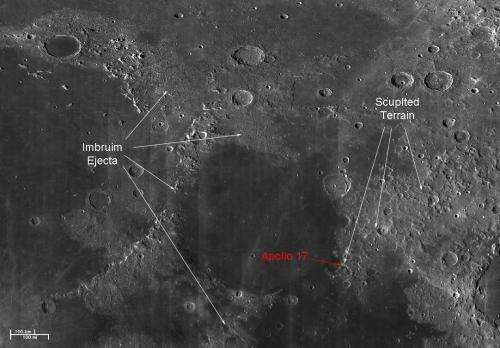
Recent high quality data from the Lunar Reconnaissance Orbiter Camera shows that the sculpted terrain, which is present at the Apollo 17 landing site, is related to material that is known to be from the Imbruim impact. This means that Apollo 17 may have sampled Imbrium and not Serenitatis material. This could explain the unusually close ages of these two basins, suggested by the Apollo samples. If so, the Serenitatis impact may have occurred much earlier than previously thought, meaning that a barrage of frequent bombardments did not occur, and life on Earth could have evolved without being molested by too many impact events. Credit: NASA/GSFC/Arizona State University

This is why a team of researchers, led by Dr. Paul Spudis of the Lunar and Planetary Institute, is looking very carefully at this question. Their research is using the principle of superposition to show that several of the areas visited by the Apollo program were blanketed by material from the Imbrium impact. This could mean that many of the collected Apollo materials may be sampling the same event.

Dr. Spudis’s research focuses on the Montes Taurus area, between the Serenitatis and Crisium basins, not far from the Apollo 17 landing site. This is a region dominated by sculpted hills that have been interpreted to be ejected material from the adjacent Serenitatis basin impact. But, Dr. Spudis and his team have found that, instead, this sculpted material comes from the Imbrium basin some 600 kilometers away.

Previous data of this area, from the Lunar Orbiter IV camera, hadn’t shown this because a fog on the camera lens made the details difficult to see (this fog problem was eventually resolved, and Lunar Orbiter IV provided a lot of useful data on other parts of the Moon).The new LROC data, however, shows that the sculpted terrain seen at Apollo 17 is very widespread, extending far beyond the Montes Taurus region. Furthermore, the grooves and lineated features of this terrain point to the Imbrium basin, not the Serenitatis basin, and line up with similar features in the Alpes and Fra Mauro Formations, which are known to be ejecta from the Imbrium impact. In the north of Serenitatis, these Imbrium formations even seem to transform into the Montes Taurus, confirming that the sculpted hills do, in fact, originate from the Imbrium impact.

If the sculpted hills are Imbruim ejecta, then it is possible that Apollo 17 sampled Imbrium and not Serenitatis materials.  That casts suspicion on the very close radiometric ages of these two basins. Perhaps these ages are so close because we effectively measured the same material. In that case, the age of Serenitatis could be much older than the 3.87 billion years the Apollo 17 samples suggest.  If true, this would mean that there was no Late Heavy Bombardment at the time life was forming on the early Earth, leaving life to evolve with relatively few impact-related interruptions.

More information: Spudis et al., 2011, Journal of Geophysical Research, V116, E00H03

Source: Universe Today

4.5 /5 (4 votes)  

Rank 4.5 /5 (4 votes)
Relevant PhysicsForums posts
  • Distance of planets from stars and revolution
    created6 hours ago
  • revamping general concept and cosmological principle
    createdMay 25, 2012
  • Transiting Exoplanet Light Curve
    createdMay 25, 2012
  • Math behind Theoretical Physics
    createdMay 24, 2012
  • Do we know whats at the center of galaxies yet?
    createdMay 23, 2012
  • Structure of the Milky Way?
    createdMay 20, 2012
  • More from Physics Forums - General Astronomy

More news stories

Land and sea species differ in climate change response: study

(Phys.org) -- Marine and terrestrial species will likely differ in their responses to climate warming, new research by Simon Fraser University and Australia’s University of Tasmania has found.

Space & Earth / Environment

created 4 hours ago | popularity 3.7 / 5 (3) | comments 5 | with audio podcast

Yale study concludes public apathy over climate change unrelated to science literacy

Are members of the public divided about climate change because they don't understand the science behind it? If Americans knew more basic science and were more proficient in technical reasoning, would public consensus match ...

Space & Earth / Environment

created 6 hours ago | popularity 4.8 / 5 (4) | comments 11 | with audio podcast

10 million years needed to recover from mass extinction

It took some 10 million years for Earth to recover from the greatest mass extinction of all time, latest research has revealed.

Space & Earth / Earth Sciences

created 6 hours ago | popularity 5 / 5 (3) | comments 1 | with audio podcast

Sophisticated simulations predict future warming

The chances of our planet being hit by a global warming of 3 degrees Celsius by 2050 is as likely as it being hit by an increase of 1.4 degrees, new research shows. Presented in the journal Nature Geoscience, the British study ...

Space & Earth / Earth Sciences

created May 22, 2012 | popularity 4.4 / 5 (9) | comments 51

Aliens don't want to eat us, says former SETI director

Alien life probably isn’t interested in having us for dinner, enslaving us or laying eggs in our bellies, according to a recent statement by former SETI director Jill Tarter.

Space & Earth / Space Exploration

created May 25, 2012 | popularity 4.4 / 5 (14) | comments 41


Stunning image of smallest possible five-ringed structure

Scientists have created and imaged the smallest possible five-ringed structure – about 100,000 times thinner than a human hair – and you'll probably recognise its shape.

'Unzipped' carbon nanotubes could help energize fuel cells, batteries

Multi-walled carbon nanotubes riddled with defects and impurities on the outside could replace some of the expensive platinum catalysts used in fuel cells and metal-air batteries, according to scientists at ...

Change in developmental timing was crucial in the evolutionary shift from dinosaurs to birds: study

At first glance, it's hard to see how a common house sparrow and a Tyrannosaurus Rex might have anything in common. After all, one is a bird that weighs less than an ounce, and the other is a dinosaur that ...

Computer model used to pinpoint prime materials for efficient carbon capture

When power plants begin capturing their carbon emissions to reduce greenhouse gases – and to most in the electric power industry, it's a question of when, not if – it will be an expensive undertaking.

T cells 'hunt' parasites like animal predators seek prey, study shows

By pairing an intimate knowledge of immune-system function with a deep understanding of statistical physics, a cross-disciplinary team at the University of Pennsylvania has arrived at a surprising finding: T cells use a movement ...

Scientists develop ultra-sensitive test that detects diseases in their earliest stages

Scientists have developed an ultra-sensitive test that should enable them to detect signs of a disease in its earliest stages, in research published today in the journal Nature Materials.